




























Views
Downloads

Printable Letter X Tracing Worksheet | Kindergarten

Paste this activity's link or code into your existing LMS (Google Classroom, Canvas, Teams, Schoology, Moodle, etc.).
Students can open and work on the activity right away, with no student login required.
You'll still be able to track student progress and results from your teacher account.
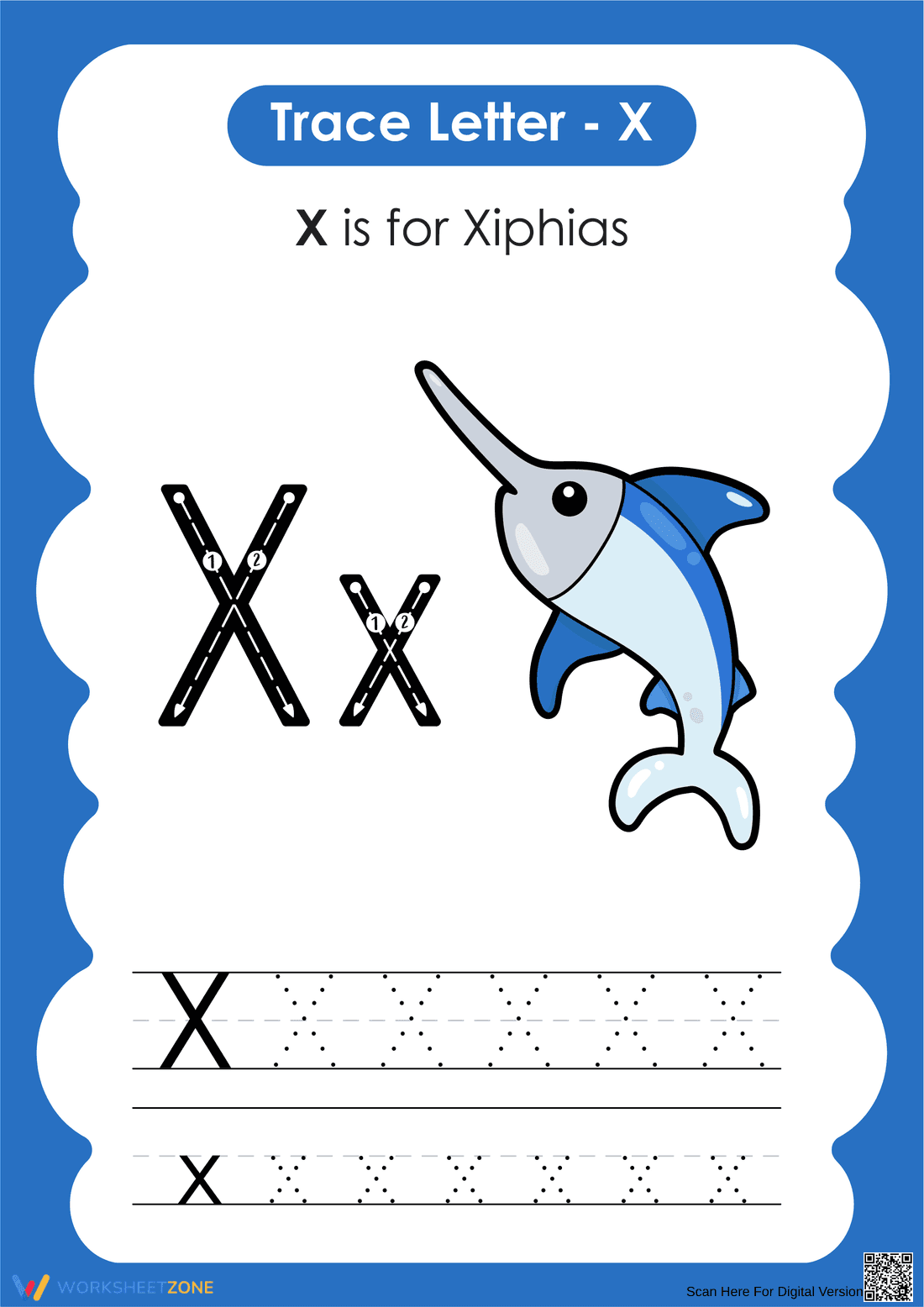
This single-page worksheet provides targeted practice for early learners to master writing the letter X. Students trace both uppercase and lowercase forms, building essential fine motor skills and letter recognition. Featuring clear directional arrows and a fun visual, this resource helps young writers gain confidence in their penmanship.
At a Glance
- Grade: Kindergarten · Subject: ELA
- Standard:
CCSS.ELA-LITERACY.L.K.1.A— Print upper- and lowercase letters- Skill Focus: Letter X tracing
- Format: 1 page · 12 problems · No answer key · PDF
- Best For: Independent practice
- Time: 5–10 minutes
What's Inside
Inside this printable PDF, educators will find a straightforward layout designed for early childhood education. The page begins with a large, guided example of the uppercase and lowercase letter X, complete with numbered directional arrows to ensure proper stroke order. An illustration of a "Xiphias" (swordfish) anchors the letter to a vocabulary word. Below, students complete two rows of dotted tracing practice, totaling ten smaller letters to reinforce muscle memory.
Zero-Prep Workflow
- Print (1 minute): Download the PDF and print. The design ensures clear reproduction.
- Distribute (1 minute): Hand out the sheets with pencils. The visual cues make the task obvious to young learners.
- Review (0 minutes): As a tracing activity, no formal grading is required. Teachers can quickly scan the room to monitor grip.
Total teacher prep time is under two minutes, making this ideal for morning work or sub plans.
Standards Alignment
This resource is directly aligned to CCSS.ELA-LITERACY.L.K.1.A: Print many upper- and lowercase letters. By providing explicit stroke order guidance and repetitive practice, the worksheet ensures students develop the foundational handwriting skills required by early literacy frameworks. Both standard codes can be copied directly into lesson plans, IEP goals, or district curriculum mapping tools.
How to Use It
Use this tracing sheet during morning work as a focused activity to start the day, or place it in a literacy center for independent practice after direct instruction. As a formative assessment tip, observe students while they trace the large guided letters; watch to see if they follow the numbered arrows or attempt to draw from the bottom up. Expected completion time is 5 to 10 minutes.
Who It's For
This worksheet is designed for Preschool and Kindergarten students developing fine motor skills and learning the alphabet. It is also an excellent intervention tool for first graders needing handwriting support. For differentiation, provide thicker crayons for students struggling with pencil grip. Pair this activity with a read-aloud book featuring the letter X.
Developing automaticity in handwriting is a critical component of early literacy that directly impacts later reading and writing proficiency. According to Fisher & Frey (2014), explicit instruction in letter formation, combined with guided and independent practice, significantly improves students' ability to produce legible text without cognitive overload. This worksheet supports that research by providing clear, numbered stroke directions followed by repetitive tracing tasks. By aligning with CCSS.ELA-LITERACY.L.K.1.A to print upper- and lowercase letters, educators ensure that foundational motor patterns are established early. When students do not have to expend working memory on how to form a letter, they can focus entirely on phonics, spelling, and eventual composition. This targeted practice sheet offers the exact repetition needed to build that essential muscle memory for the letter X, setting young learners up for long-term academic success.


