


























Views
Downloads
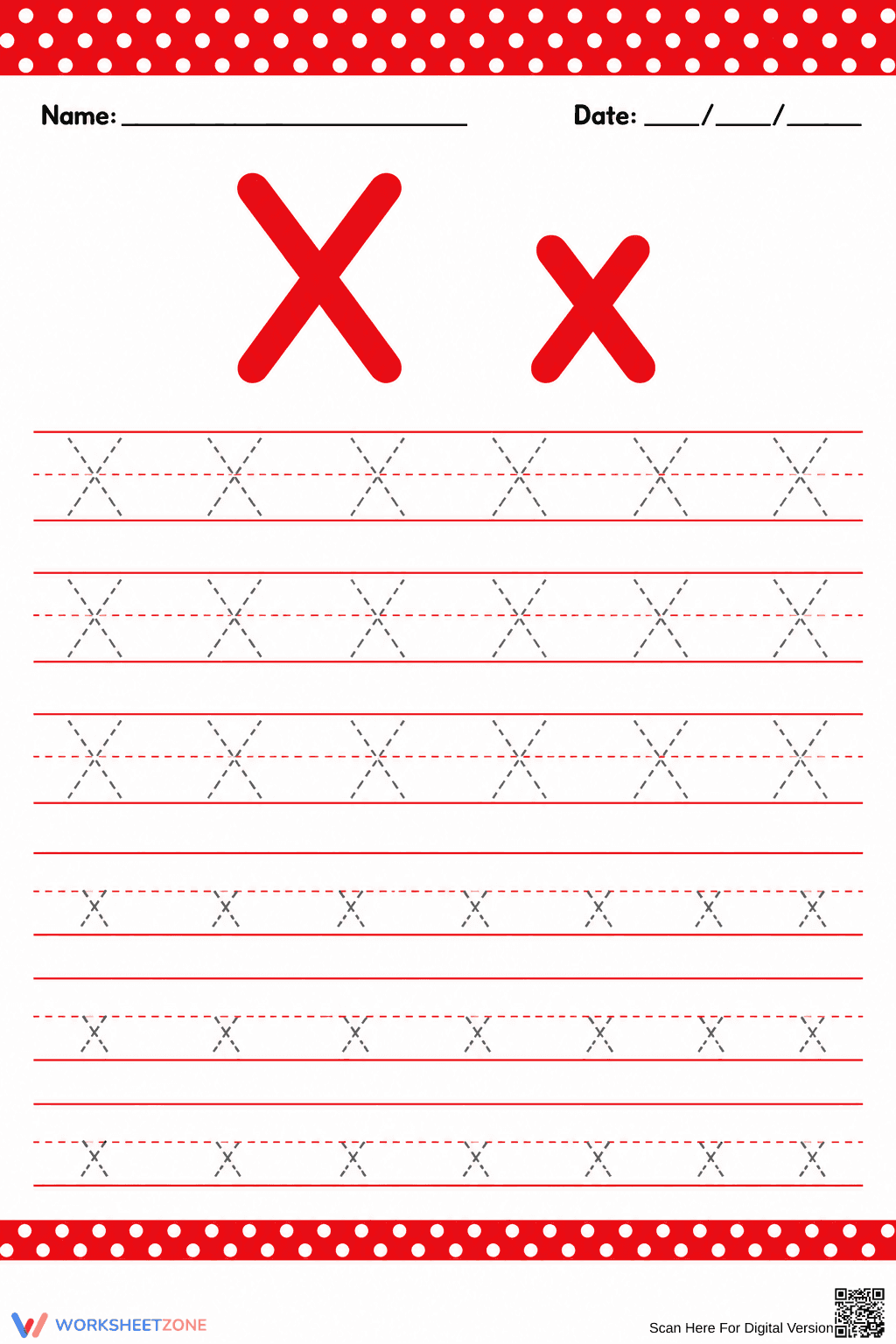

Letter X Tracing Worksheet | Essential Grade K-1 Phonics
Paste this activity's link or code into your existing LMS (Google Classroom, Canvas, Teams, Schoology, Moodle, etc.).
Students can open and work on the activity right away, with no student login required.
You'll still be able to track student progress and results from your teacher account.
This Grade K-1 Letter X tracing worksheet helps early learners master the specific motor movements required for uppercase and lowercase letter formation. By providing structured paths, students build the muscle memory necessary for fluent handwriting and phonemic awareness before moving to independent writing.
At a Glance
- Grade: K-1 · Subject: ELA Phonics
- Standard:
CCSS.ELA-LITERACY.L.K.1.A— Print many upper- and lowercase letters of the alphabet- Skill Focus: Letter X Formation
- Format: 1 page · 36 tasks · Answer key included · PDF
- Best For: Morning work or literacy centers
- Time: 10–15 minutes
This single-page PDF features six rows of guided tracing. The top three rows focus on the uppercase "X," while the bottom three rows provide practice for the lowercase "x." The layout includes clear red baselines and dashed midlines to ensure proper letter height and alignment, helping students understand spatial relationships on the page.
The zero-prep workflow is designed for busy educators. Print the single sheet in under 30 seconds. Distribute to students during the first 2 minutes of your phonics block or as a quiet transition activity. Review student strokes as they work to provide immediate corrective feedback. This resource is an ideal sub-plan addition because it requires no prior instruction to complete.
This resource aligns with `CCSS.ELA-LITERACY.L.K.1.A`, which requires students to print many upper- and lowercase letters. It also supports `CCSS.ELA-LITERACY.RF.K.1.D` by reinforcing letter recognition through repetitive visual and motor engagement. Both standard codes can be copied directly into lesson plans, IEP goals, or district curriculum mapping tools.
Use this worksheet during the "You Do" phase of a gradual release model. After demonstrating the diagonal strokes of the letter X on the board, assign this for independent practice. It also serves as a quick formative assessment to identify students struggling with fine motor control or those who may need additional occupational therapy support.
This is designed for Kindergarten and Grade 1 students, particularly those in the early stages of handwriting development. It pairs naturally with an alphabet anchor chart or a beginning sounds picture sort to reinforce the /ks/ sound associated with the letter X. It is also suitable for English Language Learners (ELL) who are learning the Roman alphabet for the first time.
According to the RAND AIRS 2024 report, consistent tactile practice with letter formation is a foundational component of early literacy that directly correlates with later reading fluency. This worksheet provides 36 specific opportunities for students to engage with the letter X, meeting the CCSS.ELA-LITERACY.L.K.1.A standard for printing upper- and lowercase letters. Research from Fisher & Frey (2014) emphasizes that guided practice with immediate feedback, such as tracing with teacher supervision, accelerates the transition from letter recognition to automatic production. By focusing on the unique diagonal strokes of the letter X, this resource helps bridge the gap between phonemic awareness and written expression in early childhood classrooms. This structured approach ensures that students develop the necessary fine motor skills to support their future writing endeavors across all academic subjects.


