


























Views
Downloads
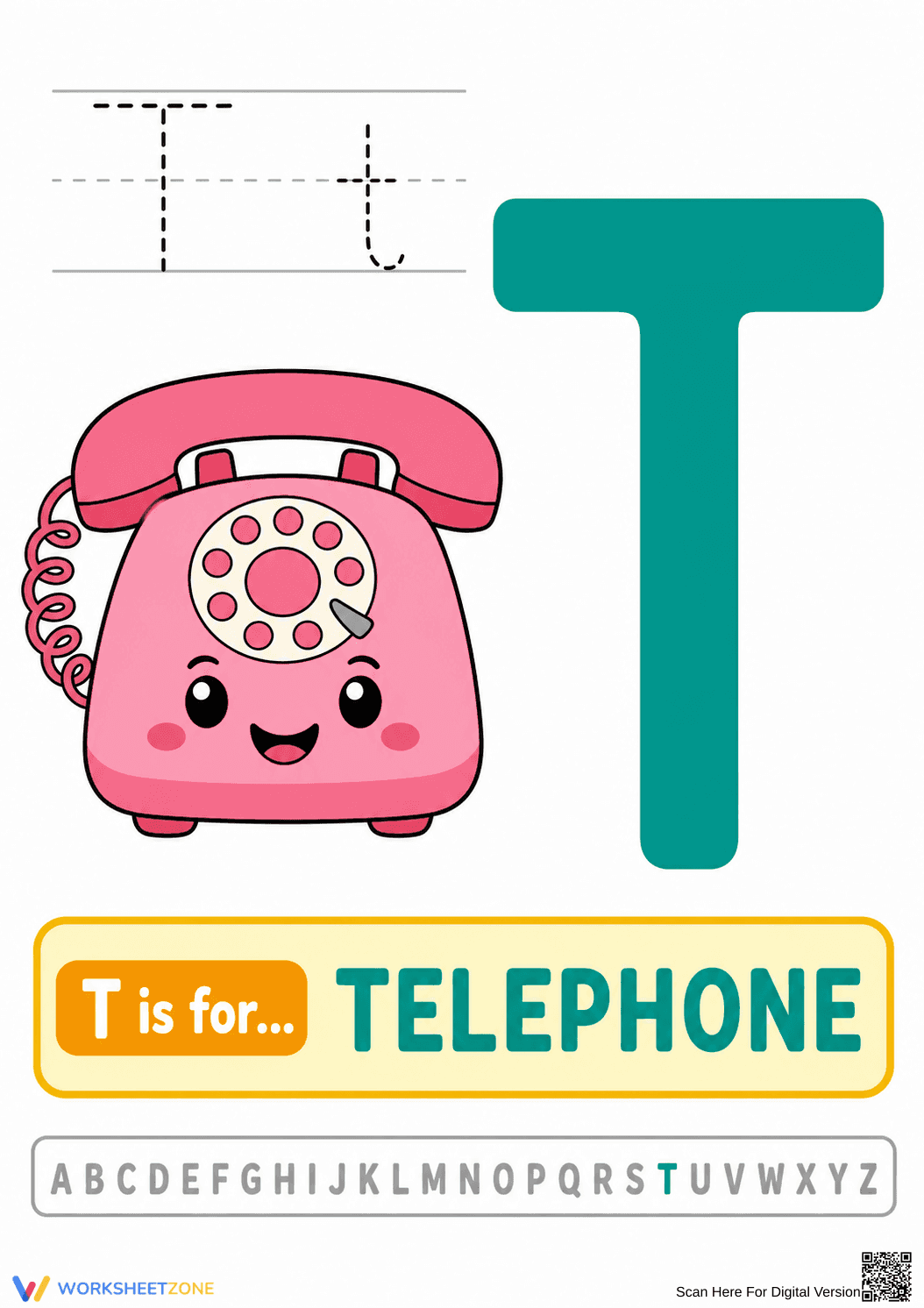

Printable Letter T Beginning Sound Worksheet
Paste this activity's link or code into your existing LMS (Google Classroom, Canvas, Teams, Schoology, Moodle, etc.).
Students can open and work on the activity right away, with no student login required.
You'll still be able to track student progress and results from your teacher account.
This foundational phonics worksheet helps early learners master the beginning sound of the letter T. Students practice letter recognition, connect the visual symbol to its phonetic sound, and develop fine motor skills through guided tracing. This resource provides a clear, engaging introduction to early literacy concepts essential for reading readiness.
At a Glance
- Grade: Kindergarten · Subject: ELA
- Standard:
CCSS.ELA-LITERACY.RF.K.3.A— Produce the primary sound for each consonant- Skill Focus: Letter T Beginning Sound
- Format: 1 page · 2 tasks · No answer key · PDF
- Best For: Morning work or centers
- Time: 5–10 minutes
This single-page resource features a vibrant layout designed to reinforce letter-sound correspondence. It includes a large telephone illustration to anchor the "T" sound, alongside guided tracing lines for uppercase and lowercase forms. An alphabet strip provides context, helping learners see where the letter T fits within the alphabet sequence.
This resource requires zero teacher preparation.
- Print (1 minute): Simply download the PDF and print the desired number of copies. Graphics print clearly.
- Distribute (1 minute): Hand out the sheets during morning arrival, literacy centers, or as a quick transition activity.
- Review (3 minutes): Briefly model the tracing path on the board and practice saying the "T is for Telephone" chant together as a class.
Total prep time is under two minutes, making this an ideal, stress-free addition to any emergency sub plan or daily routine.
This worksheet is directly aligned to CCSS.ELA-LITERACY.RF.K.3.A: "Demonstrate basic knowledge of one-to-one letter-sound correspondences by producing the primary sound or many of the most frequent sounds for each consonant." It also supports early handwriting standards by providing structured tracing practice for upper and lowercase letters. Both standard codes can be copied into lesson plans, IEP goals, or curriculum maps.
Display this worksheet on a smartboard during whole-group phonics instruction. It also serves as an excellent independent literacy center activity where students can practice tracing and coloring after a brief introduction. While students work, teachers can conduct quick formative assessments by walking around and asking individual children to point to the letter and produce the /t/ sound. Expected completion time is a brief five to ten minutes.
This printable is designed for Kindergarten students beginning formal phonics. It is also highly effective for Pre-K students showing early reading readiness, or first-grade students who need targeted intervention on consonant sounds. To differentiate, teachers can provide textured materials like glitter glue or yarn for tactile learners to trace over the large letter T. This page pairs perfectly with a classroom alphabet anchor chart or a read-aloud book focusing on the letter T.
Establishing strong letter-sound correspondence is a critical predictor of future reading success. When students practice producing the primary sound for each consonant, as outlined in CCSS.ELA-LITERACY.RF.K.3.A, they build the necessary decoding skills for fluent reading. According to a comprehensive EdReports 2024 analysis of foundational literacy programs, explicit and systematic phonics instruction that pairs visual letter recognition with auditory sound production significantly improves early literacy outcomes. This Letter T beginning sound worksheet integrates these evidence-based practices by combining visual anchors, such as the telephone illustration, with kinesthetic tracing activities. By engaging multiple modalities—seeing the letter, saying the sound, and writing the shape—young learners solidify their understanding of the alphabetic principle. This multi-sensory approach ensures that foundational phonics concepts are retained, setting the stage for more advanced phonemic awareness and eventual reading comprehension.


