


























Views
Downloads
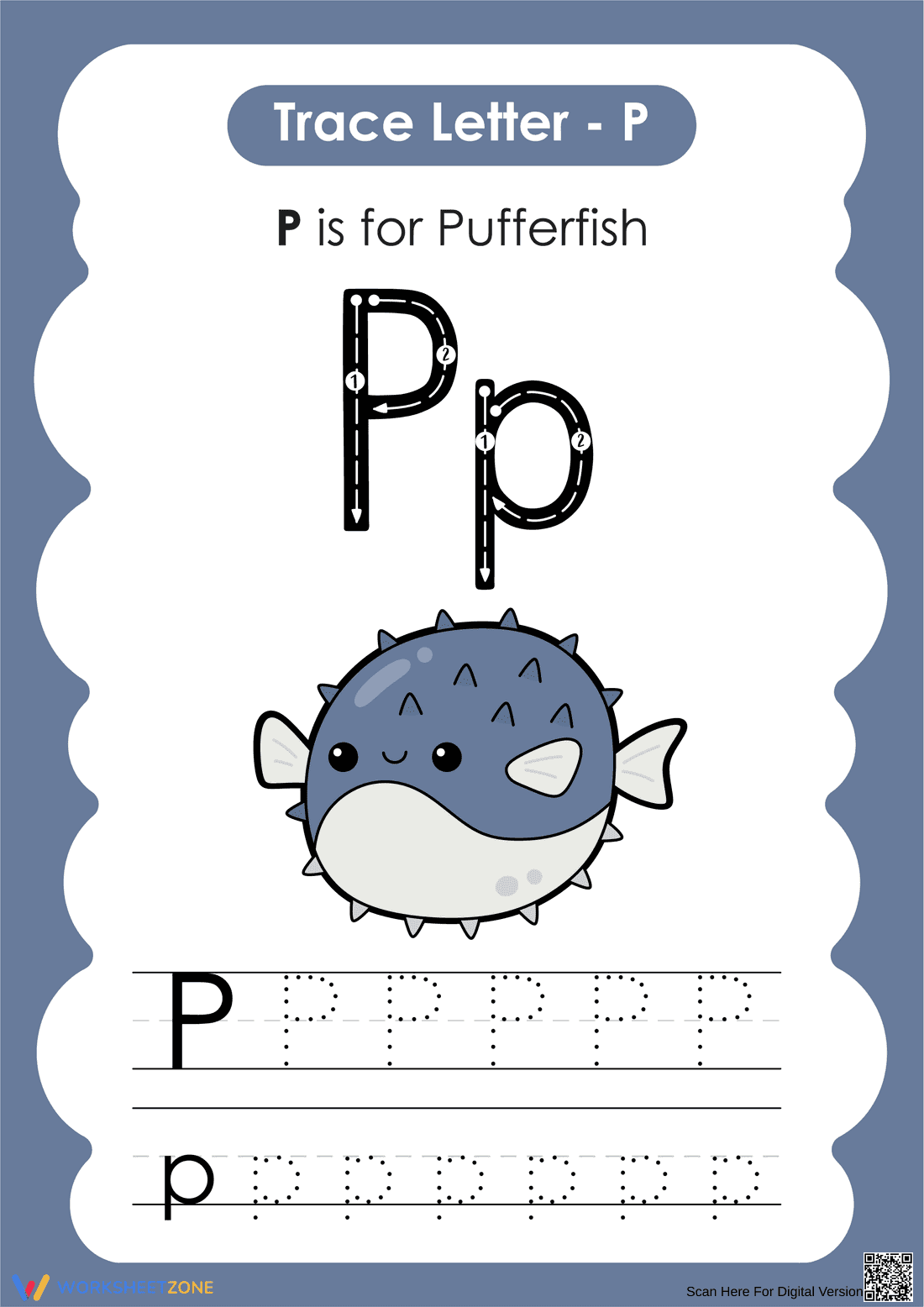

Letter P Tracing Worksheet | Printable Alphabet Activity
Paste this activity's link or code into your existing LMS (Google Classroom, Canvas, Teams, Schoology, Moodle, etc.).
Students can open and work on the activity right away, with no student login required.
You'll still be able to track student progress and results from your teacher account.
This printable letter P tracing worksheet helps early learners master uppercase and lowercase letter formation through structured handwriting practice. Students develop fine motor control by tracing dashed lines guided by directional arrows, building confidence with the letter P using a cute pufferfish theme.
At a Glance
- Grade: Kindergarten · Subject: English Language Arts
- Standard:
CCSS.ELA-LITERACY.RF.K.1.D— Recognize and name all upper- and lowercase letters of the alphabet- Skill Focus: Letter P formation and tracing
- Format: 1 page · 12 problems · Visual stroke guides · PDF
- Best For: Morning work and fine motor centers
- Time: 10–15 minutes
This single-page PDF worksheet provides a clean layout for early childhood development. Large model letters display numbered arrows demonstrating correct stroke order for capital P and lowercase p. Below the pufferfish graphic, two tracks contain 12 tracing opportunities. Each row begins with a solid guide letter followed by six dashed letters, allowing children to transition smoothly to independent stroke replication.
Implementing this alphabet activity requires minimal effort, making it ideal for busy classrooms. First, print the single-page PDF document in less than 30 seconds. Next, distribute the sheets to your students, taking just 1 minute to explain the directional arrows. Finally, review student letter formation in real-time. The entire setup takes under 2 minutes, giving teachers a reliable, high-quality instructional tool instantly.
Standards Alignment
This resource supports foundational reading and writing skills. It aligns precisely with the Common Core State Standard CCSS.ELA-LITERACY.RF.K.1.D, which requires students to recognize and name all upper- and lowercase letters of the alphabet. Both standard codes can be copied directly into lesson plans, IEP goals, or district curriculum mapping tools.
How to Use It
Incorporate this worksheet during your morning routine or in literacy centers. Introduce the worksheet immediately after direct instruction on the letter P sound. As a formative assessment tip, observe students during their first three tracing attempts to ensure they follow the numbered stroke arrows. Expect students to complete the entire page within 10 to 15 minutes.
Who It's For
This handwriting resource is designed for preschool, kindergarten, and first-grade students developing early print awareness. It serves as an excellent intervention tool for tier two support groups needing extra fine motor practice. Pair this worksheet naturally with an alphabet anchor chart to maximize instructional impact.
According to the Fisher & Frey (2014) framework for gradual release of responsibility, structured visual scaffolds like directional stroke arrows are critical for early childhood skill acquisition. This worksheet applies that research by providing explicit numbered guides before asking students to complete the 12 tracing tasks independently. Early print awareness and letter configuration mastery are strong predictors of later reading achievement. By aligning directly with the standard code `CCSS.ELA-LITERACY.RF.K.1.D`, this resource ensures that preschool and kindergarten students build the precise muscle memory needed for fluent handwriting. The inclusion of a clear keyword association, such as the pufferfish graphic, strengthens phoneme-grapheme connections during independent practice sessions. Teachers can confidently integrate this evidence-based tool into daily phonics routines to support diverse learners.


