


























Views
Downloads

Grade K Letter P — Printable No-Prep Worksheet
Paste this activity's link or code into your existing LMS (Google Classroom, Canvas, Teams, Schoology, Moodle, etc.).
Students can open and work on the activity right away, with no student login required.
You'll still be able to track student progress and results from your teacher account.
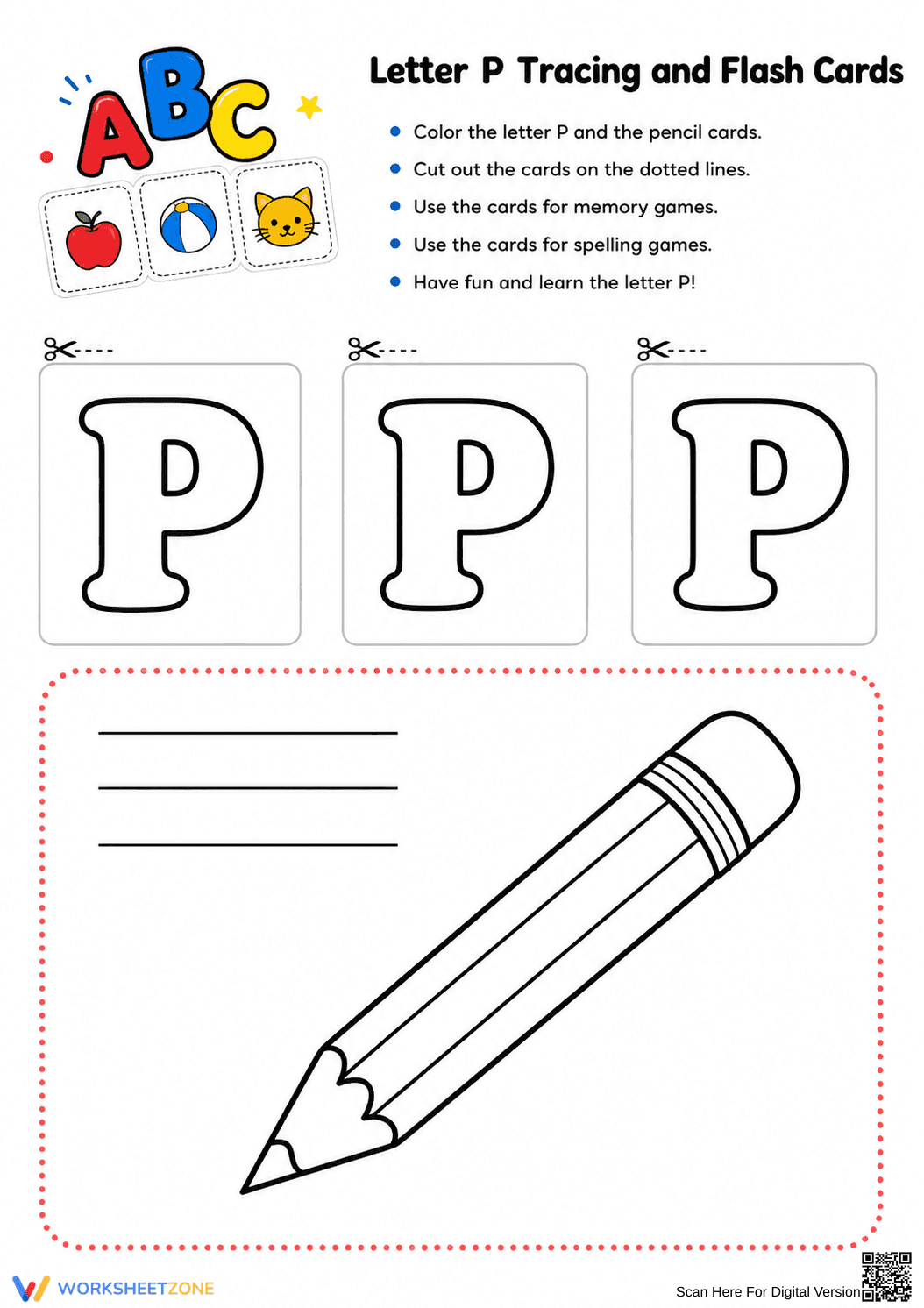
This Kindergarten phonics worksheet helps students recognize and interact with the letter P through hands-on crafting. By coloring, cutting, and tracing, early learners build fine motor skills while reinforcing letter-sound correspondence. The engaging flashcard format transforms basic alphabet practice into an interactive learning experience.
At a Glance
- Grade: Kindergarten · Subject: ELA
- Standard:
CCSS.ELA-LITERACY.RF.K.1.D— Recognize and name all alphabet letters- Skill Focus: Letter P recognition and beginning sounds
- Format: 1 page · 4 tasks · No answer key required · PDF
- Best For: Independent centers and phonics practice
- Time: 15–20 minutes
This single-page resource features four distinct interactive components designed for early childhood education. Students will find three large uppercase letter P templates and one large pencil illustration to color. The page includes clear dotted guidelines for scissor practice, allowing children to create their own flashcards. Additionally, writing lines are provided next to the pencil graphic to encourage early tracing and letter formation practice.
Zero-Prep Workflow
This resource requires minimal teacher setup:
- Print (1 minute): Simply print the single-page PDF. No special paper or color ink is required, making it highly cost-effective.
- Distribute (1 minute): Hand out the sheets along with crayons and child-safe scissors. The visual instructions are intuitive for young learners.
- Review (0 minutes): No formal grading or answer key review is necessary.
With under two minutes of total teacher prep time, this activity is an excellent addition to emergency sub plans or spontaneous literacy centers.
Standards Alignment
This worksheet is directly aligned to CCSS.ELA-LITERACY.RF.K.1.D, which requires students to recognize and name all upper- and lowercase letters of the alphabet. It also supports foundational phonics skills by associating the letter P with the "pencil" graphic, reinforcing beginning sounds. Both standard codes can be copied directly into lesson plans, IEP goals, or district curriculum mapping tools.
How to Use It
Deploy this printable during morning work or literacy centers. Before direct instruction, teachers can use the flashcards as a warm-up exercise to introduce the letter of the week. During independent practice, students can color and cut out their cards, then use them for memory matching or spelling games with peers. As a formative assessment observation tip, watch how students grip their scissors and trace the lines to gauge fine motor development. The entire activity typically takes 15 to 20 minutes to complete.
Who It's For
This resource is primarily designed for Kindergarten students, though it serves as excellent remedial practice for first graders needing extra phonics support. The cutting and coloring tasks provide natural differentiation for kinesthetic learners. It pairs perfectly with an alphabet anchor chart or a read-aloud session focusing on words that start with the letter P.
Effective early literacy instruction relies heavily on multi-sensory engagement to solidify foundational skills. According to a RAND AIRS 2024 study on early childhood education, integrating fine motor activities like cutting and coloring with phonics instruction significantly improves letter retention in young learners. This worksheet directly targets CCSS.ELA-LITERACY.RF.K.1.D, helping students recognize and name all alphabet letters through interactive flashcard creation. By combining tactile crafting with visual letter recognition, educators can foster stronger neural pathways for reading readiness. The inclusion of beginning sound associations, such as the pencil graphic, further bridges the gap between abstract symbols and concrete vocabulary. Utilizing resources that blend physical activity with cognitive tasks ensures a more comprehensive approach to early literacy, setting a robust foundation for future reading success in the primary classroom.


