


























Views
Downloads
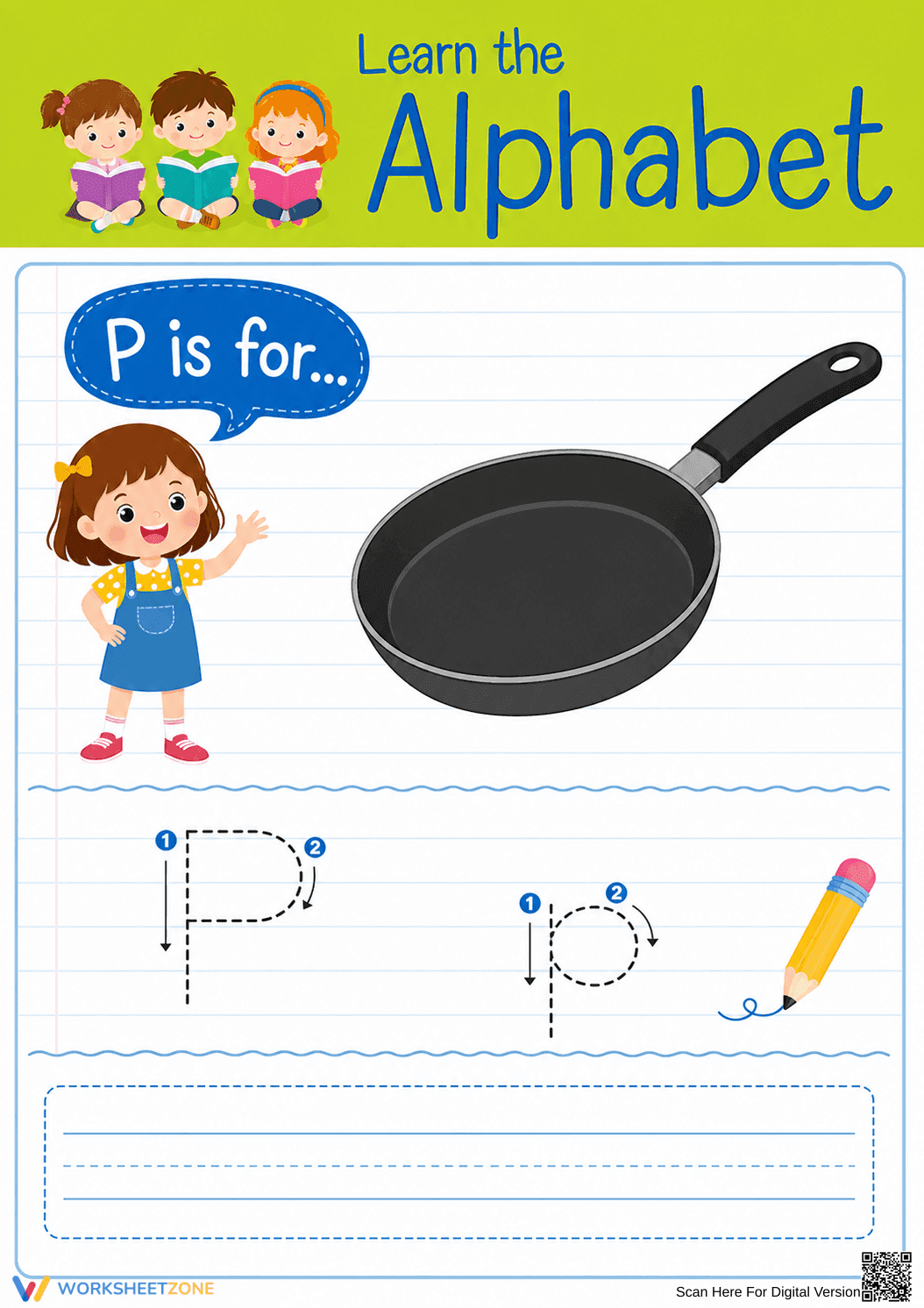

Printable Letter P Beginning Sound Worksheet | Grade K
Paste this activity's link or code into your existing LMS (Google Classroom, Canvas, Teams, Schoology, Moodle, etc.).
Students can open and work on the activity right away, with no student login required.
You'll still be able to track student progress and results from your teacher account.
This foundational phonics worksheet helps early learners master the letter P through targeted beginning sound recognition and handwriting practice. Students connect the visual representation of the letter to its phonetic sound, then practice proper stroke order for both uppercase and lowercase forms to build essential literacy skills.
At a Glance
- Grade: K · Subject: ELA
- Standard:
CCSS.ELA-LITERACY.L.K.1.A— Print many upper- and lowercase letters- Skill Focus: Letter P Sound and Handwriting
- Format: 1 page · 3 tasks · No answer key needed · PDF
- Best For: Morning work or literacy centers
- Time: 10–15 minutes
This single-page resource features a clear, engaging layout designed specifically for young learners. It includes a visual vocabulary anchor showing a pan to reinforce the beginning /p/ sound. Below the illustration, students find guided tracing paths with numbered directional arrows for both uppercase 'P' and lowercase 'p'. The bottom section provides standard primary handwriting lines for independent letter formation practice.
This worksheet is designed for immediate classroom implementation with absolutely zero teacher setup required.
- Print (1 minute): Simply download the PDF and print the required number of copies for your class.
- Distribute (1 minute): Hand out the sheets along with pencils or crayons. The visual instructions are intuitive for early readers.
- Review (3 minutes): Quickly check student letter formation and stroke direction as they work independently.
The entire preparation process takes under two minutes, making this an excellent option for emergency sub plans or quick morning work transitions.
This resource is directly aligned to primary standard CCSS.ELA-LITERACY.L.K.1.A, requiring students to print many upper- and lowercase letters. It also supports foundational phonics skills by reinforcing letter-sound correspondence. Both standard codes can be copied directly into lesson plans, IEP goals, or district curriculum mapping tools.
Teachers can utilize this worksheet during morning arrival as a quiet, focused activity to start the day. It also functions perfectly as an independent station during literacy center rotations. While students are working, observe their pencil grip and ensure they are following the numbered directional arrows for proper stroke sequence, which serves as an excellent formative assessment opportunity. Expect students to complete the page within 10 to 15 minutes.
This resource is primarily designed for Kindergarten students developing basic phonics and handwriting skills. It also serves as effective remediation for first-grade students who struggle with letter formation or b/d/p/q reversals. Pair this worksheet with a whole-group read-aloud focusing on the /p/ sound or a tactile sand-tray tracing activity for multi-sensory reinforcement.
Mastering foundational literacy skills requires consistent, structured practice with both phonetic sounds and physical letter formation. This resource targets CCSS.ELA-LITERACY.L.K.1.A, helping students print many upper- and lowercase letters accurately. According to a recent EdReports 2024 analysis of early literacy curricula, explicit instruction in letter formation combined with phonemic awareness significantly improves later reading fluency and writing automaticity. When young learners practice tracing with directional arrows before moving to independent writing lines, they develop the necessary motor memory to reduce letter reversals and increase writing speed. This targeted practice ensures that cognitive load is eventually freed up for higher-level composition tasks. By integrating visual vocabulary cues with structured handwriting tasks, educators can effectively support early literacy development in a single, cohesive activity.


