


























Views
Downloads

Letter O Tracing Printable | Grade K ELA
Paste this activity's link or code into your existing LMS (Google Classroom, Canvas, Teams, Schoology, Moodle, etc.).
Students can open and work on the activity right away, with no student login required.
You'll still be able to track student progress and results from your teacher account.
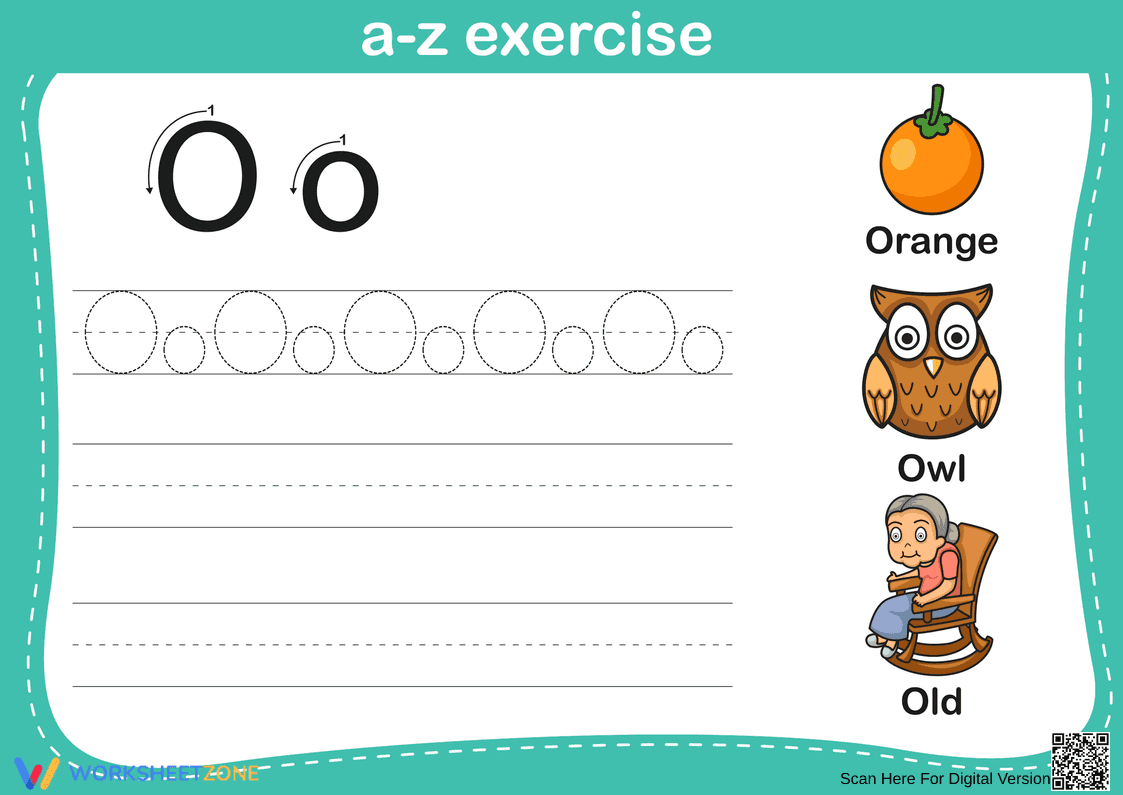
This foundational handwriting worksheet provides early learners with targeted practice on Letter O formation. Students develop fine motor control and letter recognition skills by tracing and writing uppercase and lowercase forms. The activity connects physical writing practice with beginning sound vocabulary to reinforce early phonics concepts.
At a Glance
- Grade: Kindergarten · Subject: ELA
- Standard:
CCSS.ELA-LITERACY.L.K.1.A— Print upper- and lowercase letters- Skill Focus: Letter O formation and recognition
- Format: 1 page · 14 tasks · No key needed · PDF
- Best For: Morning work or literacy centers
- Time: 10–15 minutes
This single-page resource features a clear, structured layout for early writers. It includes directional arrows demonstrating the correct starting point and continuous stroke for the letter O. Students complete one row of guided tracing on dotted lines, followed by two blank primary-lined rows for independent practice. The right margin displays three vocabulary images—orange, owl, and old—to build letter-sound correspondence.
This resource is designed for immediate classroom implementation with a streamlined workflow:
- Print (1 minute): Generate copies directly from the PDF file. The high-contrast black-and-white design ensures crisp reproduction.
- Distribute (1 minute): Hand out to students during morning routines or center rotations. The visual instructions make the task immediately clear.
- Review (1 minute): Quickly scan student work for correct stroke direction and line adherence.
Total teacher preparation requires under two minutes, making this an excellent emergency sub plan or quick-fill activity for early finishers.
This activity aligns directly with CCSS.ELA-LITERACY.L.K.1.A, requiring students to print many upper- and lowercase letters. It also supports foundational phonics skills by associating the written letter with spoken vocabulary words. Both standard codes can be copied directly into lesson plans, IEP goals, or district curriculum mapping tools.
Deploy this worksheet during small group literacy centers to monitor pencil grip and stroke direction closely. Alternatively, assign it as independent morning work to establish a calm, focused start to the school day. While students work, observe whether they start the letter O at the top and pull back to the left, correcting any bottom-up formations immediately. Expected completion time ranges from 10 to 15 minutes depending on the student's fine motor development.
This resource serves Preschool, Kindergarten, and Grade 1 students developing basic handwriting proficiency. It provides essential scaffolding for learners who struggle with spatial awareness on primary lines. Pair this practice sheet with a tactile activity, such as tracing the letter O in sand or shaving cream, to reinforce the motor pathway before moving to pencil and paper.
Mastering letter formation is a critical precursor to fluent writing and reading comprehension in early childhood education. This resource specifically targets CCSS.ELA-LITERACY.L.K.1.A, ensuring students can print upper- and lowercase letters accurately and efficiently. According to Fisher & Frey (2014), explicit instruction in handwriting and repeated guided practice significantly reduces the cognitive load required for transcription, allowing young writers to eventually focus their mental energy on idea generation and phonics application rather than basic mechanics. By combining directional tracing cues with independent practice lines and visual vocabulary anchors, this worksheet provides the structured repetition necessary for developing automaticity. The integration of beginning sound images—such as orange and owl—further bridges the gap between physical letter production and phonemic awareness, establishing a strong, multifaceted foundation for early literacy success and confident communication.


