


























Views
Downloads
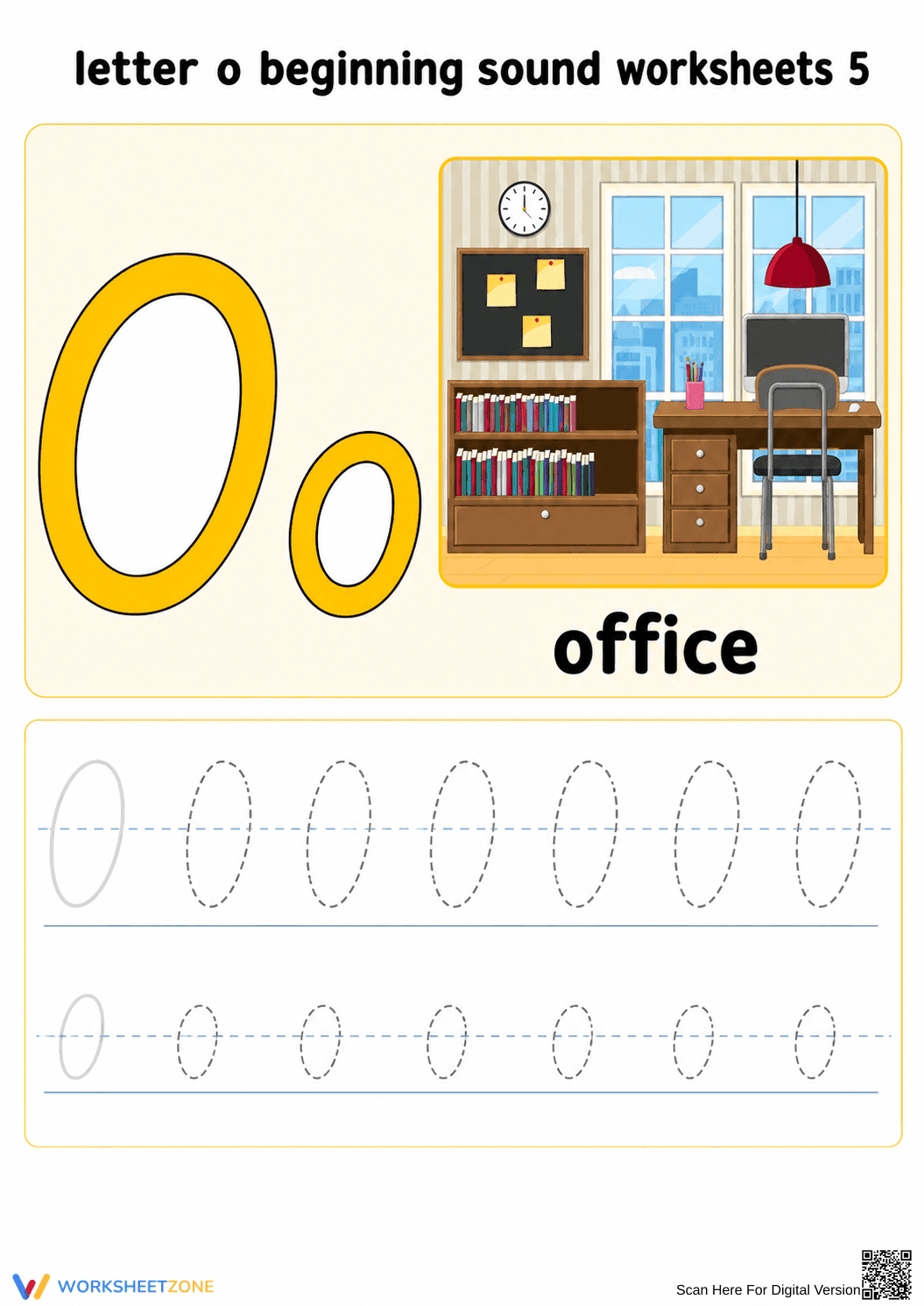

Printable Letter O Beginning Sound Worksheet | Grade K
Paste this activity's link or code into your existing LMS (Google Classroom, Canvas, Teams, Schoology, Moodle, etc.).
Students can open and work on the activity right away, with no student login required.
You'll still be able to track student progress and results from your teacher account.
This foundational phonics worksheet helps early learners master the beginning sound of the letter O while practicing essential handwriting skills. Students connect the visual representation of the letter to its initial sound using a familiar vocabulary word, then build fine motor control through guided uppercase and lowercase letter tracing.
At a Glance
- Grade: K · Subject: ELA
- Standard:
CCSS.ELA-LITERACY.RF.K.3.B— Associate vowel sounds with common spellings- Skill Focus: Letter O Beginning Sound & Tracing
- Format: 1 page · 15 problems · No answer key · PDF
- Best For: Independent morning work
- Time: 10–15 minutes
Inside this single-page resource, educators will find a distraction-free layout designed for young learners. The top section features large, bold models of the uppercase and lowercase letter O, paired with a colorful illustration of an office to reinforce the short O beginning sound. The bottom section provides two structured handwriting lines with dashed letters, offering 14 total tracing opportunities to practice proper letter formation.
This resource requires zero teacher setup.
- Print (1 minute): Simply send the PDF to your school copier. The high-contrast design prints beautifully in both color and grayscale.
- Distribute (1 minute): Hand out the sheets along with pencils or crayons. The intuitive layout means students immediately understand the task.
- Review (1 minute): Quickly scan student work to check for proper pencil grip and correct stroke order during the tracing portion.
With prep time under two minutes, it is perfect for emergency sub plans.
This activity aligns directly with CCSS.ELA-LITERACY.RF.K.3.B: "Associate the long and short sounds with the common spellings (graphemes) for the five major vowels." It also supports handwriting development by requiring students to print upper- and lowercase letters. Both standard codes can be copied directly into lesson plans, IEP goals, or district curriculum mapping tools.
Deploy this worksheet during morning arrival as a focused bell-ringer activity. Students can independently trace the letters, giving the teacher time to take attendance. Alternatively, it serves as a highly effective literacy center station following direct instruction on the letter O. While observing students complete the tracing lines, teachers can conduct quick formative assessments on pencil grip and letter formation, correcting any bottom-to-top stroke habits before they become ingrained. Expect students to complete the page in 10 to 15 minutes.
This printable is designed primarily for Kindergarten students, though it serves as excellent remediation for first graders who need extra phonics or handwriting support. The clear visual cues and dashed tracing lines provide built-in scaffolding for students developing fine motor skills. Pair this worksheet with a tactile activity, such as forming the letter O with playdough or tracing it in a sand tray, to create a multisensory learning experience.
Developing strong letter-sound correspondence alongside daily handwriting practice is a critical step in early literacy acquisition. This resource targets CCSS.ELA-LITERACY.RF.K.3.B by helping students associate vowel sounds with common spellings. According to Fisher & Frey (2014), integrating physical writing tasks with phonemic awareness activities significantly improves letter recognition and retention in early childhood education. When students physically trace the letter O while verbalizing its beginning sound, they form stronger neural pathways connecting the grapheme to the phoneme. This dual-modality approach ensures that foundational reading skills are securely anchored in both visual memory and fine motor memory, setting the stage for future reading fluency. By providing structured, repetitive tracing tasks paired with clear vocabulary anchors like "office," educators can effectively support early decoding skills and prepare young learners for more complex reading tasks in later grades.


