


























Views
Downloads

Letter M Beginning Sound Worksheet | Essential Phonics
Paste this activity's link or code into your existing LMS (Google Classroom, Canvas, Teams, Schoology, Moodle, etc.).
Students can open and work on the activity right away, with no student login required.
You'll still be able to track student progress and results from your teacher account.
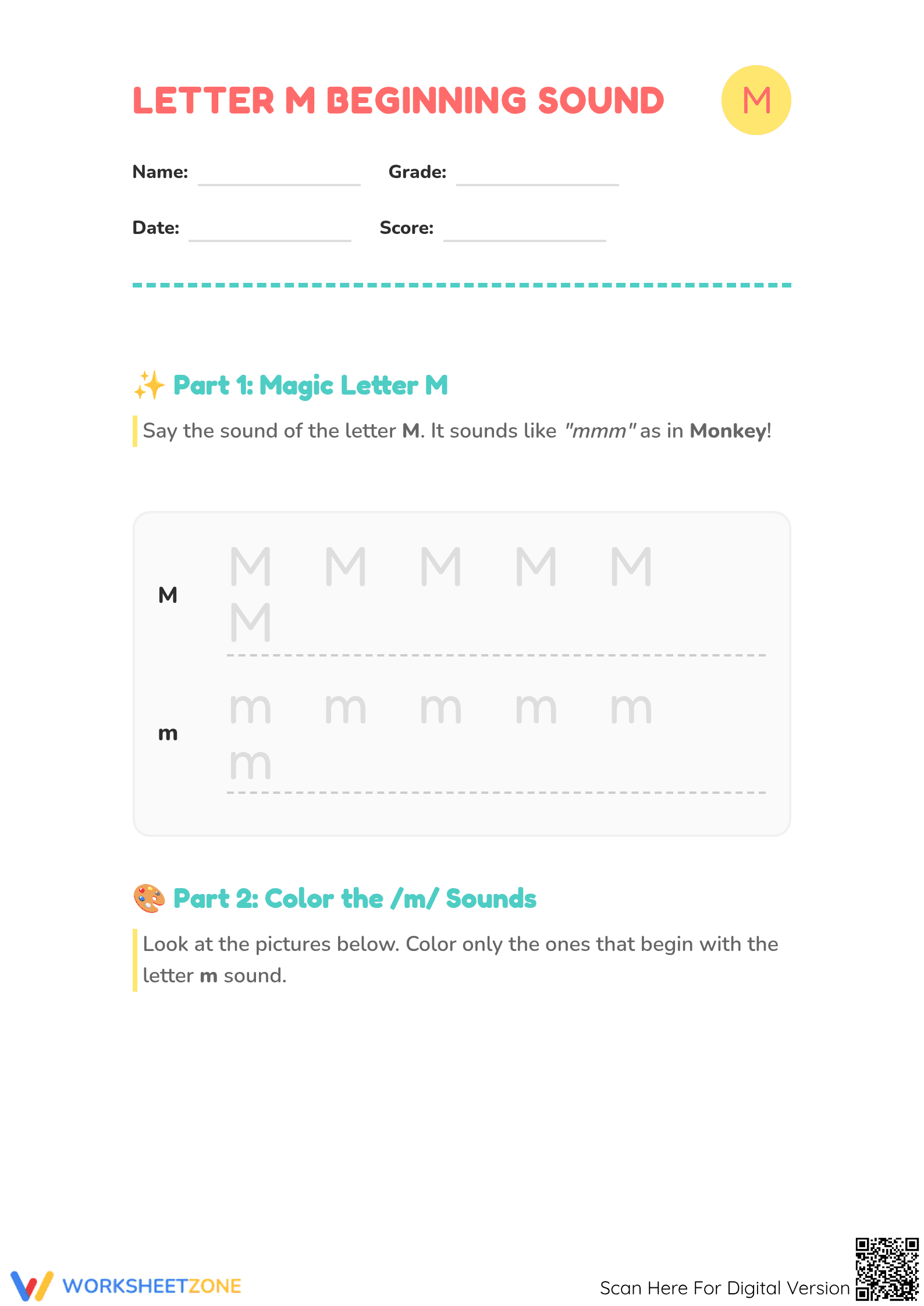
This foundational phonics worksheet helps early learners master the letter M beginning sound through a multi-sensory approach. By combining auditory recognition with visual tracing and creative drawing, students develop a robust understanding of how the letter M functions in spoken and written English.
At a Glance
- Grade: Kindergarten · Subject: ELA Phonics
- Standard:
CCSS.ELA-LITERACY.RF.K.3.A— Produce the primary sound for the letter M- Skill Focus: Letter M Beginning Sound
- Format: 3 pages · 26 problems · Answer key included · PDF
- Best For: Initial phonics instruction and literacy centers
- Time: 15–20 minutes
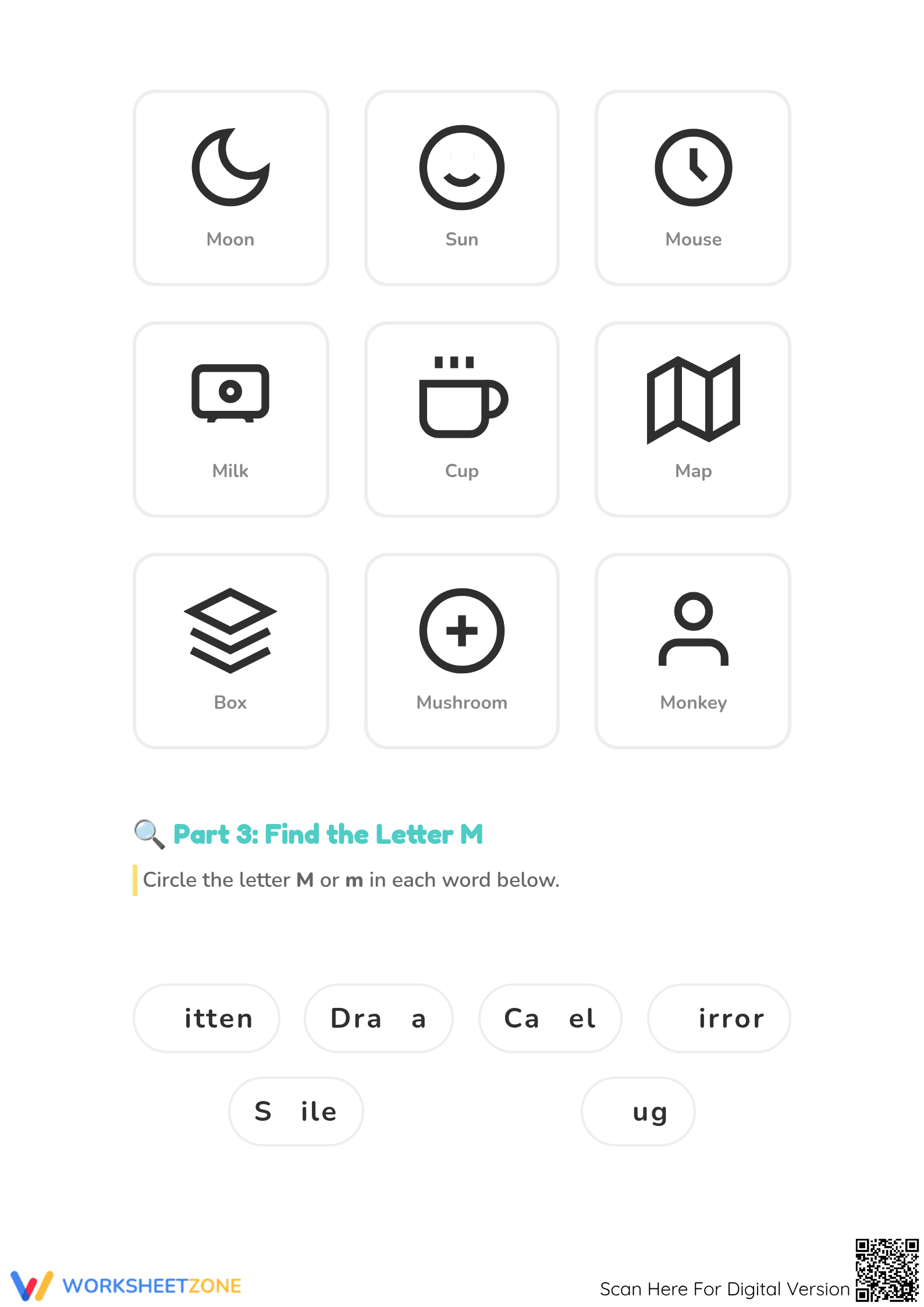
What's Inside: The packet contains three comprehensive pages designed for young learners. It features a dedicated tracing section for both uppercase and lowercase M, a visual discrimination task with nine distinct images, a word-level identification exercise, and a creative drawing prompt. A full answer key is provided to facilitate quick grading or self-correction.
Skill Progression
- Guided practice: Students begin with "Magic Letter M," tracing the letter 10 times to build muscle memory and reinforce the connection between the shape and the "mmm" sound.
- Supported practice: The "Color the /m/ Sounds" section provides 9 visual cues where students must distinguish between words like "Moon" and "Sun," applying their phonemic awareness in a structured context.
- Independent practice: The final "Draw Your Own" task requires students to generate their own example of an /m/ word, demonstrating mastery of the beginning sound without external prompts.
Standards Alignment: This resource is primarily aligned with `CCSS.ELA-LITERACY.RF.K.3.A`, which requires students to demonstrate basic knowledge of one-to-one letter-sound correspondences. It also supports `CCSS.ELA-LITERACY.RF.K.1.D` by having students recognize and name upper- and lowercase letters. Both standard codes can be copied directly into lesson plans, IEP goals, or district curriculum mapping tools.
How to Use It: Use this worksheet during the "You Do" phase of a direct instruction lesson on beginning sounds. It works well as a quiet-time activity or a rotation in a literacy center. Teachers can use the coloring section as a formative assessment; observe if students can orally name the pictures before coloring to check for vocabulary gaps. Completion typically takes 15 to 20 minutes.
Who It's For: This resource is designed for Kindergarten students, though it serves as an intervention tool for Grade 1 students who need phonics support. It is helpful for English Language Learners (ELLs) due to the heavy reliance on visual icons. Pair this with a "Letter M" anchor chart or a physical sound box containing objects like a magnet, map, and milk carton.
According to the Fisher & Frey (2014) framework for gradual release of responsibility, effective literacy instruction must transition from teacher modeling to independent student application. This worksheet adheres to that research by providing clear scaffolds—such as tracing guides and visual icons—before asking the student to produce an original example. Phonics mastery in early childhood is a significant predictor of later reading fluency, as noted in the NAEP reports on foundational literacy. By isolating the /m/ sound, this resource reduces cognitive load, allowing students to focus on the specific phoneme-grapheme relationship. The inclusion of 26 distinct tasks across three pages ensures sufficient repetition for long-term retention. This structured approach to the CCSS.ELA-LITERACY.RF.K.3.A standard provides the necessary evidence of student mastery required for progress monitoring and instructional planning in diverse classroom settings.


