


























Views
Downloads

Letter M Beginning Sound Worksheet | Essential Phonics
Paste this activity's link or code into your existing LMS (Google Classroom, Canvas, Teams, Schoology, Moodle, etc.).
Students can open and work on the activity right away, with no student login required.
You'll still be able to track student progress and results from your teacher account.
This Kindergarten and Grade 1 phonics worksheet provides targeted practice for the letter M beginning sound. Students engage in multi-sensory activities to connect the grapheme 'M' with its corresponding phoneme /m/. By the end of these two pages, learners will confidently identify, trace, and distinguish the letter M from other initial sounds in common vocabulary words.
At a Glance
- Grade: Kindergarten · Subject: ELA Phonics
- Standard:
RF.K.3.A— Produce the primary sound for each consonant- Skill Focus: Letter M Beginning Sound
- Format: 2 pages · 22 tasks · Answer key included · PDF
- Best For: Initial phonics instruction and letter recognition
- Time: 15–20 minutes
What's Inside
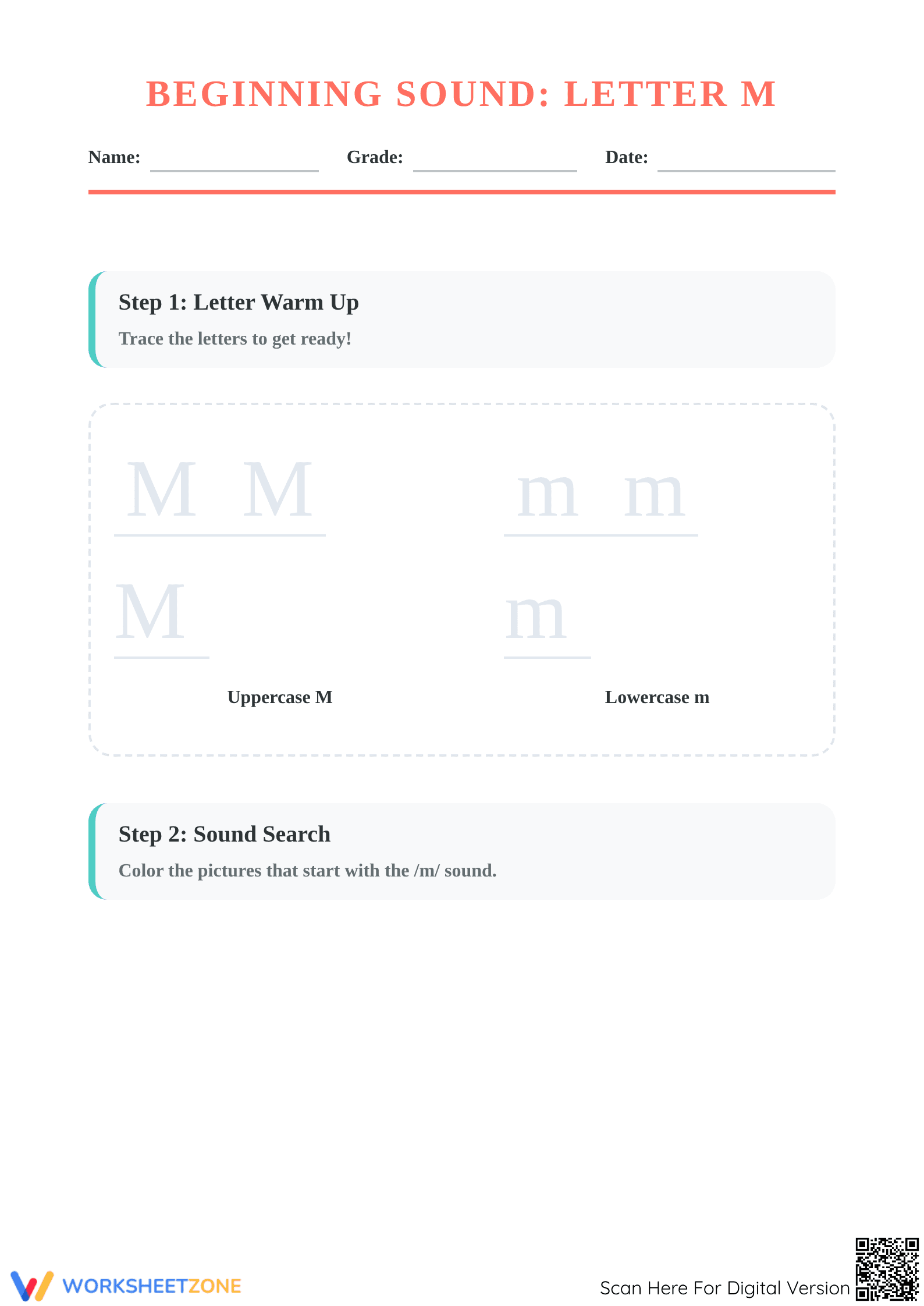
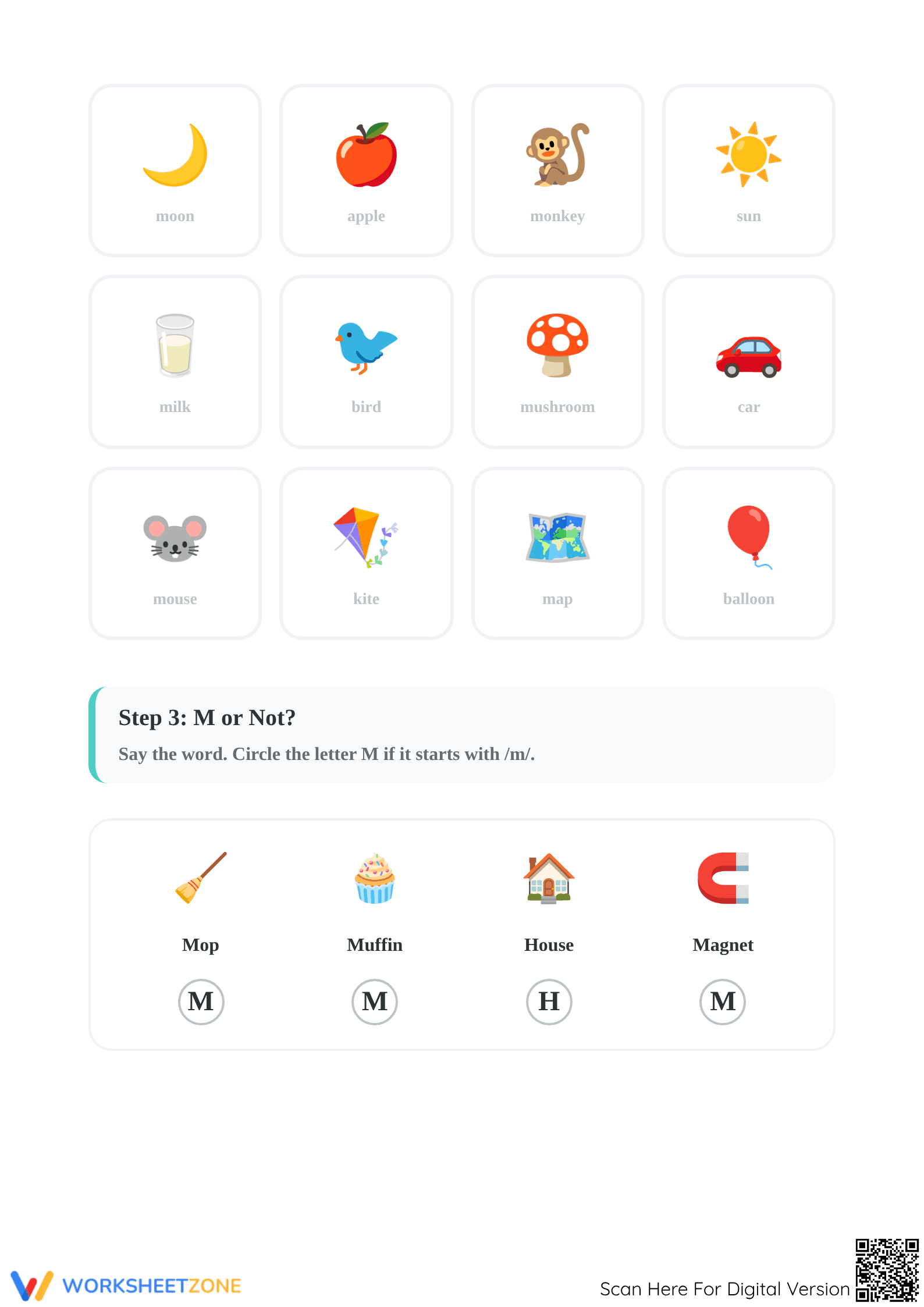
This comprehensive 2-page PDF features three distinct instructional steps designed for early readers. Page one begins with a letter warm-up for tracing uppercase and lowercase M to build handwriting fluency. The second section is a visual sound search containing 12 high-quality illustrations, such as a moon, monkey, and milk. The final section requires students to discriminate between the /m/ sound and other initial consonants using a "circle the letter" format for words like mop and magnet.
Skill Progression
- Guided Practice: Students begin with tracing 6 letters (3 uppercase, 3 lowercase) to build fine motor memory of the letter shape while vocalizing the sound.
- Supported Practice: Learners evaluate 12 different images in the Sound Search, identifying which objects start with the /m/ phoneme using visual cues.
- Independent Practice: The final 4 tasks challenge students to choose between the correct starting letter for specific objects, ensuring they can isolate the phoneme without a word bank.
This sequence follows the gradual-release model of instruction, moving from teacher-led tracing to independent phonemic discrimination.
Standards Alignment
The primary focus is `CCSS.ELA-LITERACY.RF.K.3.A`, which requires students to demonstrate basic knowledge of one-to-one letter-sound correspondences by producing the primary sound for each consonant. This resource also supports RF.K.1.B by reinforcing that spoken words are represented by specific sequences of letters.
How to Use It
Use this worksheet during the independent practice portion of a phonics lesson after introducing the letter M via an anchor chart or song. It works effectively as a formative assessment to check for phonemic awareness. Teachers should observe students during the "Sound Search" to see if they are correctly articulating the /m/ sound while naming the pictures.
Who It's For
This resource is designed for early childhood learners, specifically those in Kindergarten or Grade 1 who are beginning their literacy journey. It is also suitable for English Language Learners (ELL) who need visual support to connect English vocabulary with initial sounds. Pair this with a physical "M" mystery box or a letter M tracing tray for a complete sensory experience during literacy centers.
According to the RAND AIRS 2024 report on early literacy, explicit instruction of letter-sound correspondences is a foundational pillar for developing decoding skills. This worksheet addresses this need by isolating the letter M beginning sound through a structured, three-step pedagogical approach. By combining tactile tracing with auditory discrimination and visual identification, the resource aligns with Science of Reading principles that emphasize phonemic awareness and grapheme-phoneme mapping. Research from Fisher & Frey (2014) suggests that the gradual release of responsibility—moving from guided tracing to independent sound identification—significantly improves long-term retention of phonetic rules. This Grade Kindergarten and Grade 1 resource provides 22 specific tasks that allow for repeated exposure to the /m/ phoneme, ensuring students meet the RF.K.3.A standard. Such targeted practice is essential for bridging the gap between simple letter recognition and fluent word blending in early elementary education.


