




























Views
Downloads

Printable Letter K Tracing & Flash Cards | Grade K-1

Paste this activity's link or code into your existing LMS (Google Classroom, Canvas, Teams, Schoology, Moodle, etc.).
Students can open and work on the activity right away, with no student login required.
You'll still be able to track student progress and results from your teacher account.
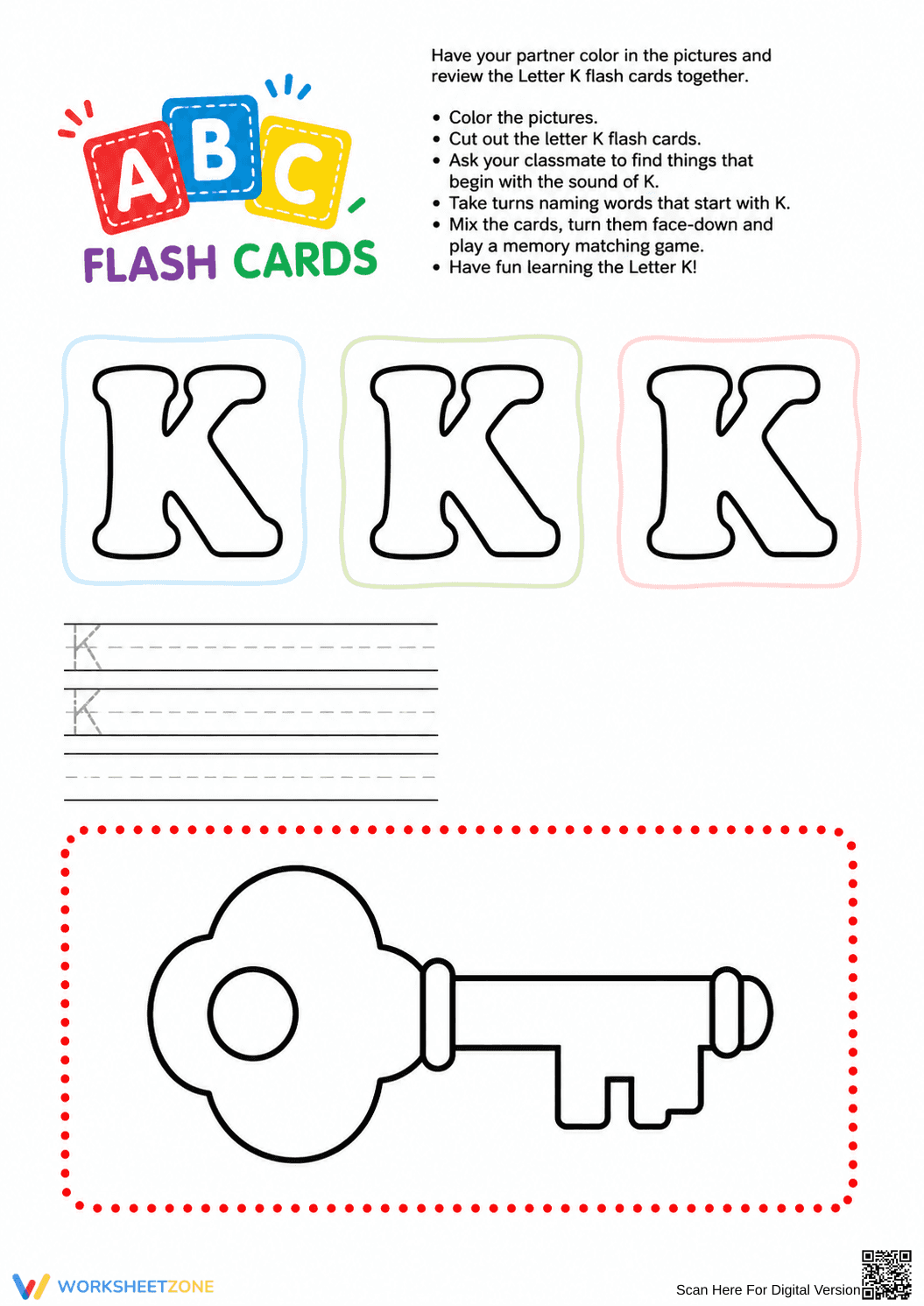
This Letter K worksheet helps early learners master alphabet recognition and fine motor skills through a multi-sensory approach. Students practice tracing uppercase letters, identifying beginning sounds with a key illustration, and creating their own flashcards. It provides a foundational step toward phonemic awareness and handwriting fluency in a single, engaging page.
At a Glance
- Grade: Kindergarten · Subject: ELA
- Standard:
RF.K.1.D— Recognize and name all upper- and lowercase letters of the alphabet- Skill Focus: Letter K recognition and tracing
- Format: 1 page · 7 tasks · Answer key included · PDF
- Best For: Morning work or literacy centers
- Time: 15–20 minutes
Inside this resource, you will find a comprehensive single-page layout featuring three large block letters for coloring, three dedicated lines for guided tracing practice, and a large key graphic to reinforce beginning sounds. The worksheet also includes a set of instructional prompts for a partner-based memory matching game using the cut-out flashcard components.
This zero-prep workflow is designed for maximum efficiency. First, print the single-page PDF (30 seconds). Second, distribute to students with crayons and scissors (1 minute). Third, review the letter sound and tracing technique as a whole group (30 seconds). This resource is an ideal grab-and-go option for emergency substitute plans or transition periods.
This worksheet aligns with `RF.K.1.D`, focusing on the identification and formation of the letter K. It also supports `RF.K.3.A` by connecting the letter shape to its primary phoneme through the visual representation of a key. Both standard codes can be copied directly into lesson plans, IEP goals, or district curriculum mapping tools.
Use this worksheet during your initial phonics block to introduce the letter K. It works exceptionally well as a formative assessment tool; observe student grip and stroke order during the tracing portion to identify those needing additional fine motor support. Alternatively, assign it as a quiet-time activity after a read-aloud featuring K words.
This resource is designed for preschool and kindergarten students beginning their literacy journey. It is particularly effective for English Language Learners (ELLs) who benefit from the visual-to-letter association. Pair this with a Letter K anchor chart or a tactile sand-tracing tray for a complete multi-sensory lesson.
According to the RAND AIRS 2024 report, multi-sensory alphabet instruction that combines visual, auditory, and kinesthetic tasks significantly improves letter-name knowledge in early childhood settings. This worksheet implements those findings by integrating coloring, cutting, and tracing into a single instructional sequence. By engaging students in the physical creation of flashcards, the resource reinforces the standard RF.K.1.D, which requires students to recognize and name all uppercase and lowercase letters. The inclusion of the key image further supports phonemic awareness by anchoring the letter K to its most common beginning sound. Research suggests that these integrated activities help bridge the gap between abstract letter recognition and concrete phonological processing. Educators can use this evidence-based tool to ensure that students meet foundational literacy benchmarks while developing the fine motor control necessary for later writing success.


