


























Views
Downloads
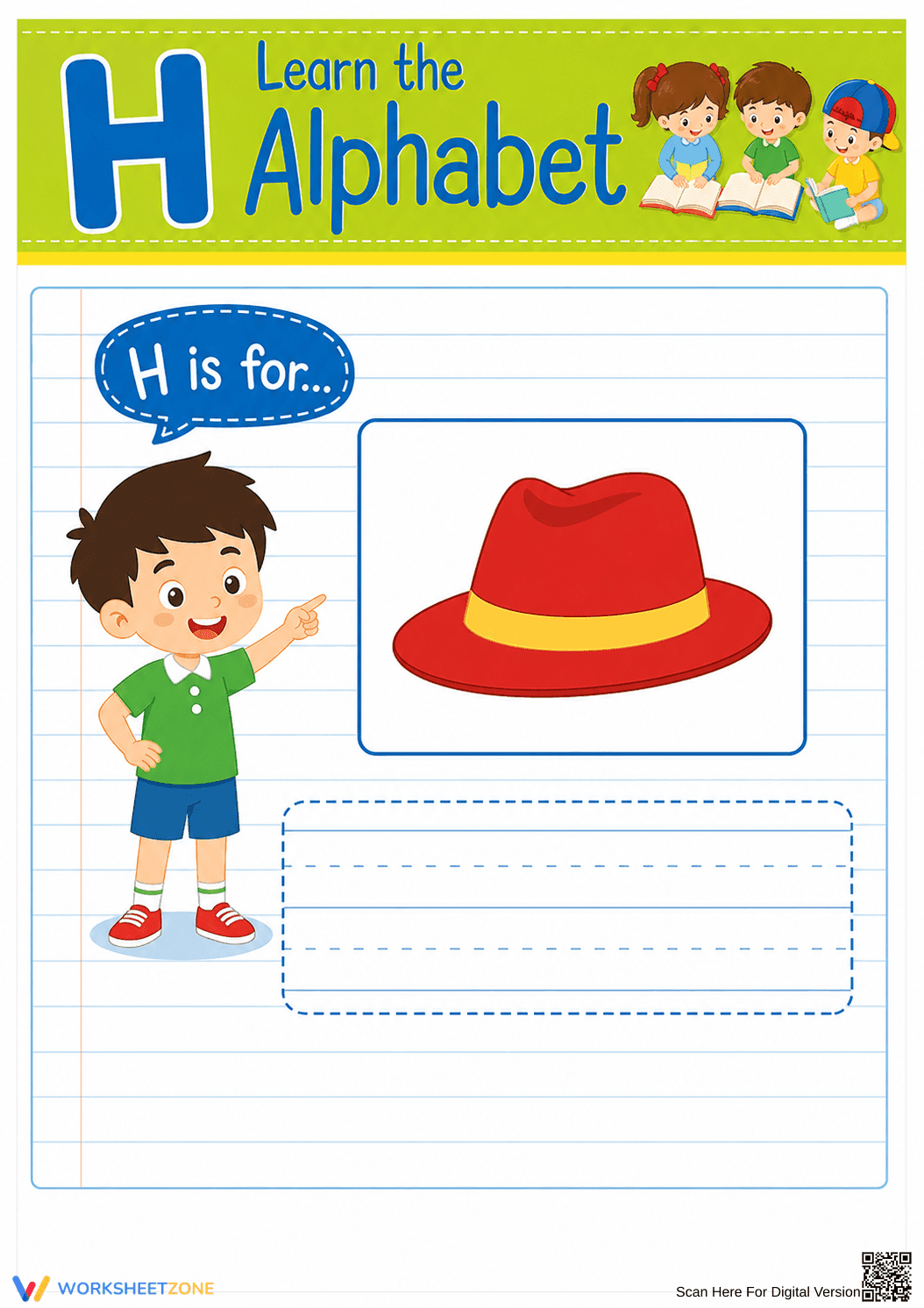

Letter H Beginning Sound Worksheet | Grade K-2 Essential
Paste this activity's link or code into your existing LMS (Google Classroom, Canvas, Teams, Schoology, Moodle, etc.).
Students can open and work on the activity right away, with no student login required.
You'll still be able to track student progress and results from your teacher account.
This Grade K-2 phonics worksheet provides targeted practice for the letter H beginning sound, helping early learners connect the grapheme 'H' with its corresponding phoneme. By using a clear visual anchor, students strengthen their phonemic awareness and letter-sound correspondence. This resource ensures students can identify and produce the 'h' sound in a structured, successful environment.
At a Glance
- Grade: K-2 · Subject: English Language Arts
- Standard:
CCSS.ELA-LITERACY.RF.K.3.A— Produce the primary sound for each consonant letter-sound correspondence- Skill Focus: Letter H Beginning Sound
- Format: 1 page · 1 task · Answer key included · PDF
- Best For: Morning work or phonics centers
- Time: 5–10 minutes
The worksheet features a high-quality illustration of a hat to serve as a mnemonic device for the /h/ sound. It includes a speech bubble prompt "H is for..." and primary-ruled writing lines designed for young hands. This layout encourages students to not only recognize the sound but also practice the fine motor skills required for letter formation and early spelling. The single-page format is clean and free of distractions, making it ideal for students who are just beginning their literacy journey.
Zero-Prep Workflow
- Print: Select the PDF and print enough copies for your group in under 30 seconds.
- Distribute: Hand out the sheets during your phonics block or as a transition activity; no additional materials are required beyond a pencil.
- Review: Use the visual cue to conduct a quick choral response of the /h/ sound before students begin writing. Total teacher preparation time is less than 2 minutes.
This resource is aligned with CCSS.ELA-LITERACY.RF.K.3.A, which requires students to demonstrate basic knowledge of one-to-one letter-sound correspondences by producing the primary sound for consonants. It also supports CCSS.ELA-LITERACY.L.K.1.A regarding the printing of upper- and lowercase letters. Both standard codes can be copied directly into lesson plans, IEP goals, or district curriculum mapping tools.
To use this effectively, introduce it after a direct instruction lesson on the letter H. It serves as an excellent formative assessment; as students work, observe their ability to isolate the initial sound and their pencil grip on the primary lines. The worksheet is also perfectly suited for a literacy station where students can work independently for 5 to 10 minutes while the teacher conducts small-group reading sessions.
This worksheet is designed for Kindergarten and Grade 1 students, as well as Grade 2 students requiring intervention or English Language Learners (ELL) building foundational vocabulary. It pairs naturally with an alphabet anchor chart or a physical "mystery bag" containing items that start with H, such as a heart, a horse, or a toy house.
Research by Fisher & Frey (2014) emphasizes the importance of the gradual release of responsibility, where visual anchors like the "hat" illustration provide the necessary scaffolding for students to move toward independent phonemic production. This worksheet applies those principles by linking a concrete object to an abstract letter sound, a critical step in the orthographic mapping process. According to the NAEP framework, early mastery of letter-sound correspondence is one of the strongest predictors of later reading fluency. By focusing on the specific phoneme /h/ through a combination of visual recognition and tactile writing practice, this resource helps solidify the foundational skills necessary for decoding more complex texts. The inclusion of primary-ruled lines further supports the developmental need for integrated literacy instruction, where writing and phonics are taught as complementary skills rather than isolated tasks.


