


























Views
Downloads

Letter H Beginning Sound Worksheet | Essential Grade K-2
Paste this activity's link or code into your existing LMS (Google Classroom, Canvas, Teams, Schoology, Moodle, etc.).
Students can open and work on the activity right away, with no student login required.
You'll still be able to track student progress and results from your teacher account.
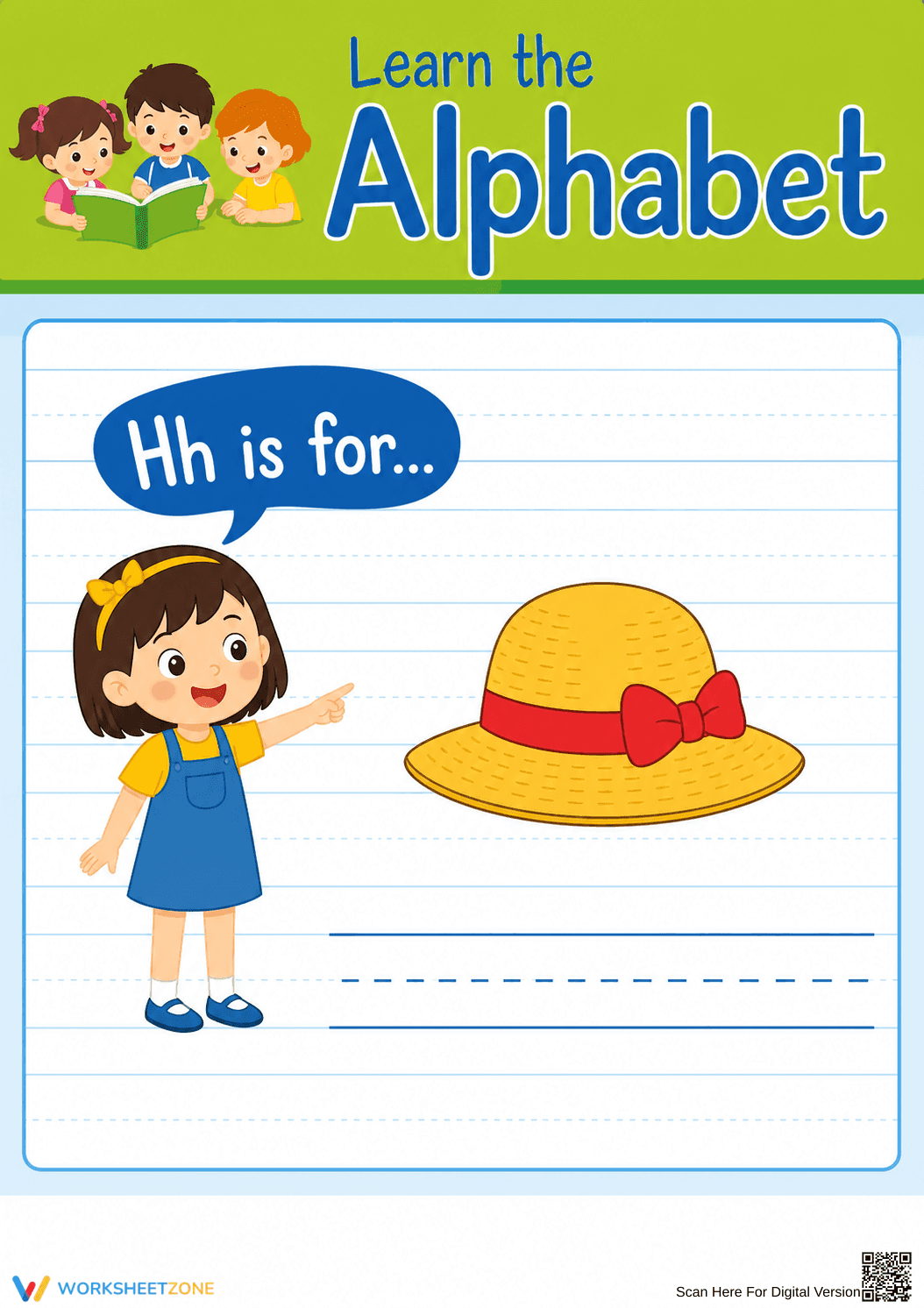
This Grade K-2 phonics worksheet helps early learners master the letter H beginning sound through visual identification and writing practice. Students connect the phoneme /h/ to the grapheme 'H' by identifying a familiar object. This targeted exercise builds the foundational phonological awareness necessary for early reading success and confident letter formation.
At a Glance
- Grade: K-2 · Subject: ELA Phonics
- Standard:
CCSS.ELA-LITERACY.RF.K.3.A— Demonstrate basic knowledge of one-to-one letter-sound correspondences by producing the primary sound- Skill Focus: Letter H Beginning Sound
- Format: 1 page · 1 primary task · Answer key included · PDF
- Best For: Initial phonics instruction and handwriting practice
- Time: 5–10 minutes
Inside this resource, you will find a clean, high-contrast layout featuring a large illustration of a hat to anchor the "H" sound. The page includes primary-ruled lines with a dotted midline to support proper letter height and formation. This single-page PDF is designed for clarity, ensuring young students stay focused on the specific phonetic relationship without visual clutter.
Skill Progression
- Guided Identification: Students engage with the prompt "Hh is for..." to establish the phonetic context.
- Supported Practice: Learners associate the visual image of the hat with the spoken /h/ sound, reinforcing the sound-symbol connection.
- Independent Practice: Students use the primary writing lines to practice forming the letter H or writing the word, transitioning from oral to written language.
This worksheet follows a gradual-release model, moving from teacher-led sound identification to independent grapheme production.
Standards Alignment
This resource is aligned with `CCSS.ELA-LITERACY.RF.K.3.A`, which requires students to demonstrate basic knowledge of one-to-one letter-sound correspondences. It also supports RF.K.1.D by reinforcing the recognition of uppercase and lowercase letters. Both standard codes can be copied directly into lesson plans, IEP goals, or district curriculum mapping tools.
How to Use It
Use this worksheet during the "You Do" phase of a direct instruction lesson on the letter H. It serves as an excellent formative assessment tool; observe if students can produce the /h/ sound before they begin writing. It is also ideal for morning work or as a quick exit ticket to verify sound-symbol recognition. Completion typically takes 5 to 10 minutes.
Who It's For
This worksheet is designed for Kindergarteners and first graders beginning their phonics journey, as well as second graders needing remedial support. It pairs naturally with a "Letter H" anchor chart or a read-aloud of a text featuring high-frequency H words. The primary lines make it accessible for students still developing fine motor control.
According to the RAND AIRS 2024 report on early literacy, explicit instruction in letter-sound correspondence is a critical predictor of later reading fluency. This worksheet targets the CCSS.ELA-LITERACY.RF.K.3.A standard by providing a concrete visual anchor—the hat—to reinforce the /h/ phoneme. Research by Fisher & Frey (2014) emphasizes that combining visual cues with writing practice accelerates the orthographic mapping process in young brains. By isolating the letter H, this resource allows for the high-repetition practice necessary for mastery. Educators can use this tool to bridge the gap between phonemic awareness and phonics, ensuring students can both hear and represent the sound accurately. This structured approach is consistent with evidence-based practices identified in the NAEP reading framework, which highlights the importance of early decoding skills in establishing a strong literacy foundation for all primary learners.


