


























Views
Downloads

Letter H Beginning Sound Worksheet | Essential Grade K-1
Paste this activity's link or code into your existing LMS (Google Classroom, Canvas, Teams, Schoology, Moodle, etc.).
Students can open and work on the activity right away, with no student login required.
You'll still be able to track student progress and results from your teacher account.
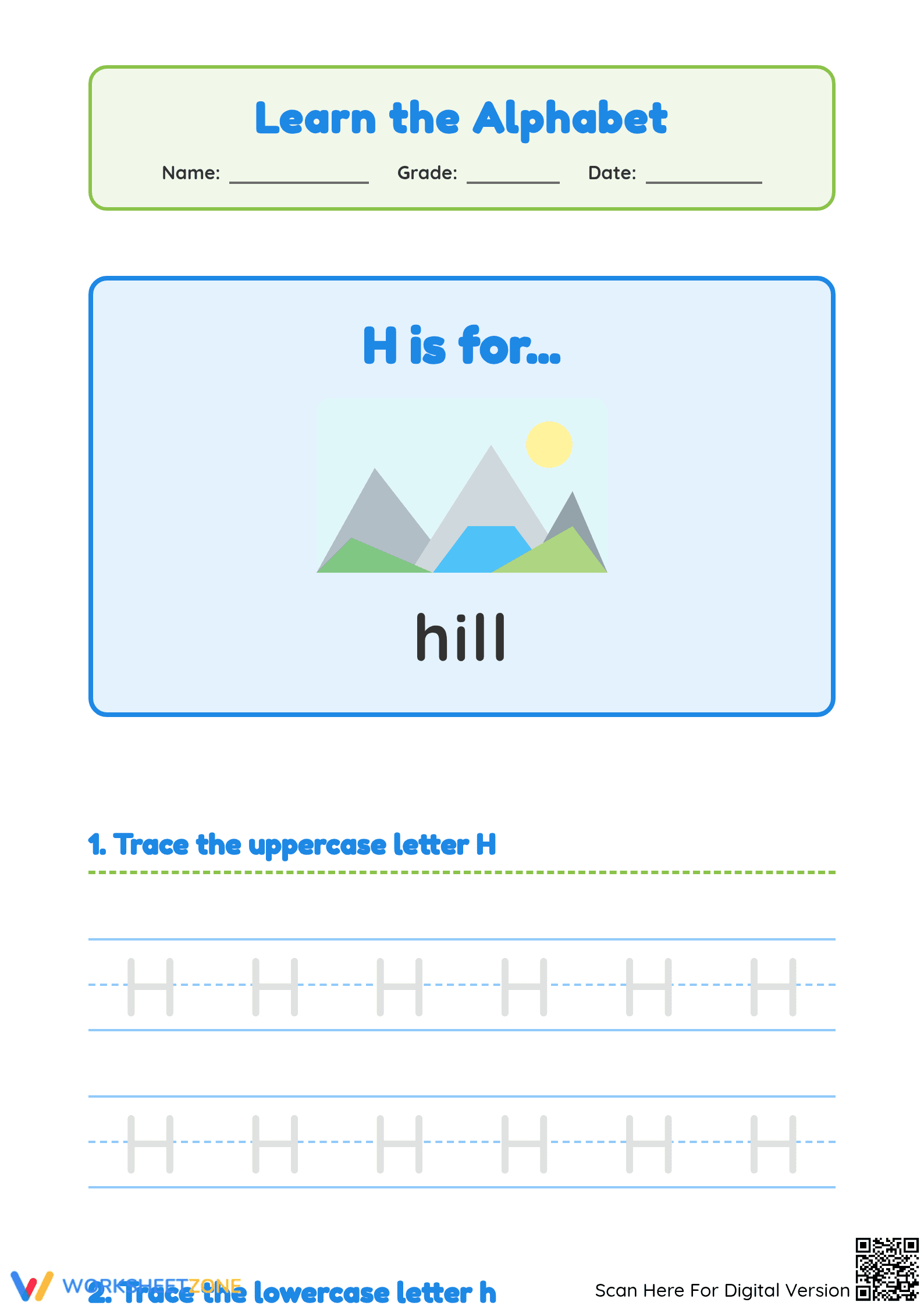
This Kindergarten and Grade 1 phonics worksheet provides targeted practice for the letter H. Students develop fine motor control and phonemic awareness by connecting the /h/ sound to the visual anchor of a hill while mastering letter formation. It ensures learners can distinguish between cases and apply their knowledge to whole-word writing.
At a Glance
- Grade: Kindergarten · Subject: ELA Phonics
- Standard:
CCSS.ELA-LITERACY.RF.K.1.D— Recognize and name all upper- and lowercase letters of the alphabet- Skill Focus: Letter H formation and beginning sounds
- Format: 2 pages · 30 problems · Answer key included · PDF
- Best For: Initial letter introduction and handwriting practice
- Time: 15–20 minutes
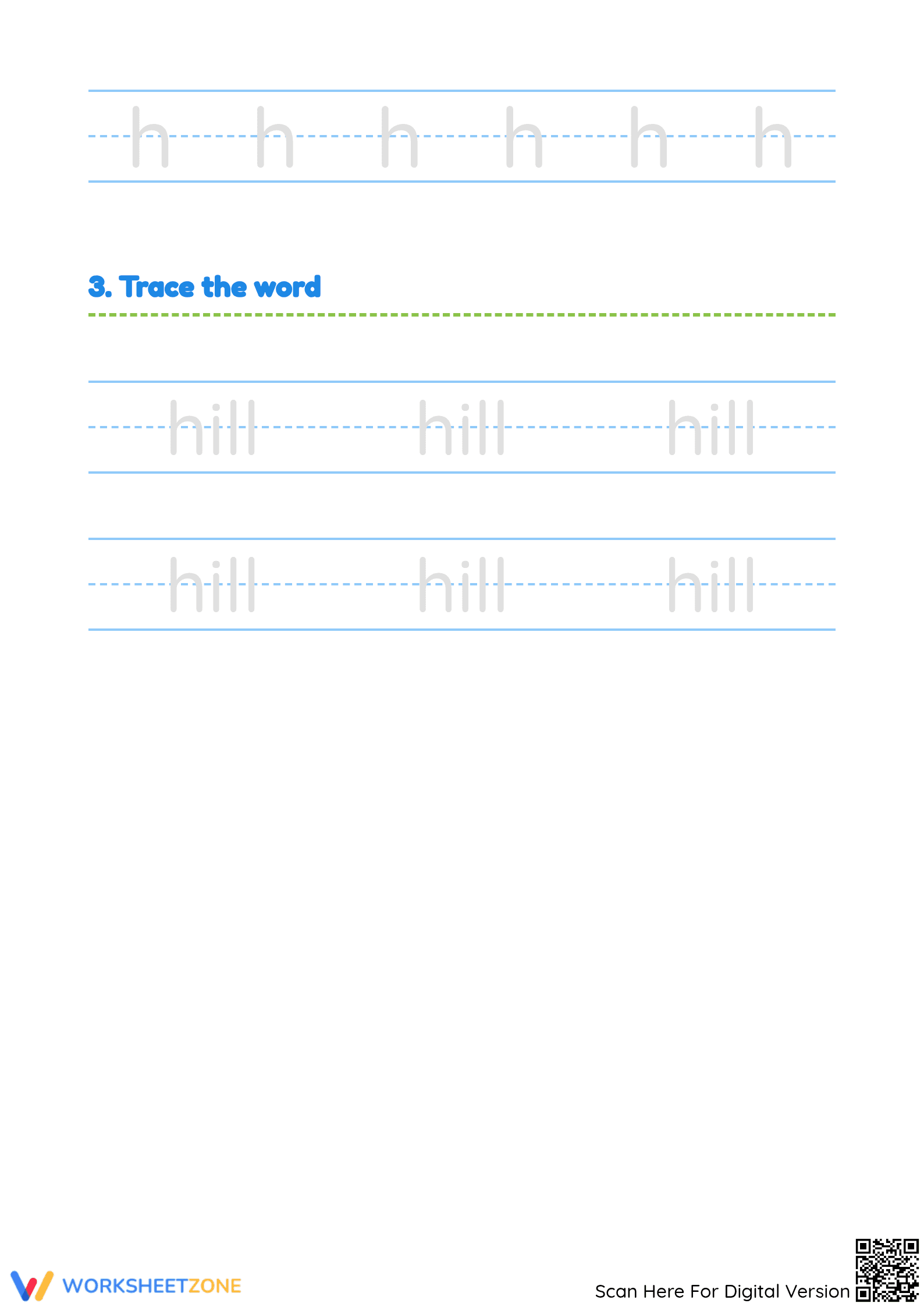
The two-page PDF includes a visual anchor featuring a hill to reinforce the beginning sound. It contains 12 uppercase tracing opportunities, 12 lowercase tracing opportunities, and 6 instances of the word "hill" for contextual application. The layout uses clear primary lines with dashed midlines to guide proper letter height and placement for early writers.
- Guided practice: 12 uppercase H repetitions with directional cues to establish muscle memory and proper stroke order.
- Supported practice: 12 lowercase h repetitions to help students differentiate between tall and short letter components on the primary grid.
- Independent practice: 6 word-level tracing tasks where students combine the letter H with other familiar sounds to form the word "hill."
This gradual-release model moves students from isolated character strokes to integrated word construction, following the I Do, We Do, You Do instructional framework.
This resource aligns with `CCSS.ELA-LITERACY.RF.K.1.D`, focusing on the identification and production of alphabet characters. It also supports `CCSS.ELA-LITERACY.L.K.1.A` regarding the printing of upper- and lowercase letters. Both standard codes can be copied directly into lesson plans, IEP goals, or district curriculum mapping tools.
Use this during the independent practice phase of a phonics lesson after introducing the /h/ sound with a picture card. It serves as an excellent formative assessment; teachers should observe if students start their strokes from the top line to ensure correct habits. Expected completion time is 15 to 20 minutes depending on fine motor maturity.
This is designed for Kindergarten students beginning their literacy journey and Grade 1 students requiring handwriting intervention. It pairs naturally with a "Letter of the Week" anchor chart or a short decodable reader featuring high-frequency "h" words like "hat" or "him."
According to the RAND AIRS 2024 report, explicit instruction in letter-sound correspondence and handwriting is a foundational predictor of later reading fluency. This worksheet addresses the specific need for repetitive, high-frequency tracing to solidify the orthographic mapping of the letter H. By utilizing the CCSS.ELA-LITERACY.RF.K.1.D standard, the resource ensures that students are meeting national benchmarks for alphabet recognition. Research from Fisher & Frey (2014) emphasizes that the gradual release of responsibility—moving from isolated letters to full words—helps young learners bridge the gap between phonemic awareness and functional literacy. This 2-page document provides the necessary 30 repetitions required to move a character from short-term recognition to long-term cognitive storage, making it a vital tool for early childhood educators seeking evidence-based phonics materials.


