


























Views
Downloads
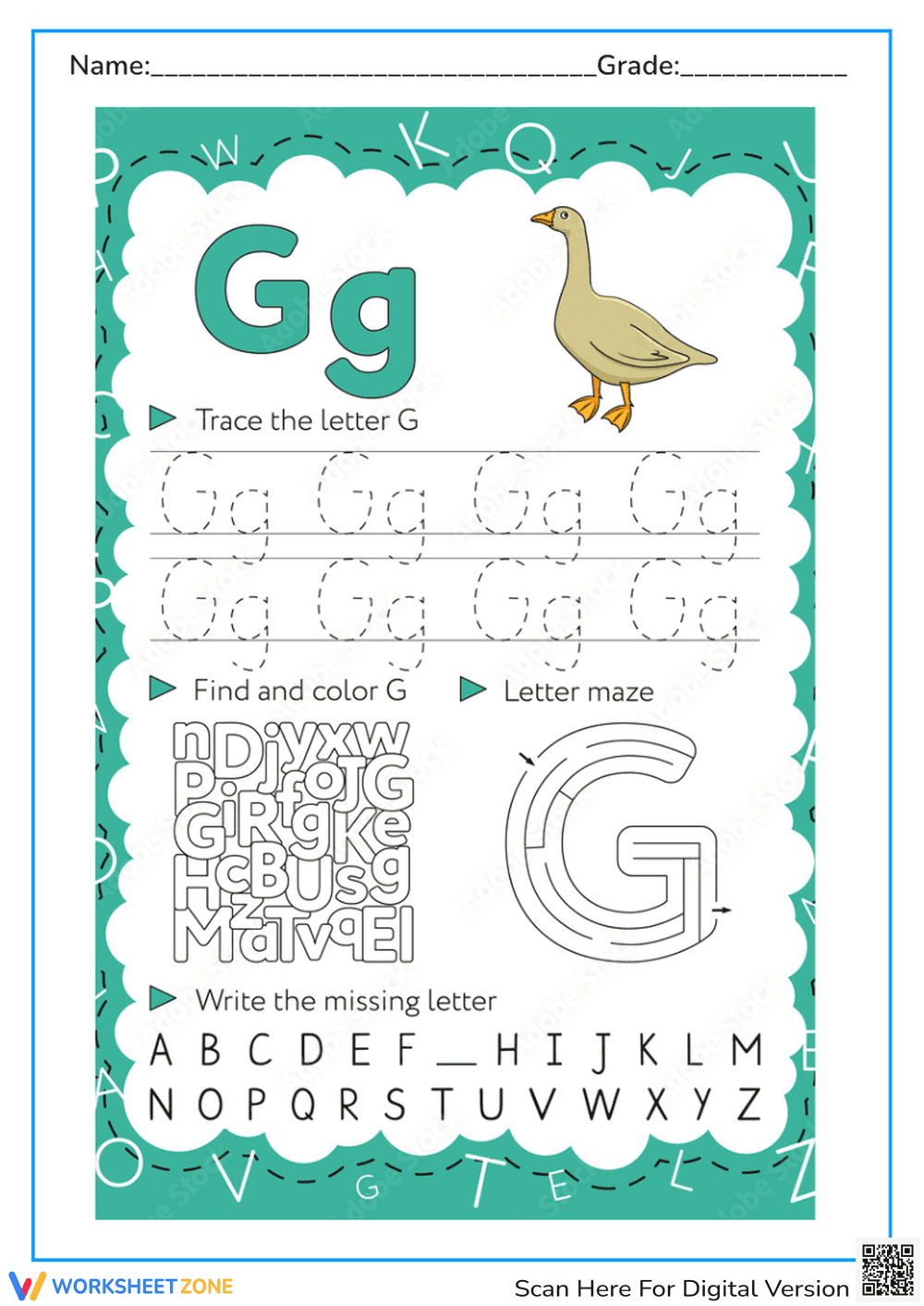

Letter G Tracing Worksheet | Essential Kindergarten Practice
Paste this activity's link or code into your existing LMS (Google Classroom, Canvas, Teams, Schoology, Moodle, etc.).
Students can open and work on the activity right away, with no student login required.
You'll still be able to track student progress and results from your teacher account.
This Letter G Tracing Worksheet provides a comprehensive approach to early literacy by combining handwriting practice with visual discrimination. Students engage with the letter G through four distinct activities designed to solidify their understanding of both uppercase and lowercase forms. By the end of the session, learners will demonstrate improved letter formation and recognition.
At a Glance
- Grade: Kindergarten · Subject: English
- Standard:
CCSS.ELA-LITERACY.RF.K.1.D— Recognize and name all upper- and lowercase letters of the alphabet- Skill Focus: Letter G formation and identification
- Format: 1 page · 4 tasks · Answer key included · PDF
- Best For: Independent morning work or literacy centers
- Time: 15–20 minutes
This single-page PDF features a structured layout. It includes a tracing section with 8 pairs of Gs, a letter search grid, a G-shaped maze, and a complete A-Z sequence where students fill in the missing letter G. The goose illustration provides a phonetic anchor for the hard /g/ sound.
The zero-prep design allows for an efficient classroom workflow. First, print the single-page PDF (30 seconds). Second, distribute the sheets to students during your literacy block or as a transition activity (1 minute). Finally, review the letter formation and the missing letter sequence as a whole group to provide immediate feedback (5 minutes). This makes it an ideal resource for busy mornings or sub plans.
This resource is directly aligned with CCSS.ELA-LITERACY.RF.K.1.D, which requires students to recognize and name all upper- and lowercase letters of the alphabet. By requiring students to identify "G" within a field of other letters and place it correctly within the alphabetical sequence, the worksheet reinforces foundational print concepts. Standard codes can be copied directly into lesson plans or curriculum mapping tools.
Use this worksheet as a formative assessment after introducing the letter G. It works best during small-group instruction where teachers can observe pencil grip during tracing. Alternatively, assign it as a quiet-time activity for early finishers. Completion typically takes between 15 and 20 minutes.
This resource is designed for preschool and kindergarten students who are beginning their journey into phonics and handwriting. It is also suitable for first-grade students requiring remedial support in letter recognition. Pair this worksheet with a physical alphabet chart or a read-aloud book featuring the letter G to create a multi-sensory learning experience.
Research from Fisher & Frey (2014) emphasizes the importance of multi-modal practice in early literacy, suggesting that combining tracing with visual discrimination tasks like mazes and letter searches accelerates the path to mastery. This worksheet addresses CCSS.ELA-LITERACY.RF.K.1.D by providing 4 distinct ways to interact with the letter G, ensuring that students move beyond rote memorization toward functional recognition. According to the NAEP, early proficiency in letter naming is one of the strongest predictors of later reading success. By integrating fine motor development with alphabetical order, this resource provides the structured repetition necessary for long-term retention. Educators can use the results of the "Find and Color" section as a quick diagnostic tool to identify students who may struggle with visual processing or letter reversals, allowing for timely intervention in the classroom setting.


