


























Views
Downloads
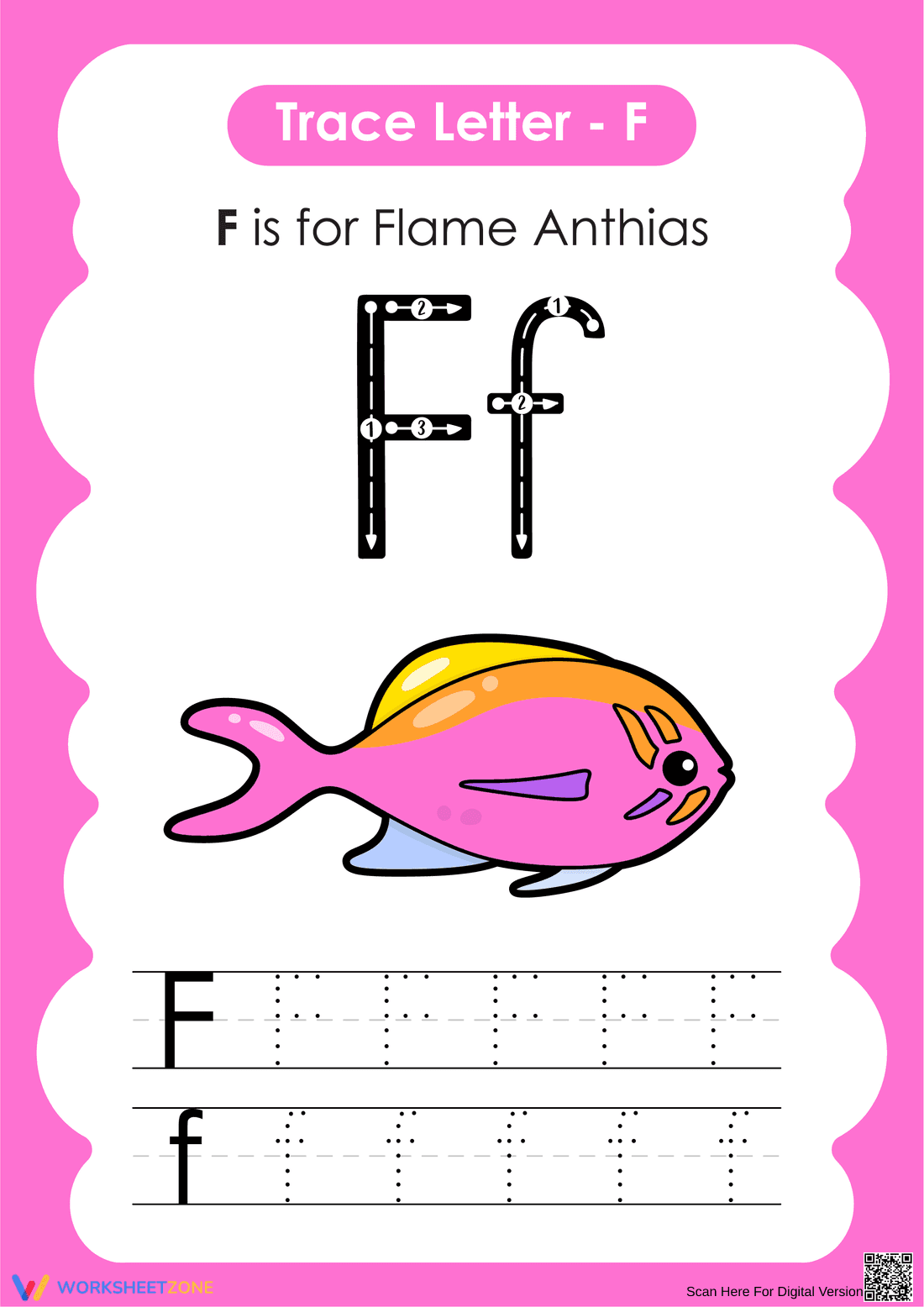

Letter F Tracing Worksheet | Essential Grade K-1
Paste this activity's link or code into your existing LMS (Google Classroom, Canvas, Teams, Schoology, Moodle, etc.).
Students can open and work on the activity right away, with no student login required.
You'll still be able to track student progress and results from your teacher account.
This Letter F tracing worksheet helps early learners master uppercase and lowercase letter formation through guided stroke practice. By combining visual cues with tactile tracing, students develop the fine motor control necessary for legible handwriting. This resource ensures students recognize the letter F while associating it with the Flame Anthias for phonemic awareness.
At a Glance
- Grade: Kindergarten · Subject: ELA
- Standard:
CCSS.ELA-LITERACY.RF.K.1.D— Recognize and name all upper- and lowercase letters of the alphabet- Skill Focus: Letter F formation
- Format: 1 page · 12 tasks · No key needed · PDF
- Best For: Morning work or literacy centers
- Time: 5–10 minutes
Inside this single-page PDF, you will find large-format stroke guides for both uppercase F and lowercase f. Each letter includes numbered arrows to demonstrate proper pencil movement. Below the instructional header, two dedicated rows provide 12 individual tracing opportunities, allowing students to transition from guided models to independent strokes.
The zero-prep workflow for this resource is designed for maximum efficiency. First, print the single-page PDF in under 30 seconds. Second, distribute the sheets to students during morning arrival or center rotations. Finally, review the stroke order by modeling the numbered arrows on a whiteboard. This makes it an ideal emergency sub plan for early childhood classrooms.
This resource aligns with `CCSS.ELA-LITERACY.RF.K.1.D`, focusing on the recognition and naming of uppercase and lowercase letters. It also supports `CCSS.ELA-LITERACY.L.K.1.A` by encouraging students to print many upper- and lowercase letters. Both standard codes can be copied directly into lesson plans, IEP goals, or district curriculum mapping tools.
Use this worksheet during the instructional phase of a handwriting lesson to demonstrate the three-stroke process for uppercase F. It also serves as an effective formative assessment tool; observe students as they trace to identify those struggling with top-to-bottom stroke direction. Expected completion typically takes 5 to 10 minutes for most learners.
This worksheet is designed for preschool, kindergarten, and first-grade students who are beginning their literacy journey. It is particularly helpful for students requiring fine motor intervention or occupational therapy support. Pair this resource with a letter-sound anchor chart or a phonics reader featuring the letter F to reinforce the connection between symbol and sound.
According to the RAND AIRS 2024 report, consistent tactile engagement with letter forms is a critical precursor to reading fluency. This worksheet addresses the foundational requirements of CCSS.ELA-LITERACY.RF.K.1.D by providing structured, repetitive practice for the letter F. Research from Fisher & Frey (2014) emphasizes that the gradual release of responsibility—moving from numbered stroke guides to independent tracing—is essential for motor memory retention in early childhood education. By focusing on both uppercase and lowercase variants, this resource ensures that students develop a comprehensive understanding of alphabetical symbols. Educators can utilize these 12 tracing tasks to bridge the gap between letter recognition and active production. This evidence-based approach supports long-term literacy outcomes by establishing strong orthographic mapping skills during the formative years of primary schooling, making it a vital component of any kindergarten ELA curriculum.


