




























Views
Downloads
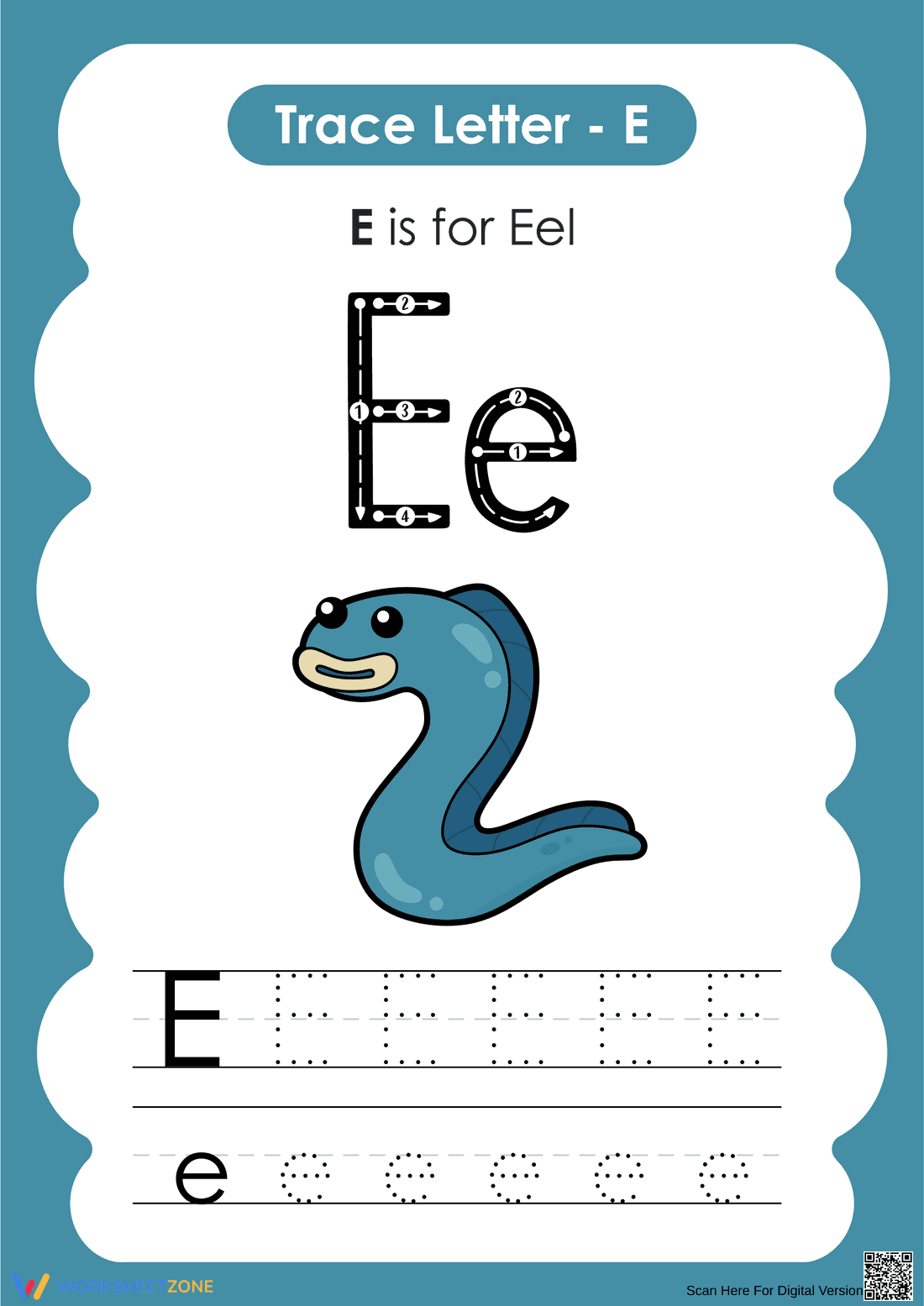

Letter E Tracing Worksheet | Essential Grade K-1 Ready

Paste this activity's link or code into your existing LMS (Google Classroom, Canvas, Teams, Schoology, Moodle, etc.).
Students can open and work on the activity right away, with no student login required.
You'll still be able to track student progress and results from your teacher account.
This Letter E tracing worksheet provides early learners with a structured way to master uppercase and lowercase letter formation. By combining visual cues with tactile practice, students develop the muscle memory required for fluent writing. The inclusion of the "E is for Eel" mnemonic reinforces initial sound recognition alongside handwriting skills.
At a Glance
- Grade: Kindergarten · Subject: ELA
- Standard:
CCSS.ELA-LITERACY.RF.K.1.D— Recognize and name all upper- and lowercase letters of the alphabet- Skill Focus: Letter E formation
- Format: 1 page · 12 tasks · No answer key needed · PDF
- Best For: Daily morning work or literacy centers
- Time: 10–15 minutes
The worksheet features large-format letters with numbered stroke guides to ensure correct pencil movement. Below the primary illustration, students find two dedicated rows for independent tracing practice. The clean layout minimizes distractions, making it ideal for students still developing fine motor control and spatial awareness on the page.
This resource is designed for a zero-prep classroom workflow. Teachers can print the single-page PDF in less than 30 seconds. Distribution takes approximately 1 minute during transition periods. Reviewing student work is instantaneous, as the tracing paths provide immediate visual evidence of letter formation accuracy. It serves as an excellent emergency sub plan component.
Aligned to `CCSS.ELA-LITERACY.RF.K.1.D`, this activity focuses on the identification and production of the letter E. It also supports `CCSS.ELA-LITERACY.L.K.1.A` regarding printing many upper- and lowercase letters. Both standard codes can be copied directly into lesson plans, IEP goals, or district curriculum mapping tools.
Use this worksheet during the "You Do" phase of a gradual release lesson on the letter E. It is particularly effective as a formative assessment tool; observe students as they follow the numbered arrows to identify those struggling with top-to-bottom or left-to-right progression. Expected completion time is 10 to 15 minutes.
This resource is for preschool, kindergarten, and first-grade students. It is especially helpful for English Language Learners (ELL) who benefit from the visual pairing of the letter with the "Eel" vocabulary word. Pair this with a tactile sand tray activity or an alphabet anchor chart for a multi-sensory learning experience.
According to Fisher & Frey (2014), the use of guided practice with explicit cues—such as the numbered stroke arrows found in this worksheet—is critical for the development of foundational literacy skills. Research indicates that early mastery of letter formation is a strong predictor of later writing fluency and reading achievement. By providing 12 distinct tracing opportunities, this worksheet ensures that students move from guided imitation to independent production. The integration of phonemic awareness through the "E is for Eel" prompt aligns with NAEP recommendations for balanced early literacy instruction. This structured approach reduces cognitive load, allowing young writers to focus on the mechanics of grip and pressure. Educators can utilize this data-driven design to support Tier 1 instruction or as a targeted intervention for students requiring additional fine motor support in the primary grades.


