


























Views
Downloads

Printable Letter E Coloring Worksheet | Grade 1 ELA
Paste this activity's link or code into your existing LMS (Google Classroom, Canvas, Teams, Schoology, Moodle, etc.).
Students can open and work on the activity right away, with no student login required.
You'll still be able to track student progress and results from your teacher account.
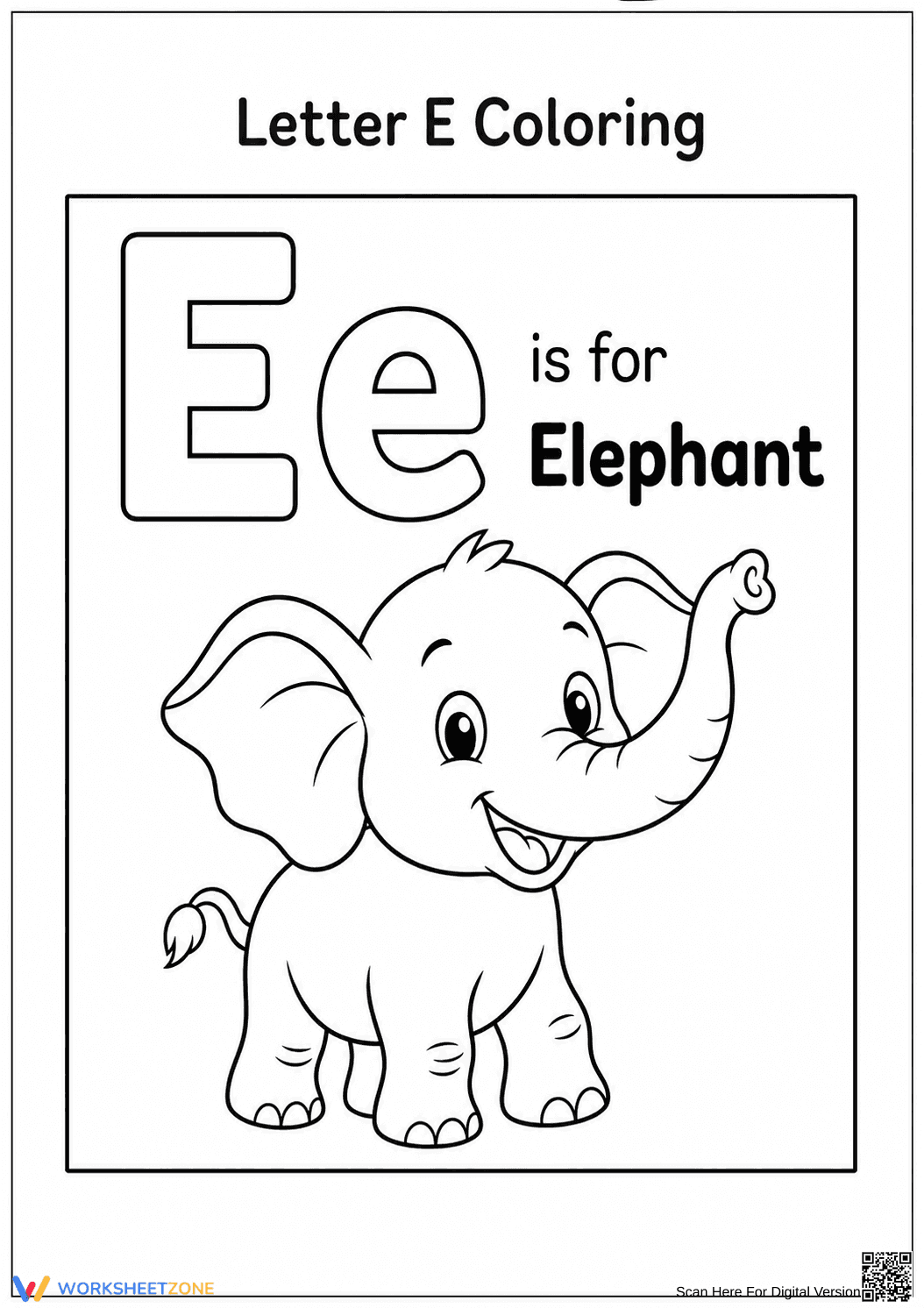
This printable Grade 1 phonics worksheet helps students master letter recognition and beginning sounds through an engaging coloring activity. Focusing on the uppercase and lowercase letter E alongside a familiar animal helps young learners reinforce visual memory and phonetic associations in a stress-free format.
At a Glance
- Grade: 1 · Subject: ELA
- Standard:
CCSS.ELA-LITERACY.RF.1.3— Apply phonics and word analysis skills- Skill Focus: Letter E Recognition and Beginning Sounds
- Format: 1 page · 1 problem · No answer key · PDF
- Best For: Independent practice and morning work
- Time: 10–15 minutes
This single-page resource features a large, clear outline of both the uppercase and lowercase letter E, paired with the text "is for Elephant" and a high-quality illustration of a smiling elephant. Bold outlines help early elementary students color within the lines, promoting fine motor skill development. The visual pairing of the letter with a corresponding animal provides a strong mnemonic device for beginning sound retention.
Zero-Prep Workflow
This resource requires zero teacher preparation.
- Print (1 minute): Simply download the PDF and print the required number of copies.
- Distribute (1 minute): Hand out the coloring pages along with crayons, markers, or colored pencils.
- Review (0 minutes): No formal grading is required, allowing you to observe student engagement.
With a total prep time of under two minutes, this worksheet is an excellent addition to any emergency sub plan or last-minute morning work folder.
Standards Alignment
This activity aligns with CCSS.ELA-LITERACY.RF.1.3, requiring students to know and apply grade-level phonics and word analysis skills in decoding words. By associating the visual representation of the letter E with the initial sound in "Elephant," students build foundational phonetic awareness. Both standard codes can be copied directly into lesson plans, IEP goals, or district curriculum mapping tools.
How to Use It
Use this coloring page as a transition activity during morning literacy. Teachers can use it before direct instruction on short vowel sounds to activate prior knowledge, or as a calming, independent task after a high-energy phonics game. While students color, teachers can conduct quick formative assessments by walking around the room and asking individual students to identify the letter and produce its corresponding sound. Expect completion within 10 to 15 minutes.
Who It's For
This worksheet is primarily designed for Grade 1 students who are solidifying their alphabet knowledge and beginning sound recognition. It benefits visual learners needing fine motor practice. For differentiation, teachers can challenge advanced students to write other words starting with the letter E on the back of the page. This resource pairs perfectly with a read-aloud book featuring elephants or a broader unit on zoo animals.
Integrating visual arts with foundational literacy instruction significantly enhances phonetic retention and letter recognition in early elementary classrooms. According to a comprehensive review by Fisher & Frey (2014), multimodal learning experiences that combine visual stimuli, such as coloring, with explicit phonics instruction lead to stronger memory encoding for young readers. This worksheet targets CCSS.ELA-LITERACY.RF.1.3 by helping students apply phonics and word analysis skills through the specific identification of the letter E and its initial sound. By engaging multiple senses and reinforcing fine motor control simultaneously, educators can create a more holistic and effective learning environment. Activities that link letters to familiar, concrete nouns—like an elephant—provide essential cognitive anchors that support long-term decoding proficiency, reading fluency, and overall academic confidence in early literacy development. This evidence-based approach ensures that foundational skills are mastered effectively.


