


























Views
Downloads

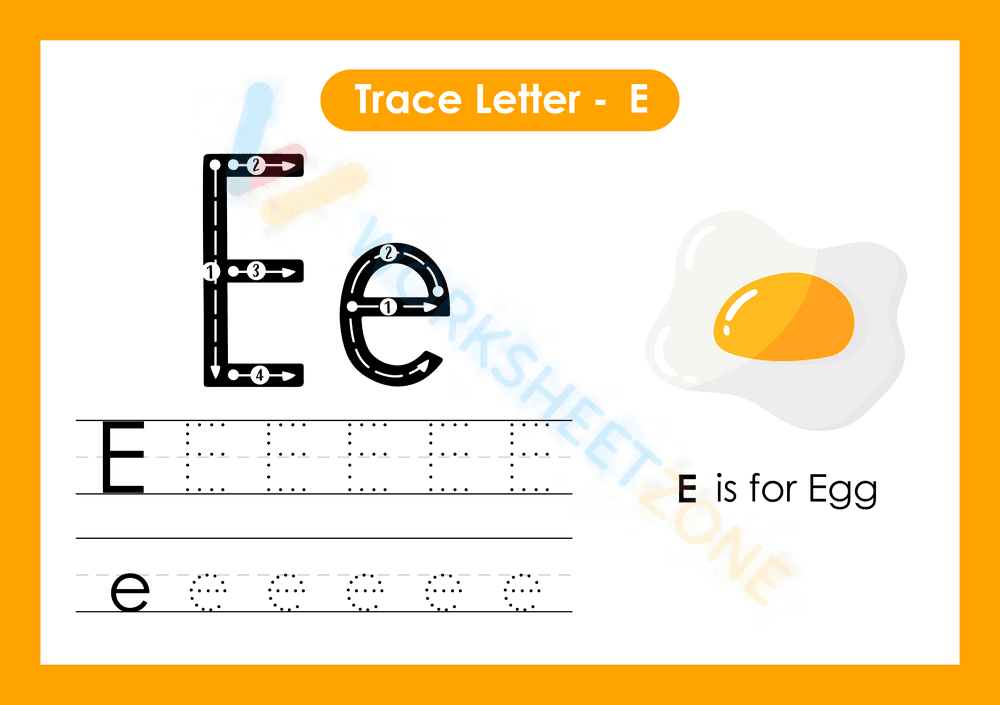

Printable Letter E Tracing Worksheet for Kindergarten
Paste this activity's link or code into your existing LMS (Google Classroom, Canvas, Teams, Schoology, Moodle, etc.).
Students can open and work on the activity right away, with no student login required.
You'll still be able to track student progress and results from your teacher account.
This printable letter E tracing worksheet helps early learners master uppercase and lowercase letter formation while connecting the letter to its beginning sound. Students trace dotted lines following numbered directional arrows to build fine motor control and handwriting confidence. Use this resource to reinforce phonics foundation skills.
At a Glance
- Grade: Kindergarten · Subject: English Language Arts
- Standard:
CCSS.ELA-LITERACY.RF.K.1.D— Recognize and name all upper- and lowercase letters of the alphabet- Skill Focus: Letter E formation and beginning sounds
- Format: 1 page · 12 tasks · No answer key required · PDF
- Best For: Morning work or independent writing centers
- Time: 10–15 minutes
This single-page PDF features large, numbered stroke-order guides for both capital 'E' and lowercase 'e' to support initial instruction. Below the visual guides, students practice writing on two structured primary handwriting lines, containing five tracing opportunities for each letter case. A clear illustration of an espresso cup pairs the letter with its beginning sound, providing a concrete vocabulary association.
This resource requires minimal teacher preparation. First, print the single-page PDF document, which takes less than one minute. Second, distribute the sheets to students along with pencils or crayons. Third, review student stroke order during the first few minutes of independent work. The total teacher preparation time is under two minutes, making this worksheet an excellent option for emergency substitute plans or quick morning warm-ups.
This worksheet aligns directly with the Common Core State Standard CCSS.ELA-LITERACY.RF.K.1.D, which requires students to recognize and name all upper- and lowercase letters of the alphabet. Additionally, the inclusion of the beginning sound anchor supports phonemic awareness development. Both standard codes can be copied directly into lesson plans, IEP goals, or district curriculum mapping tools.
Introduce this worksheet during direct instruction as a guided practice activity after demonstrating letter formation on the board. Alternatively, assign it as a formative assessment during independent center rotations to observe pencil grip and stroke direction. Teachers can monitor if students follow the numbered arrows or write from bottom to top. The activity takes approximately ten to fifteen minutes to complete.
This worksheet targets kindergarten students learning basic letter formation, but it also serves preschool students needing early intervention or first-grade students requiring handwriting remediation. Differentiate the task by providing chunky pencils for students struggling with fine motor skills. Pair this worksheet with a read-aloud book focusing on the letter E or a physical letter-matching game.
Early childhood handwriting instruction benefits from structured, guided practice that combines visual cues with motor execution. This worksheet aligns with CCSS.ELA-LITERACY.RF.K.1.D by providing explicit stroke-order arrows that scaffold the learning process for young writers. According to research by Fisher & Frey (2014) on the gradual release of responsibility, structured visual supports like dotted lines and numbered paths allow students to transition smoothly from guided practice to independent mastery. By connecting the motor task of tracing with the phonological anchor of the beginning sound in "espresso," this resource reinforces the letter-sound correspondence necessary for early literacy development. Teachers can confidently integrate this tool into daily phonics routines to track student progress in letter recognition and fine motor control, ensuring alignment with national standards and evidence-based instructional practices.


