


























Views
Downloads

Essential Letter E Beginning Sound Worksheet | Grade K
Paste this activity's link or code into your existing LMS (Google Classroom, Canvas, Teams, Schoology, Moodle, etc.).
Students can open and work on the activity right away, with no student login required.
You'll still be able to track student progress and results from your teacher account.
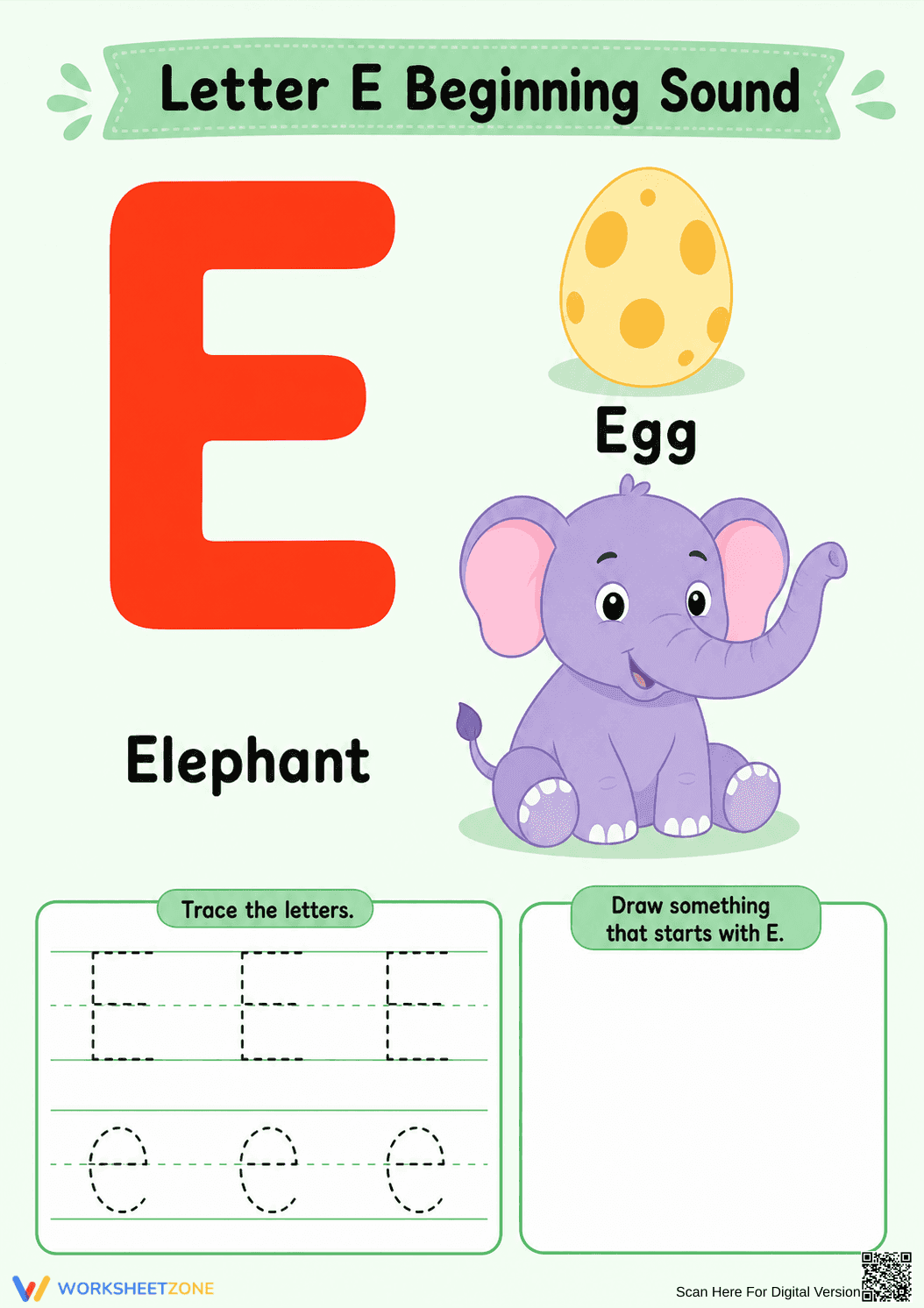
This Letter E beginning sound worksheet helps early learners master phonemic awareness and letter formation through engaging visual cues and tactile practice. Students identify words starting with the short 'e' sound, trace uppercase and lowercase letters, and demonstrate comprehension through creative drawing. It provides a solid foundation for early reading success and alphabet mastery.
At a Glance
- Grade: Kindergarten · Subject: ELA Phonics
- Standard:
CCSS.ELA-LITERACY.RF.K.3.A— Demonstrate basic knowledge of one-to-one letter-sound correspondences by producing the primary sound.- Skill Focus: Letter E recognition and phonics
- Format: 1 page · 2 tasks · Answer key included · PDF
- Best For: Morning work or phonics centers
- Time: 10–15 minutes
This single-page PDF features high-quality illustrations of an egg and an elephant to anchor the short 'e' sound. The layout includes a dedicated tracing section for both uppercase 'E' and lowercase 'e' on primary-ruled lines to support proper handwriting mechanics. Additionally, a creative drawing prompt encourages students to apply their knowledge by visualizing and sketching an original object that begins with the target sound.
- Guided Practice: Students begin by observing large-scale visual anchors (egg and elephant) while the teacher models the short 'e' phoneme.
- Supported Practice: Six tracing prompts (3 uppercase, 3 lowercase) provide directional cues for fine motor development and letter shape internalisation.
- Independent Practice: The final drawing task requires students to independently retrieve a word from their vocabulary that starts with 'E' and represent it visually.
This sequence follows the gradual-release model to ensure students move from recognition to independent production.
The primary standard addressed is `CCSS.ELA-LITERACY.RF.K.3.A`, which requires students to demonstrate basic knowledge of one-to-one letter-sound correspondences. This worksheet also supports `CCSS.ELA-LITERACY.L.K.1.A` regarding the printing of many upper- and lowercase letters. Both standard codes can be copied directly into lesson plans, IEP goals, or district curriculum mapping tools.
Use this worksheet during the "You Do" phase of a phonics lesson after introducing the letter E using an anchor chart. It is ideal for formative assessment; observe students as they trace to check for correct stroke order and pencil grip. The completed drawing provides a quick check for phonemic awareness. Expect students to finish in approximately 12 minutes.
This resource is designed for Kindergarten students, though it serves as an excellent intervention tool for Grade 1 students needing phonics reinforcement. It pairs naturally with a "Letter of the Week" curriculum or a short-vowel reading passage. The simple instructions make it accessible for English Language Learners (ELLs) building basic vocabulary.
Phonemic awareness is a critical predictor of later reading achievement, as highlighted in the NAEP framework and research by Fisher & Frey (2014). This worksheet targets the specific skill of letter-sound correspondence for the Letter E, aligned with `CCSS.ELA-LITERACY.RF.K.3.A`. By combining visual anchors like "egg" and "elephant" with tactile tracing and creative drawing, the resource engages multiple learning modalities. Research indicates that multisensory approaches to alphabet instruction help solidify the connection between graphemes and phonemes in early childhood education. This structured practice ensures that students develop the foundational decoding skills necessary for fluency. Educators can utilize this tool to provide the 10 to 15 minutes of daily focused phonics practice recommended for early literacy development. The inclusion of both uppercase and lowercase forms supports comprehensive letter recognition, which is essential for transitioning from isolated sounds to reading full words in context.


