


























Views
Downloads
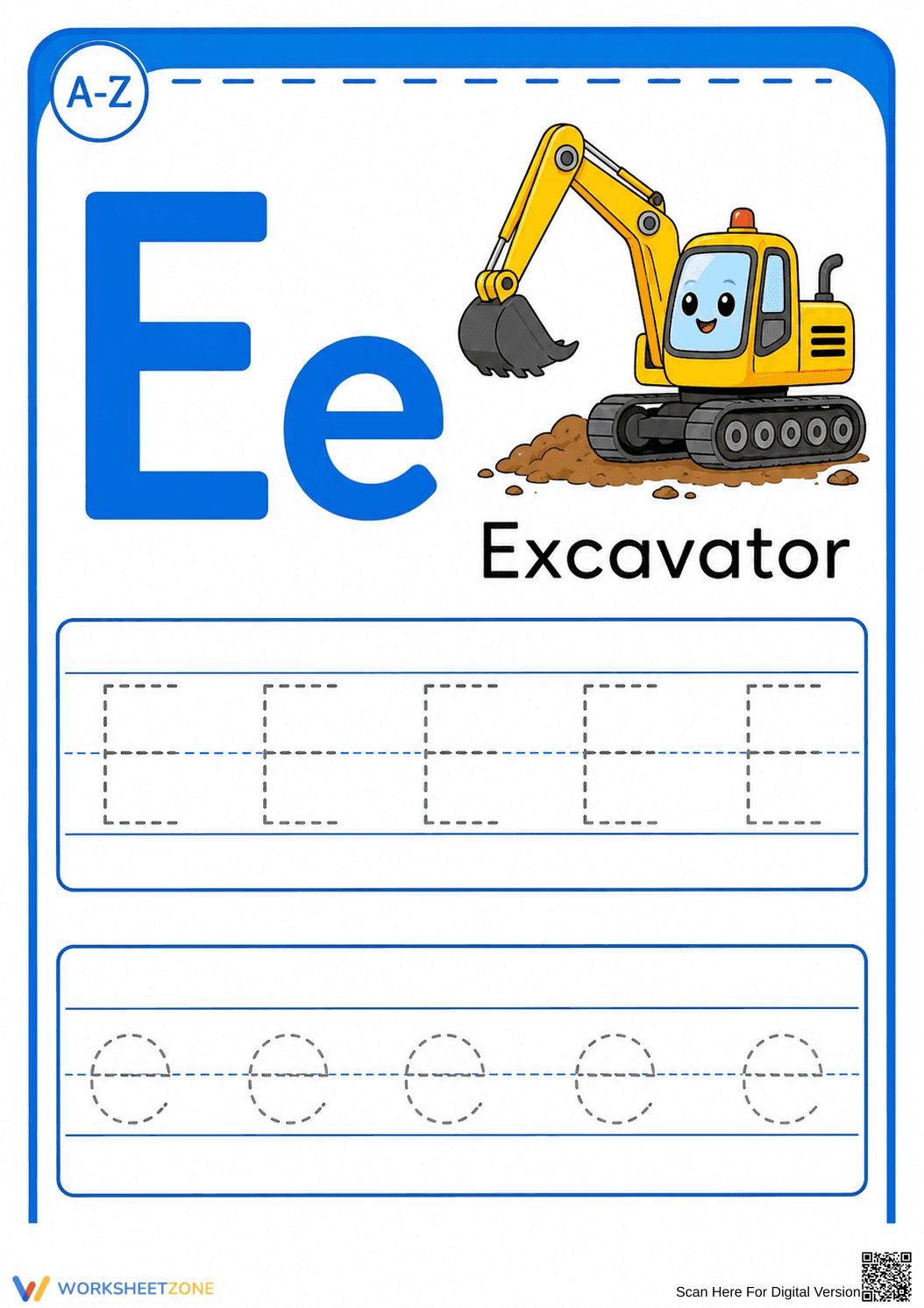

Letter E Tracing Printable | Grade K Phonics
Paste this activity's link or code into your existing LMS (Google Classroom, Canvas, Teams, Schoology, Moodle, etc.).
Students can open and work on the activity right away, with no student login required.
You'll still be able to track student progress and results from your teacher account.
This printable kindergarten phonics worksheet helps early learners master the letter E through targeted handwriting practice and beginning sound recognition. Students trace uppercase and lowercase letters while associating the short vowel sound with a familiar vocabulary word, building essential foundational literacy skills for reading readiness.
At a Glance
- Grade: K · Subject: ELA
- Standard:
CCSS.ELA-LITERACY.L.K.1.A— Print many upper- and lowercase letters- Skill Focus: Letter E Tracing and Beginning Sounds
- Format: 1 printable page · 10 tracing problems · Answer key not required · PDF
- Best For: Independent morning work and literacy centers
- Time: 10–15 minutes
Inside this single-page resource, educators will find a straightforward layout designed specifically for young learners. The top section features a large, clear illustration of an excavator alongside bold uppercase and lowercase E models to reinforce visual recognition and the short vowel sound. Below, the worksheet provides five guided tracing opportunities for the uppercase letter E and five for the lowercase letter e, utilizing standard dashed lines to support proper letter formation and fine motor development.
This resource offers a highly efficient zero-prep workflow.
- Print (1 minute): Simply download the PDF and print the required number of copies. The black-and-white friendly design ensures crisp reproduction.
- Distribute (1 minute): Hand out the sheets during morning arrival or literacy centers. The intuitive layout requires minimal verbal instruction.
- Review (1 minute): Quickly scan student work to verify proper stroke order and line adherence.
Total teacher preparation time is under two minutes, making this an excellent option for emergency sub plans or spontaneous skill reinforcement.
This worksheet is directly aligned to primary literacy goals, specifically targeting CCSS.ELA-LITERACY.L.K.1.A: Print many upper- and lowercase letters. It also supports foundational phonics skills by reinforcing letter-sound correspondence for the short E vowel. Both standard codes can be copied directly into lesson plans, IEP goals, or district curriculum mapping tools.
Teachers can utilize this tracing sheet in multiple instructional contexts. It serves as an excellent independent activity during morning work, allowing students to settle in while practicing fine motor skills. Alternatively, it functions well within a small-group literacy center following direct instruction on the letter E. While students trace, teachers can conduct quick formative assessments by observing pencil grip and stroke direction, correcting any improper habits early. Expected completion time is ten to fifteen minutes.
This resource is primarily designed for kindergarten students developing basic handwriting and phonics skills. It is also highly appropriate for pre-K students demonstrating early readiness, or first-grade students requiring targeted intervention for letter formation. To differentiate, teachers can provide textured surfaces underneath the paper for tactile feedback or pair the worksheet with a physical alphabet anchor chart. It pairs perfectly with a whole-class read-aloud focusing on short E vocabulary words.
Mastering foundational handwriting and phonics skills is a critical step in early childhood literacy development. According to a comprehensive review by Fisher & Frey (2014), explicit instruction in letter formation combined with phonemic awareness activities significantly improves subsequent reading fluency and spelling accuracy. This worksheet directly supports these findings by integrating visual vocabulary with physical tracing tasks. By addressing CCSS.ELA-LITERACY.L.K.1.A, students actively print many upper- and lowercase letters, reinforcing the motor memory required for automaticity. The inclusion of the excavator illustration further anchors the abstract letter symbol to a concrete beginning sound, reducing cognitive load during early reading attempts. Consistent practice with structured materials like this ensures that young learners develop the necessary fine motor control and phonetic recognition to succeed in subsequent grade levels.


