




























Views
Downloads
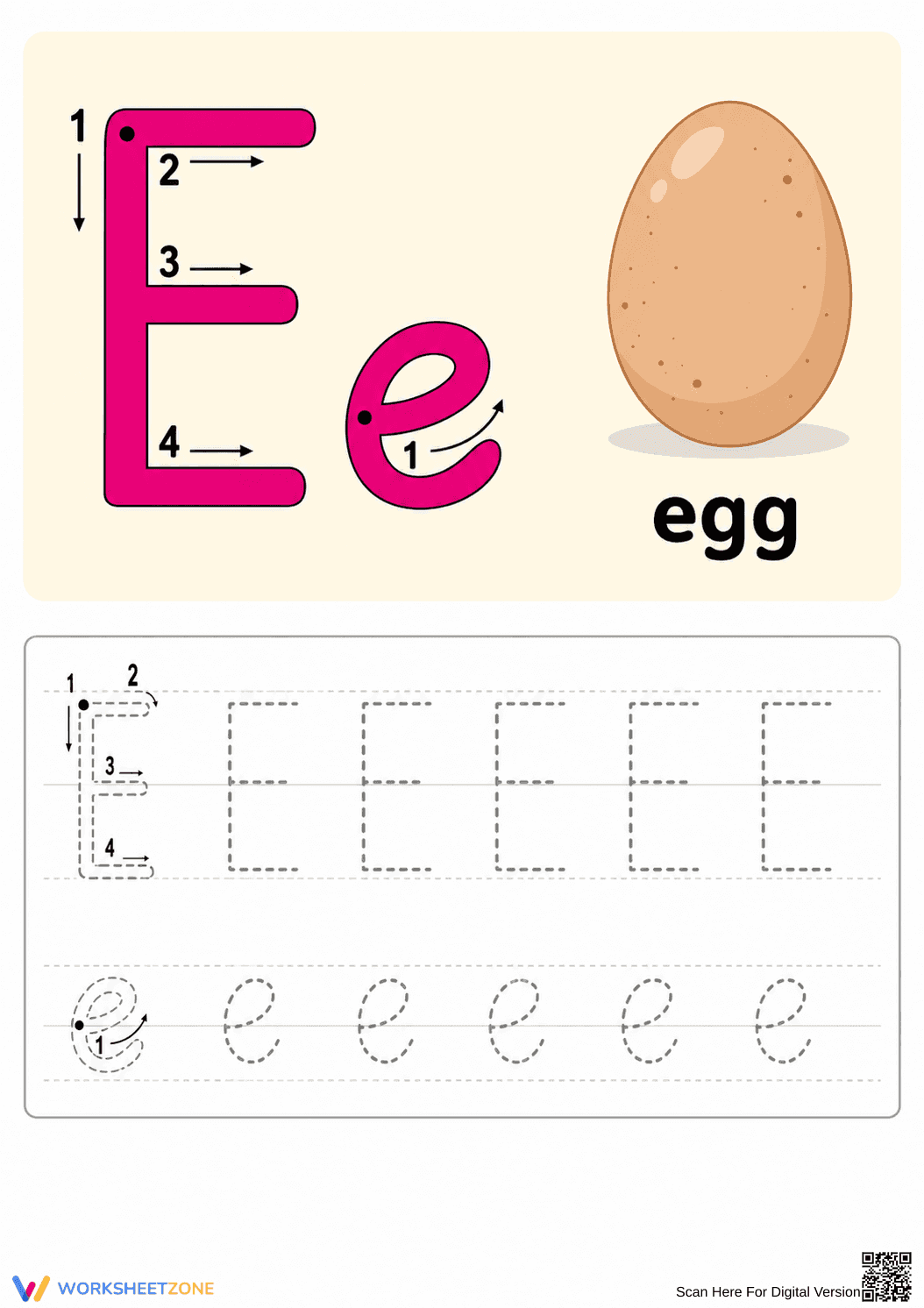

Printable Letter E Beginning Sound & Tracing Worksheet

Paste this activity's link or code into your existing LMS (Google Classroom, Canvas, Teams, Schoology, Moodle, etc.).
Students can open and work on the activity right away, with no student login required.
You'll still be able to track student progress and results from your teacher account.
This Letter E worksheet provides foundational phonics practice by combining visual recognition with tactile tracing. Students identify the beginning sound of "egg" while mastering the specific stroke order for both uppercase and lowercase forms. It is designed to build muscle memory and letter-sound correspondence in early learners through a clear, distraction-free layout.
At a Glance
- Grade: Kindergarten · Subject: ELA Phonics
- Standard:
CCSS.ELA-LITERACY.L.K.1.A— Print upper- and lowercase letters with correct stroke order and form- Skill Focus: Letter E formation and phonemic awareness
- Format: 1 page · 12 tracing tasks · Visual guide included · PDF
- Best For: Morning work or independent literacy centers
- Time: 10–15 minutes
The worksheet features a large-format visual guide at the top, displaying the letter E alongside a high-frequency "egg" illustration. Numbered arrows provide a step-by-step roadmap for proper letter construction. Below the guide, two dedicated rows of primary-ruled lines offer 6 uppercase and 6 lowercase tracing opportunities. The high-contrast design ensures that students can easily follow the dashed lines without visual clutter.
Zero-Prep Workflow
- Print: Select the single-page PDF and print enough copies for your class in under 30 seconds.
- Distribute: Hand out the sheets during your phonics block; the intuitive layout requires less than 1 minute of teacher explanation.
- Review: Walk the room to check for correct pencil grip and stroke direction, providing immediate feedback as students complete the 12 tasks. This zero-prep resource is ideal for emergency sub plans or transition periods.
Standards Alignment
The primary focus is `CCSS.ELA-LITERACY.L.K.1.A`, which requires students to print many upper- and lowercase letters. By following the numbered stroke guides, students develop the fine motor control necessary for legible handwriting. Additionally, it supports `CCSS.ELA-LITERACY.RF.K.1.D` by reinforcing letter recognition. Both standard codes can be copied directly into lesson plans, IEP goals, or district curriculum mapping tools.
How to Use It
Use this worksheet during the "You Do" phase of a gradual release model. After demonstrating the letter E on the whiteboard, assign this page for independent practice. It also serves as an effective formative assessment tool; observe if students start their strokes from the top (as indicated) or the bottom. Expected completion time ranges from 10 to 15 minutes depending on fine motor development.
Who It's For
This resource is tailored for Kindergarten students beginning their phonics journey, but it also supports Grade 1 students needing remedial handwriting practice. It pairs naturally with an alphabet anchor chart or a short reading passage featuring "E" words. The clear visual cues make it accessible for English Language Learners (ELLs) who are learning the Roman alphabet for the first time.
Research by Fisher & Frey (2014) emphasizes the importance of the gradual release of responsibility, particularly in foundational literacy skills like letter formation. This worksheet facilitates that transition by providing a clear visual model followed by scaffolded tracing tasks. According to the RAND AIRS 2024 report, high-quality instructional materials that integrate phonemic awareness with orthographic practice—such as linking the "e" sound in "egg" to the physical act of writing the letter—significantly improve long-term retention in early childhood education. By focusing on the specific standard CCSS.ELA-LITERACY.L.K.1.A, this tool ensures that students are not just copying shapes but are building the specific motor pathways required for academic writing. The inclusion of numbered stroke guides addresses common developmental hurdles in fine motor control, allowing for a more structured approach to handwriting than free-form practice alone.


