


























Views
Downloads
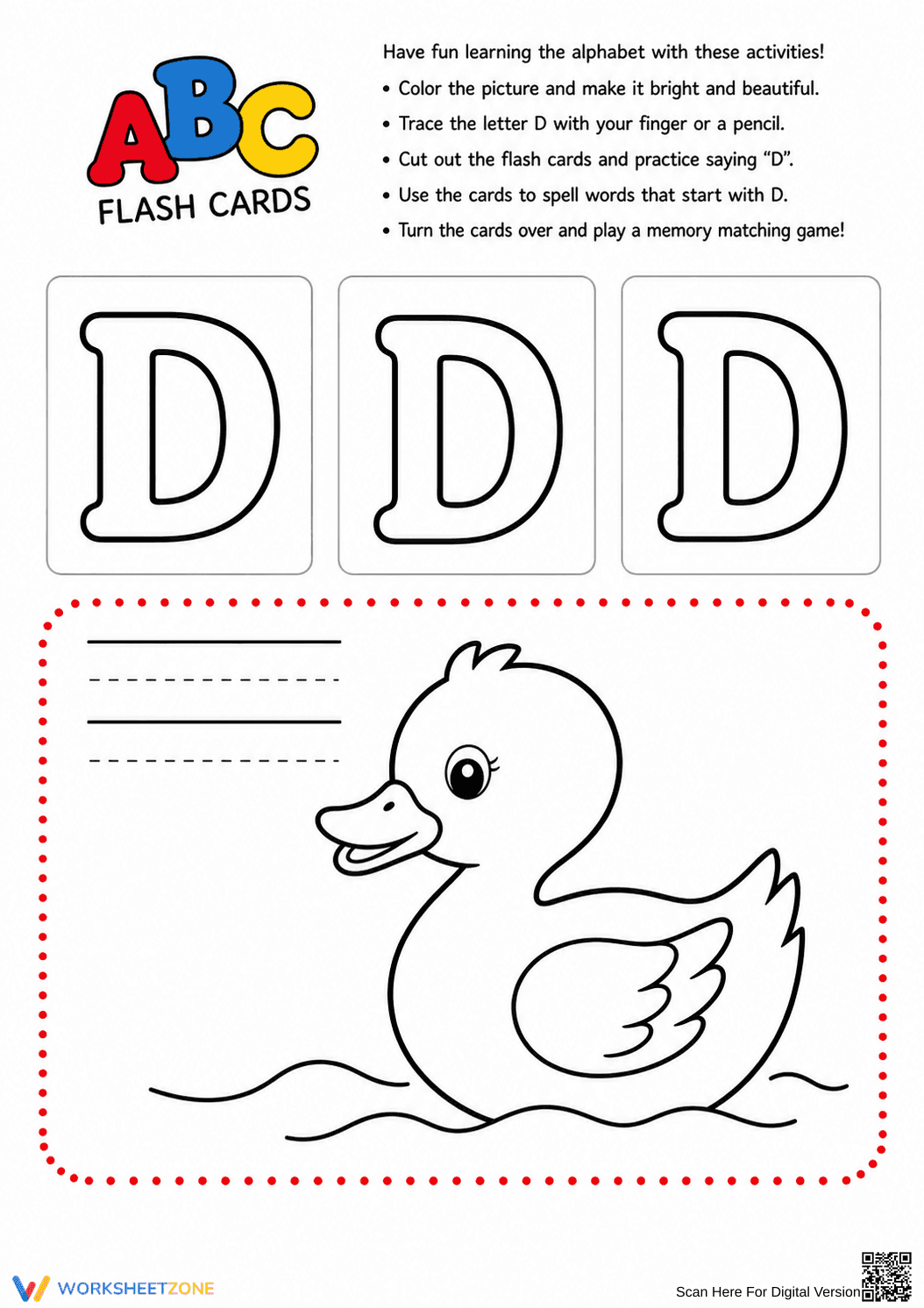

Essential Letter D Tracing & Flash Cards | Grade K-1
Paste this activity's link or code into your existing LMS (Google Classroom, Canvas, Teams, Schoology, Moodle, etc.).
Students can open and work on the activity right away, with no student login required.
You'll still be able to track student progress and results from your teacher account.
This Grade K-1 Letter D worksheet helps early learners master alphabet recognition and phonemic awareness through multi-sensory engagement. Students practice letter formation and beginning sounds by interacting with visual cues and tactile tracing. This resource ensures students can identify and produce the letter D while building fine motor skills through coloring and cutting.
At a Glance
- Grade: K–1 · Subject: ELA
- Standard:
RF.K.1.D— Recognize and name all upper- and lowercase letters of the alphabet- Skill Focus: Letter D recognition and formation
- Format: 1 page · 5 activities · No answer key required · PDF
- Best For: Literacy centers and morning work
- Time: 15–20 minutes
This comprehensive one-page printable features five distinct learning modalities. It includes large-format uppercase D tracing boxes, a duck coloring illustration to reinforce beginning sounds, and dedicated space for handwriting practice. The layout is designed for easy cutting, allowing the page to transform into three durable flashcards for spelling games or memory matching exercises.
Teachers can implement this resource in under 2 minutes. Simply print the PDF, distribute it to students with crayons and scissors, and provide a brief verbal prompt for the D sound. This worksheet is an ideal sub-plan addition or a quiet-time activity that requires zero teacher setup beyond basic classroom supplies like pencils and glue.
This resource aligns with `CCSS.ELA-LITERACY.RF.K.1.D`, which requires students to recognize and name all upper- and lowercase letters of the alphabet. It also supports `RF.K.3.A` by connecting the letter D to its primary phoneme through the duck visual. Both standard codes can be copied directly into lesson plans, IEP goals, or district curriculum mapping tools.
Use this worksheet during the independent practice phase of a phonics lesson after introducing the letter D sound. It serves as an excellent formative assessment; observe students as they trace to ensure correct stroke order and directionality. The completed flashcards can be stored in student cubbies for a 5-minute daily review session during transition periods.
This activity is designed for preschool, kindergarten, and first-grade students who are developing foundational literacy skills. It is particularly effective for English Language Learners (ELLs) who benefit from the visual association between the word duck and the letter D. Pair this with a letter D anchor chart for maximum impact.
According to the RAND AIRS 2024 report on early literacy, multi-sensory approaches that combine tactile tracing with visual phonics cues significantly improve letter-sound correspondence in Grade K students. This worksheet targets the RF.K.1.D standard by providing a structured environment for students to recognize and name the letter D. By integrating coloring, cutting, and tracing, the resource addresses diverse learning styles while reinforcing the foundational skills necessary for decoding. Research from Fisher & Frey (2014) suggests that such integrated tasks support the gradual release of responsibility, moving students from guided recognition to independent identification. This printable provides 5 specific tasks that bridge the gap between simple identification and active usage in spelling and memory games, ensuring that the letter D is encoded into long-term memory through varied repetition and engagement.


