


























Views
Downloads
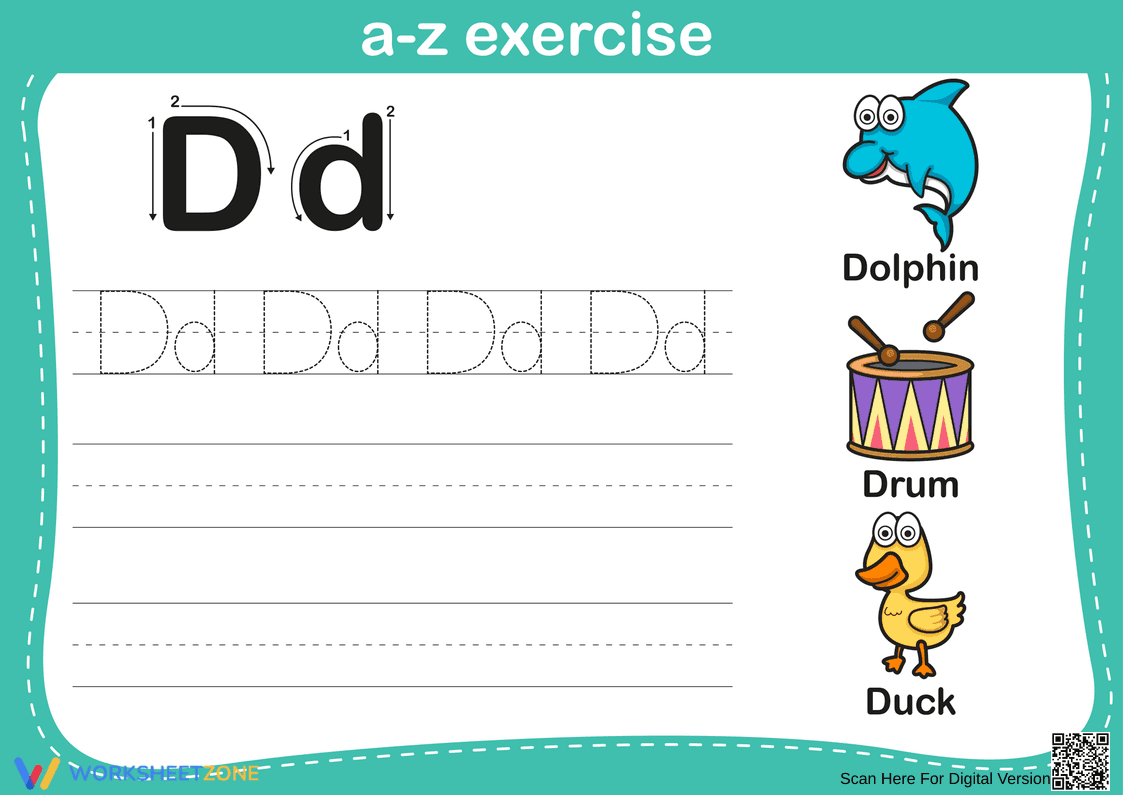

Letter D Tracing Worksheet | Essential Grade K-1
Paste this activity's link or code into your existing LMS (Google Classroom, Canvas, Teams, Schoology, Moodle, etc.).
Students can open and work on the activity right away, with no student login required.
You'll still be able to track student progress and results from your teacher account.
This Letter D tracing worksheet provides early learners with a structured path to mastering uppercase and lowercase letter formation. By combining visual stroke guides with repetitive practice, students build the fine motor control necessary for legible handwriting while reinforcing initial sound recognition through familiar vocabulary like dolphin, drum, and duck.
At a Glance
At a Glance
- Grade: Kindergarten · Subject: ELA
- Standard:
CCSS.ELA-LITERACY.L.K.1.A— Print many upper- and lowercase letters of the alphabet- Skill Focus: Letter D formation
- Format: 1 page · 15 tasks · No key needed · PDF
- Best For: Morning work or literacy centers
- Time: 10–15 minutes
What's Inside
Inside this single-page PDF, you will find a clear header featuring the letter D with numbered stroke arrows to guide initial attempts. The worksheet includes one full line of dashed-line tracing for "Dd" pairs, followed by three empty primary-ruled lines for independent practice. Three colorful illustrations provide immediate phonics context for the /d/ sound.
Zero-Prep Workflow
The zero-prep workflow for this resource is designed for maximum efficiency. First, print the single-page PDF in seconds. Second, distribute to students with a pencil or crayon. Third, review student letter formation as they work to provide immediate corrective feedback. Total teacher preparation time is under 2 minutes, making it an ideal sub plan or transition activity for busy classrooms.
Standards Alignment
This resource aligns with `CCSS.ELA-LITERACY.L.K.1.A`, which requires students to print many upper- and lowercase letters. It also supports RF.K.1.D by helping students recognize and name the letter D in various contexts. Both standard codes can be copied directly into lesson plans, IEP goals, or district curriculum mapping tools.
How to Use It
Use this worksheet during the independent practice phase of a handwriting lesson after demonstrating the stroke order on a whiteboard. It also serves as an effective formative assessment tool; observe if students follow the numbered arrows or create their own stroke patterns. Expected completion typically takes 10 to 15 minutes depending on fine motor development.
Who It's For
This activity is designed for preschool, kindergarten, and first-grade students who are beginning their literacy journey. It is particularly helpful for students requiring extra fine motor support or English Language Learners. Pair this worksheet with a letter D alphabet song or a physical sand tray tracing activity for a multi-sensory learning experience.
According to Fisher & Frey (2014), the gradual release of responsibility is vital in early literacy, moving from guided tracing to independent production. This worksheet facilitates that transition for the letter D, ensuring students internalize the correct motor patterns before attempting free-hand writing. By focusing on CCSS.ELA-LITERACY.L.K.1.A, the resource addresses a foundational skill that predicts later reading fluency and writing stamina. Research from the NAEP suggests that early mastery of letter formation reduces the cognitive load on young writers, allowing them to focus more on composition and spelling in later grades. This printable provides the 15+ repetitions often cited as necessary for initial motor memory consolidation in early childhood settings. This systematic approach ensures that every student, regardless of their starting point, can achieve the mechanical proficiency required for the Kindergarten ELA standards.


