


























Views
Downloads
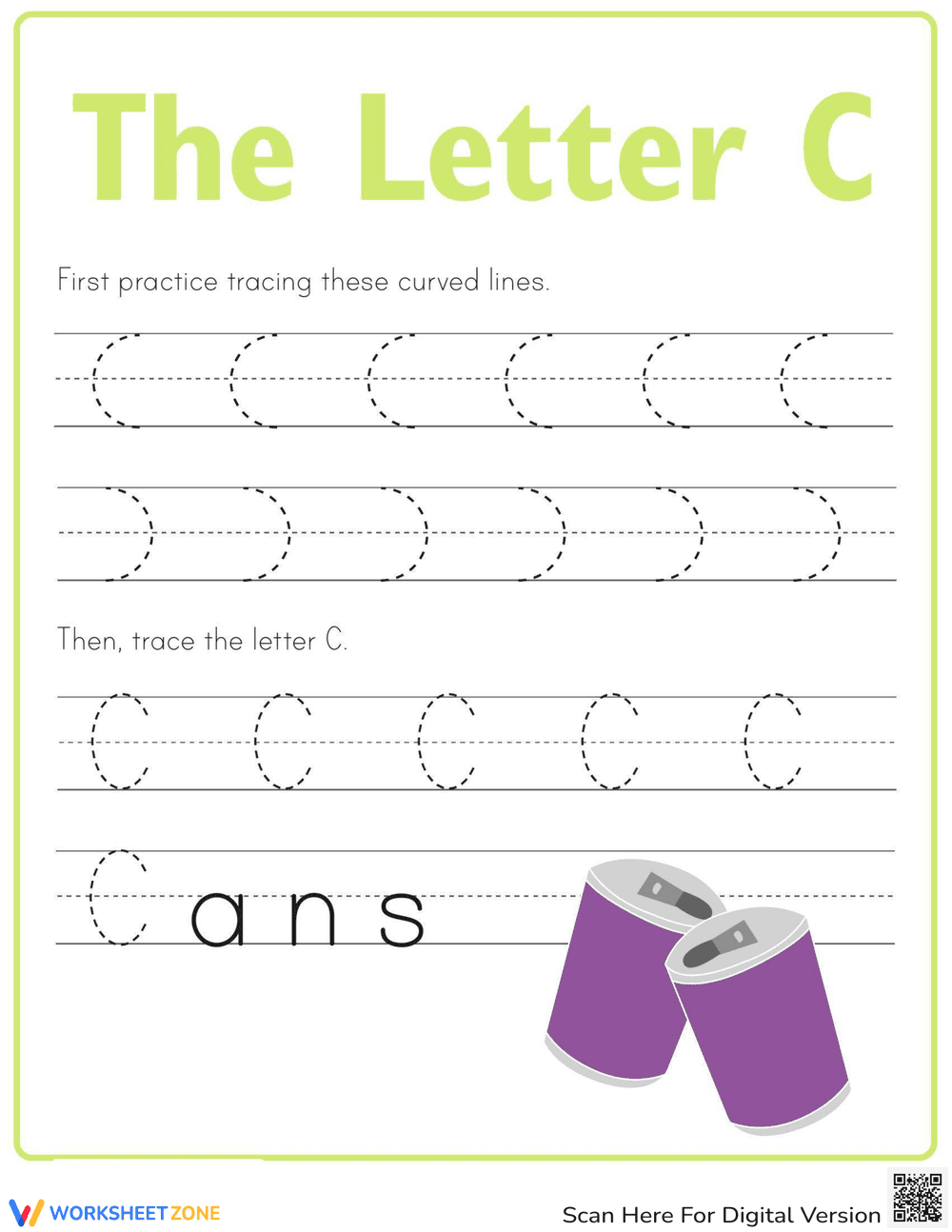

Kindergarten Letter C Tracing — Printable No-Prep Worksheet
Paste this activity's link or code into your existing LMS (Google Classroom, Canvas, Teams, Schoology, Moodle, etc.).
Students can open and work on the activity right away, with no student login required.
You'll still be able to track student progress and results from your teacher account.
This printable handwriting worksheet helps early learners master the uppercase letter C through structured tracing exercises. Students develop fine motor control by tracing preparatory curves before progressing to letter formation and word association. This resource ensures young writers build muscle memory and print letters legibly.
At a Glance
- Grade: Kindergarten · Subject: English Language Arts
- Standard:
CCSS.ELA-LITERACY.L.K.1.A— Print lowercase and uppercase letters legibly- Skill Focus: Letter C formation and motor control
- Format: 1 page · 18 tasks · No answer key required · PDF
- Best For: Morning work or independent writing centers
- Time: 10–15 minutes
This single-page PDF contains three distinct practice zones designed for early childhood development. The top section features 12 curved line tracing paths to build wrist flexibility. The middle section provides 5 guided letter C tracing opportunities on primary writing lines. The bottom section displays the word "cans" with a dashed letter C and a clear visual illustration to connect phonics with handwriting.
Teachers can integrate this resource into their daily routine with a simple three-step workflow. First, print the single-page PDF (takes 10 seconds). Second, distribute the sheets to students during morning arrival or writing centers (takes 30 seconds). Third, review student pencil grip and stroke direction as they work (takes 1 minute). The total teacher preparation time is under 2 minutes, making this sheet an excellent option for emergency sub plans, homework, or quick warm-up activities.
This activity aligns directly with the Common Core State Standard CCSS.ELA-LITERACY.L.K.1.A, which requires students to print lowercase and uppercase letters. By practicing the specific curved strokes needed for the letter C, students build the foundational mechanics required for legible handwriting. Both standard codes can be copied directly into lesson plans, IEP goals, or district curriculum mapping tools.
Use this worksheet during direct instruction as a guided practice activity immediately after introducing the letter C sound. Walk around the room to observe pencil grip and ensure students trace from top to bottom. Alternatively, assign this sheet as an independent station activity during literacy rotations to assess fine motor readiness. Students typically complete the 18 tasks within 10 to 15 minutes.
This worksheet is designed for preschool, kindergarten, and struggling first-grade students who need targeted handwriting practice. It offers scaffolded support for learners developing fine motor strength. Pair this worksheet with a letter C read-aloud book or a physical sand-tray tracing activity to reinforce letter recognition and phonics connections.
According to the Fisher & Frey (2014) gradual release of responsibility framework, structured tracing activities provide the necessary scaffolding for early writers before they transition to independent letter production. This worksheet aligns with CCSS.ELA-LITERACY.L.K.1.A by breaking down the complex motor task of writing the letter C into manageable steps. Research indicates that early fine motor writing practice directly correlates with later reading achievement and spelling accuracy. By practicing the 18 tracing tasks, students build the muscle memory required for automatic letter recognition and production. This resource serves as a practical tool for teachers seeking to implement evidence-based handwriting instruction in early childhood classrooms. The structured layout ensures that students focus on stroke direction and letter shape, establishing a strong foundation for future literacy development.


