


























Views
Downloads
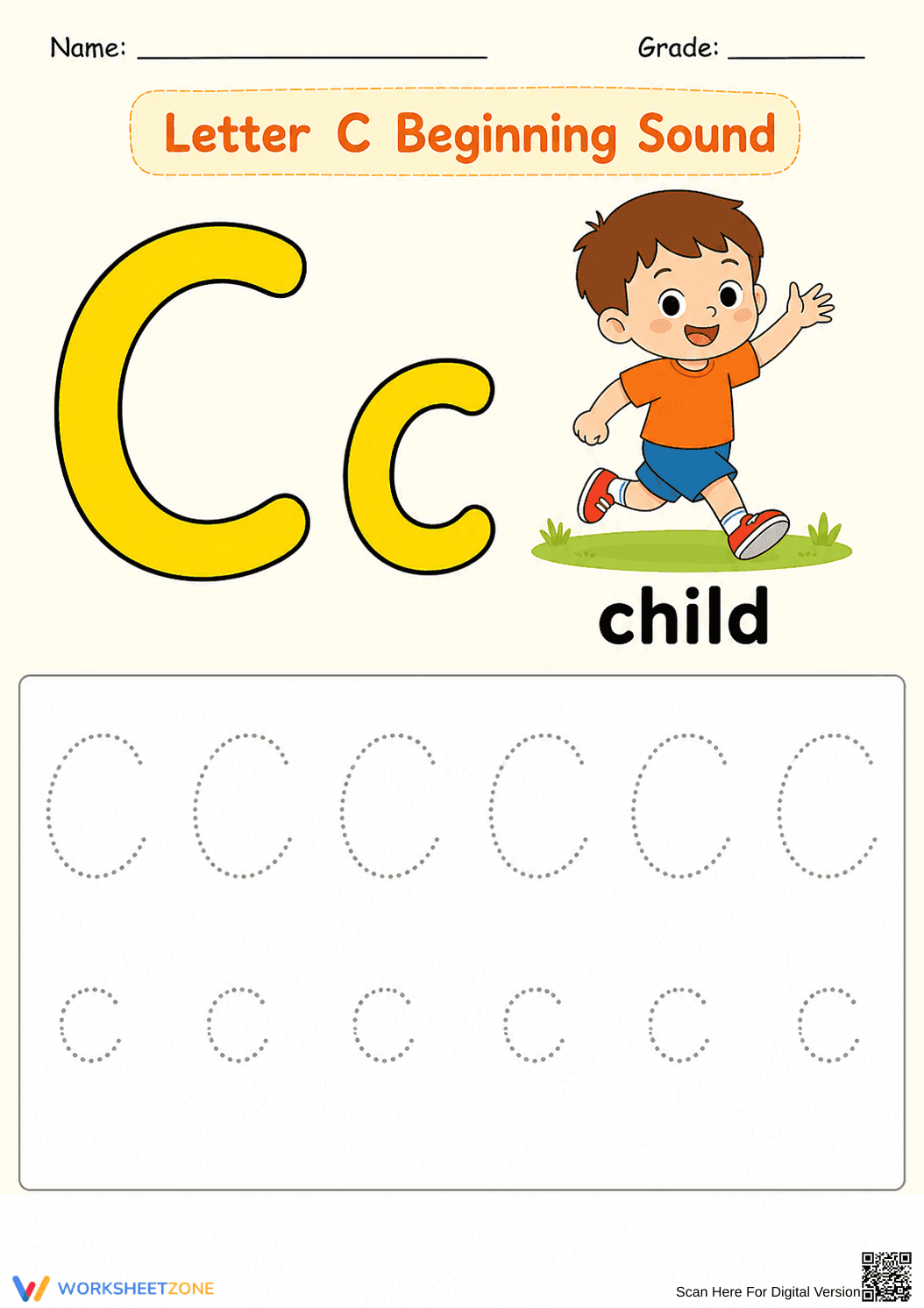

Letter C Beginning Sound Worksheet | Essential Phonics
Paste this activity's link or code into your existing LMS (Google Classroom, Canvas, Teams, Schoology, Moodle, etc.).
Students can open and work on the activity right away, with no student login required.
You'll still be able to track student progress and results from your teacher account.
This Letter C beginning sound worksheet helps early learners connect the visual form of the letter with its initial phonetic sound. By combining visual identification with tactile tracing practice, students build the foundational literacy skills necessary for decoding and handwriting. It provides a clear, focused environment for mastering the letter C in both cases.
At a Glance
At a Glance
- Grade: Kindergarten · Subject: ELA Phonics
- Standard:
CCSS.ELA-LITERACY.RF.K.1.B— Recognize that spoken words are represented by specific sequences of letters- Skill Focus: Letter C formation and beginning sounds
- Format: 1 page · 12 problems · Answer key included · PDF
- Best For: Initial letter introduction and handwriting practice
- Time: 10–15 minutes
What's Inside
The worksheet features a large visual anchor showing uppercase 'C' and lowercase 'c' alongside a "child" illustration to reinforce the beginning sound. Below the visual prompt, students find two rows of tracing practice: six uppercase 'C' characters and six lowercase 'c' characters. The layout is clean and distraction-free, ensuring young learners stay focused on the specific motor movements required for letter formation.
Skill Progression
- Guided Practice: Students begin by observing the large-format letter models and the "child" anchor image to establish the sound-symbol connection.
- Supported Practice: The first row provides six dashed-line uppercase 'C' templates, allowing students to trace the curves with high levels of scaffolding.
- Independent Practice: The second row offers six lowercase 'c' tracing tasks, encouraging students to refine their fine motor control and letter sizing.
This sequence follows a gradual-release model, moving from visual recognition to active physical reproduction of the letter forms.
Standards Alignment
This resource is aligned with `CCSS.ELA-LITERACY.RF.K.1.B`, which requires students to recognize that spoken words are represented in written language by specific sequences of letters. It also supports RF.K.3.A by building knowledge of letter-sound correspondences. Both standard codes can be copied directly into lesson plans, IEP goals, or district curriculum mapping tools.
How to Use It
Use this worksheet during the "You Do" phase of a phonics lesson after introducing the letter C sound. It works well as a morning work activity or a center rotation task. Teachers should observe students' grip and stroke direction—starting at the top and curving around—to provide immediate formative feedback. Completion typically takes 10 to 15 minutes.
Who It's For
This worksheet is designed for Kindergarten students, though it serves as an excellent intervention tool for Grade 1 or Grade 2 students needing handwriting support. It pairs naturally with an alphabet anchor chart or a read-aloud book featuring "C" words. The high-contrast design is beneficial for students with visual processing needs.
Research from Fisher & Frey (2014) emphasizes the importance of the gradual release of responsibility, particularly in early literacy where tactile tracing bridges the gap between seeing a letter and writing it independently. This worksheet applies that principle by providing structured tracing paths that reduce cognitive load while students focus on the phonemic connection to the word "child." By isolating the letter C, the resource prevents the "overwhelming choice" effect often found in multi-letter worksheets. According to NAEP data, early mastery of letter-sound correspondence is one of the strongest predictors of later reading fluency. This printable provides the high-repetition, low-stakes environment necessary for that mastery. The inclusion of the CCSS.ELA-LITERACY.RF.K.1.B standard ensures that the task remains focused on the core requirement of recognizing written sequences as representations of spoken language, a vital step in the alphabetic principle.


