


























Views
Downloads

Letter A Beginning Sound Worksheet | Essential Grade K-1
Paste this activity's link or code into your existing LMS (Google Classroom, Canvas, Teams, Schoology, Moodle, etc.).
Students can open and work on the activity right away, with no student login required.
You'll still be able to track student progress and results from your teacher account.
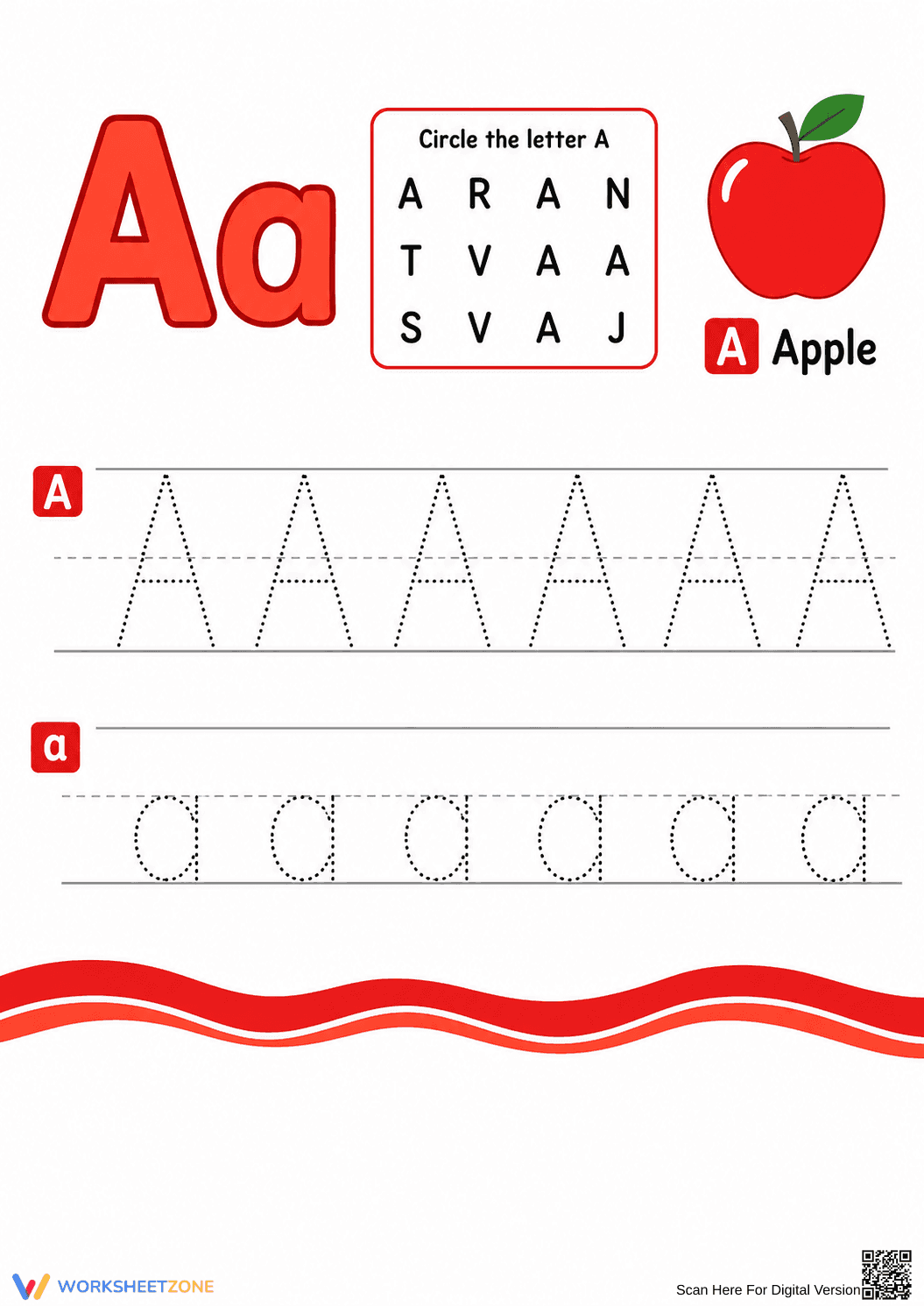
This Kindergarten Letter A worksheet provides students with focused practice in letter recognition and formation. By combining visual identification with tactile tracing, learners solidify their understanding of the first letter of the alphabet. Students will identify uppercase A in a letter grid and practice writing both cases to build foundational literacy skills.
At a Glance
- Grade: Kindergarten · Subject: ELA Phonics
- Standard:
CCSS.ELA-LITERACY.RF.K.1.D— Recognize and name all upper- and lowercase letters of the alphabet- Skill Focus: Letter A Identification & Tracing
- Format: 1 page · 13 tasks · Answer key included · PDF
- Best For: Morning work or phonics centers
- Time: 10–15 minutes
Inside this resource, you will find a comprehensive single-page activity. It features a "Circle the Letter A" grid containing 12 different characters to sharpen visual discrimination. Below the grid, two dedicated tracing rows provide six uppercase and six lowercase templates. A visual anchor (an apple) reinforces the initial phoneme, making it a complete introductory tool for early readers.
Zero-Prep Workflow
- Print: Open the PDF and print the single-page activity in seconds.
- Distribute: Hand out the sheets during your phonics block or as a transition activity.
- Review: Check the letter grid and tracing accuracy as a whole group or during individual check-ins.
Total teacher preparation time is under 2 minutes, making this an ideal solution for busy classrooms or unexpected sub plans.
Standards Alignment
This worksheet aligns with `CCSS.ELA-LITERACY.RF.K.1.D`, which requires students to recognize and name all upper- and lowercase letters of the alphabet. It also supports `RF.K.3.A` by connecting the letter "A" to its common beginning sound through the apple visual. Both standard codes can be copied directly into lesson plans, IEP goals, or district curriculum mapping tools.
How to Use It
Use this as a formative assessment after introducing the letter A. Observe students as they work through the letter grid; those who struggle to distinguish "A" from "V" or "N" may need additional visual discrimination support. It also serves as an excellent quiet-time activity or a reliable sub-plan component that requires no prior instruction. Expected completion time is 10 to 15 minutes.
Who It's For
This resource is ideal for Kindergarten students beginning their phonics journey and Grade 1 students requiring remedial handwriting support. It pairs naturally with an alphabet anchor chart or a read-aloud focused on the short /a/ sound. The clear layout ensures accessibility for English Language Learners and students with fine-motor goals who need large, clear tracing paths.
Research from Fisher & Frey (2014) emphasizes the importance of multi-modal letter instruction, where visual recognition is paired with kinesthetic tracing to improve long-term retention. This worksheet implements these findings by requiring students to identify the letter A within a distractor-filled grid before engaging in repetitive tracing. According to the NAEP, early mastery of letter-sound correspondence is one of the strongest predictors of future reading success. By providing 13 distinct interaction points, this resource ensures that students move beyond passive observation to active engagement with the alphabet. The inclusion of both uppercase and lowercase forms addresses the common developmental hurdle of recognizing that different symbols represent the same phoneme. This structured approach provides the high-frequency exposure necessary for automaticity in early literacy, making it a vital component of any evidence-based Kindergarten phonics curriculum.


