


























Views
Downloads
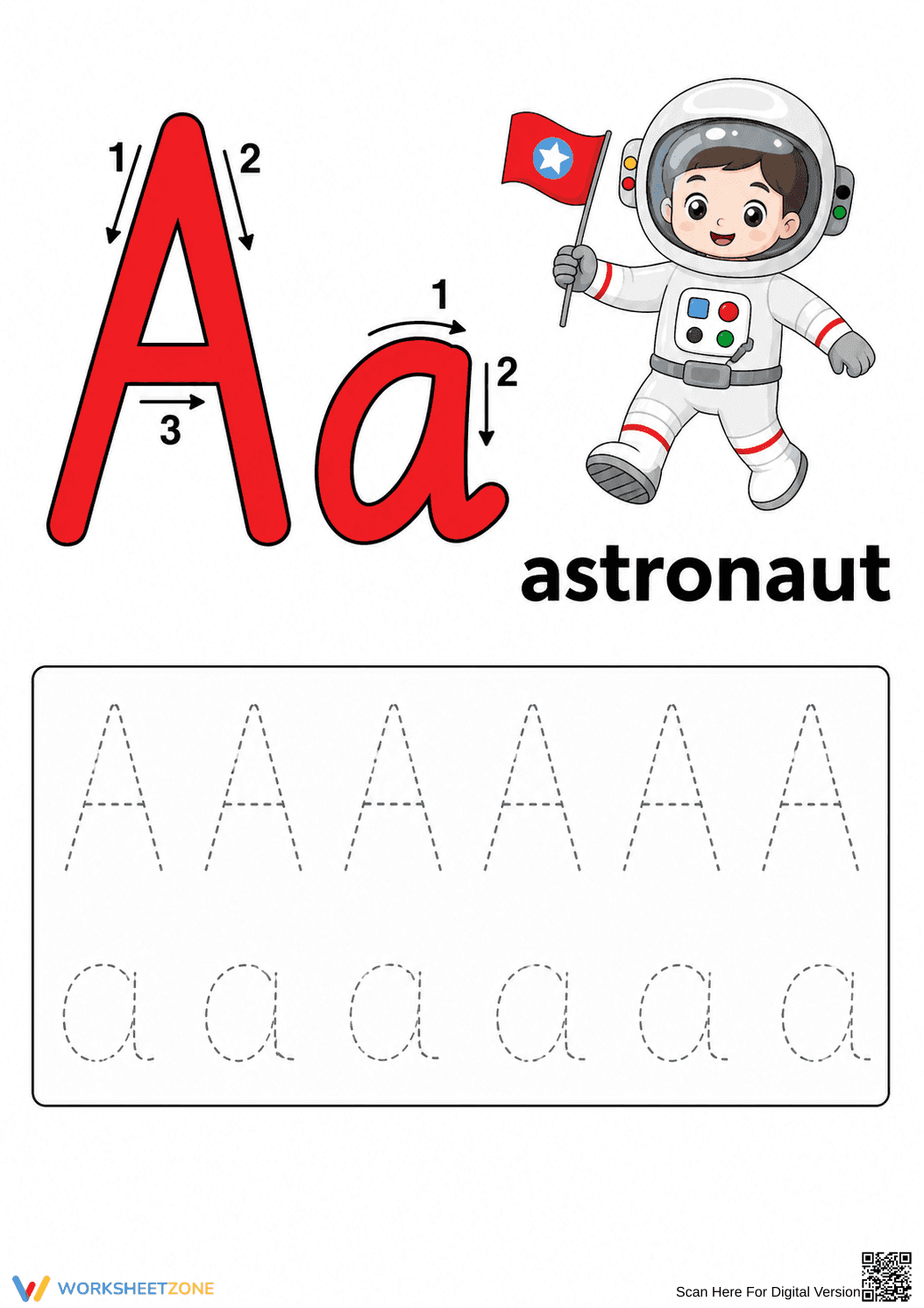

Letter A Beginning Sound Worksheet | Essential Grade K
Paste this activity's link or code into your existing LMS (Google Classroom, Canvas, Teams, Schoology, Moodle, etc.).
Students can open and work on the activity right away, with no student login required.
You'll still be able to track student progress and results from your teacher account.
This Grade K letter A worksheet helps early learners master uppercase and lowercase letter formation while connecting the letter sound to a concrete visual example. Students practice precise motor control through guided tracing paths, ensuring they develop the foundational writing skills necessary for literacy success. By integrating phonics with handwriting, this resource strengthens the alphabetic principle.
At a Glance
- Grade: Kindergarten · Subject: ELA
- Standard:
CCSS.ELA-LITERACY.L.K.1.A— Print many upper- and lowercase letters correctly and consistently- Skill Focus: Letter A formation and phonics
- Format: 1 page · 12 problems · Answer key included · PDF
- Best For: Early literacy centers and morning work
- Time: 10–15 minutes
Inside this resource, you will find a comprehensive 1-page PDF designed for immediate use. The worksheet features large, clear stroke-order diagrams for both uppercase 'A' and lowercase 'a', accompanied by a friendly astronaut illustration to reinforce the beginning sound. The bottom section provides 12 dedicated tracing opportunities (6 uppercase and 6 lowercase) on primary-ruled lines to support consistent letter sizing.
The zero-prep workflow is designed for the busy educator. First, print the required number of copies for your group (30 seconds). Next, distribute the sheets to students during your literacy block (1 minute). Finally, review the completed work to check for proper grip and stroke direction (30 seconds). This entire process requires less than 2 minutes of teacher preparation time, making it an ideal choice for sub plans or unexpected schedule changes.
This worksheet is aligned to the primary standard `CCSS.ELA-LITERACY.L.K.1.A`, which requires students to print many upper- and lowercase letters. It also supports phonemic awareness goals by linking the letter shape to its initial sound. Both standard codes can be copied directly into lesson plans, IEP goals, or district curriculum mapping tools to ensure compliance with state and national frameworks.
To use this effectively, introduce the worksheet after a direct instruction session on the letter A. Use the astronaut image as a choral response prompt to practice the short /a/ sound. For formative assessment, observe students as they trace the letters to ensure they follow the numbered arrows, as this prevents the development of inefficient writing habits. This activity typically takes 10 to 15 minutes to complete.
This resource is specifically designed for Kindergarten students, though it serves as an excellent intervention tool for Grade 1 students needing handwriting support or ESL learners building basic vocabulary. It pairs naturally with an alphabet anchor chart or a read-aloud book featuring words that begin with the letter A. The clear layout ensures that students can work independently with minimal teacher intervention.
Research from Fisher & Frey (2014) emphasizes that explicit instruction in letter formation, combined with phonemic cues like the astronaut example, accelerates early reading acquisition. This worksheet aligns with CCSS.ELA-LITERACY.L.K.1.A by providing the repetitive, scaffolded practice required for muscle memory development. By focusing on the letter A, students build the first block of the alphabetic principle. Studies from the NAEP suggest that early mastery of letter-sound correspondence is a primary predictor of third-grade reading proficiency. This resource provides 12 specific tracing tasks to ensure students move from guided observation to independent production. The inclusion of stroke-order arrows follows best practices for orthographic mapping, ensuring that students internalize the correct sequence of movements for long-term writing fluency and legibility in later grades.


