


























Views
Downloads
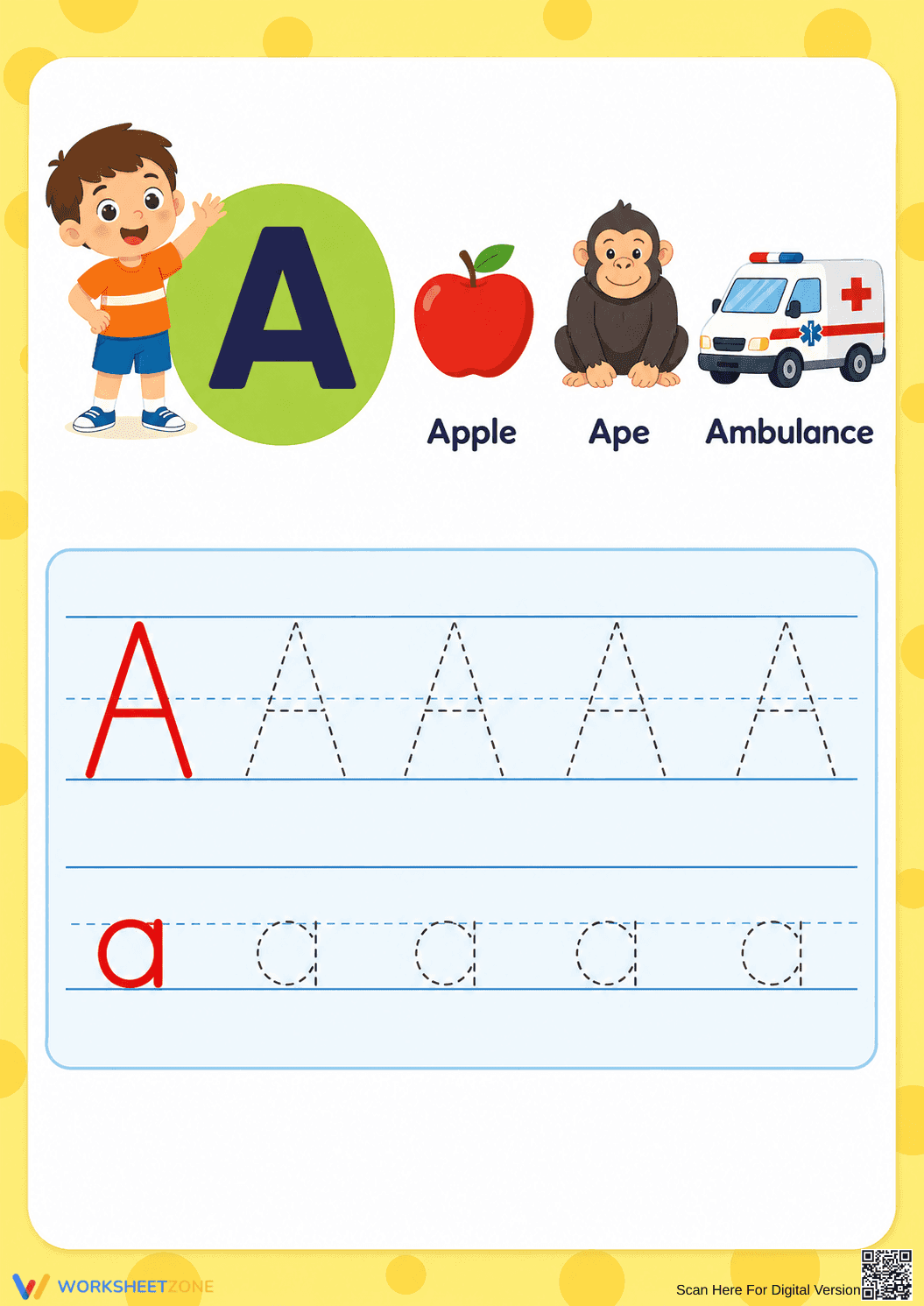

Grade K Letter A Sounds — Printable No-Prep Worksheet
Paste this activity's link or code into your existing LMS (Google Classroom, Canvas, Teams, Schoology, Moodle, etc.).
Students can open and work on the activity right away, with no student login required.
You'll still be able to track student progress and results from your teacher account.
This foundational kindergarten phonics worksheet helps early readers connect the letter A to its beginning sounds while practicing handwriting. Students trace uppercase and lowercase letters and identify familiar vocabulary words like apple and ambulance, building essential fine motor skills and letter-sound recognition in one simple activity.
At a Glance
- Grade: K · Subject: ELA
- Standard:
CCSS.ELA-LITERACY.RF.K.3.A— Produce primary sounds for consonants and vowels- Skill Focus: Letter A beginning sounds and tracing
- Format: 1 page · 10 problems · No answer key needed · PDF
- Best For: Morning work or literacy centers
- Time: 10–15 minutes
This single-page resource features a clear, visually appealing layout designed specifically for early learners. The top section introduces the letter A alongside three illustrated vocabulary words—apple, ape, and ambulance—to reinforce both short and long vowel sounds. The bottom section provides guided handwriting practice with five uppercase A tracing templates and five lowercase a tracing templates, utilizing standard primary dashed lines to support proper letter formation.
Zero-Prep Workflow
This worksheet requires zero teacher preparation.
- Print (1 minute): Simply download the PDF and print a class set.
- Distribute (1 minute): Hand out the sheets during morning routines or transition times. The visual cues make instructions self-evident.
- Review (1 minute): Quickly check student tracing accuracy and ask them to read the three vocabulary words aloud.
With a total prep time of under two minutes, this resource is an excellent addition to any emergency sub plan or last-minute literacy center rotation.
Standards Alignment
This activity is directly aligned to CCSS.ELA-LITERACY.RF.K.3.A, requiring students to demonstrate basic knowledge of one-to-one letter-sound correspondences by producing the primary sound or many of the most frequent sounds for each consonant and vowel. It also supports CCSS.ELA-LITERACY.L.K.1.A by having students print many upper- and lowercase letters. Both standard codes can be copied directly into lesson plans, IEP goals, or district curriculum mapping tools.
How to Use It
Assign this as independent morning work as students arrive. It can also be utilized during small group literacy centers after direct instruction on the letter A. As a formative assessment tip, observe students while they trace the letters to ensure they are starting at the top line and following the correct stroke order, rather than drawing from the bottom up. Most kindergarten students will complete this activity within a 10 to 15-minute timeframe.
Who It's For
This resource is primarily designed for kindergarten students who are just beginning their phonics and handwriting journeys. It also supports pre-K students showing early readiness, or first-graders needing targeted remediation in fine motor control. For a complete lesson, pair this worksheet with a read-aloud book that heavily features the letter A or a classroom alphabet anchor chart.
Mastering early phonics skills like those targeted in CCSS.ELA-LITERACY.RF.K.3.A, where students produce primary sounds for consonants and vowels, is a critical predictor of future reading success. According to a comprehensive RAND AIRS 2024 study on early literacy interventions, students who engage in simultaneous multimodal practice—such as vocalizing beginning sounds while physically tracing the corresponding letters—demonstrate a significantly higher retention rate of letter-sound correspondence compared to those who practice these skills in isolation. Integrating handwriting with phonemic awareness tasks reduces cognitive load and helps solidify the neural pathways required for fluent decoding. By combining visual vocabulary cues with guided tracing lines, this worksheet provides the exact type of structured, multimodal repetition that evidence-based research identifies as essential for developing strong, confident early readers in the primary classroom.


