




























Views
Downloads

Printable Letter A Tracing Worksheet | Kindergarten Phonics

Paste this activity's link or code into your existing LMS (Google Classroom, Canvas, Teams, Schoology, Moodle, etc.).
Students can open and work on the activity right away, with no student login required.
You'll still be able to track student progress and results from your teacher account.
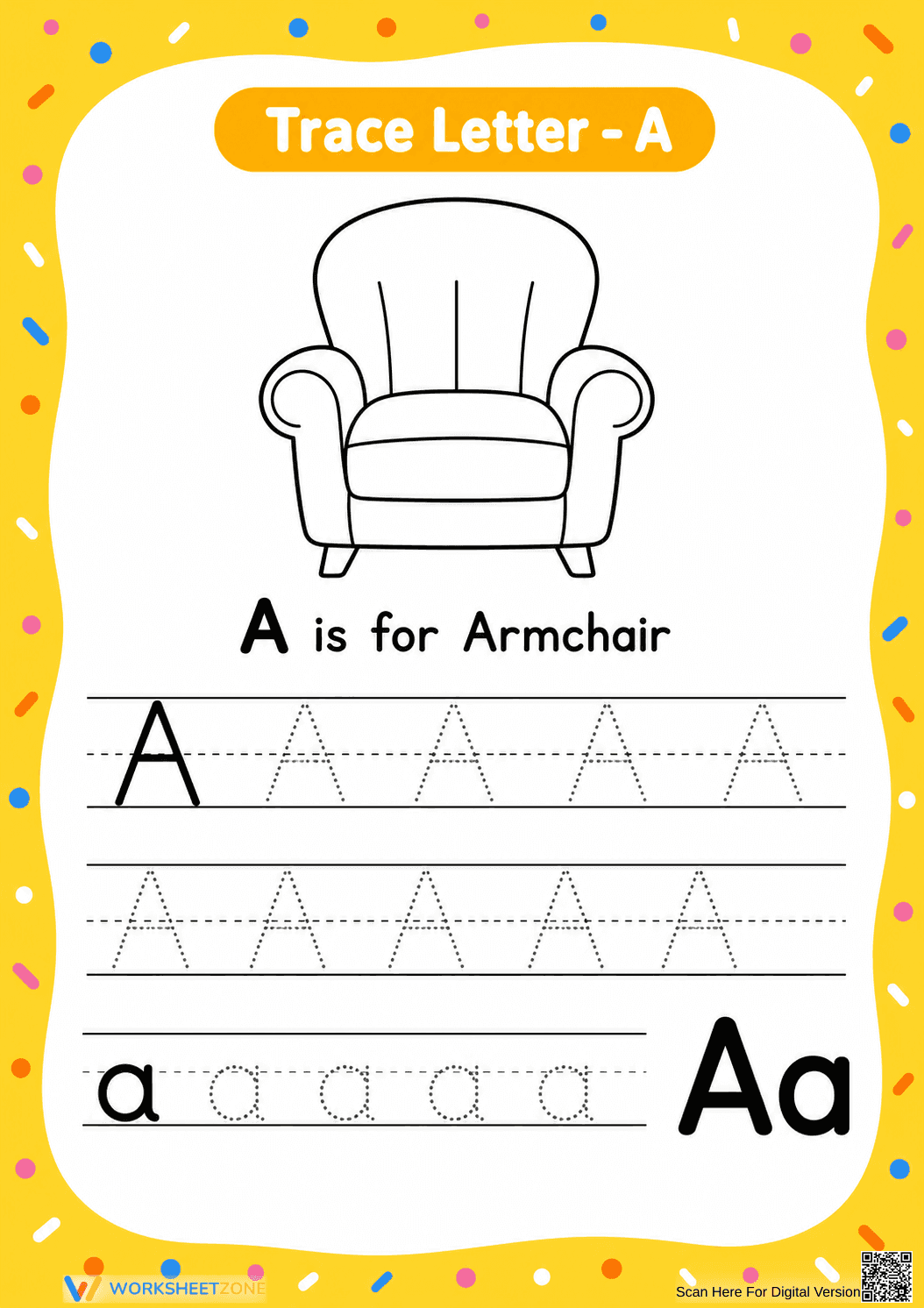
This Kindergarten Letter A worksheet helps early learners master uppercase and lowercase letter formation while connecting the "A" sound to a familiar object. By combining fine motor tracing with visual recognition of the "Armchair" example, students build the foundational literacy skills necessary for reading readiness and phonemic awareness in a structured, engaging format.
At a Glance
- Grade: Kindergarten · Subject: ELA Phonics
- Standard:
CCSS.ELA-LITERACY.L.K.1.A— Print many upper- and lowercase letters of the alphabet- Skill Focus: Letter A formation and beginning sounds
- Format: 1 page · 15 tracing tasks · No answer key needed · PDF
- Best For: Morning work or literacy centers
- Time: 10–15 minutes
What's Inside
This single-page PDF features a large, clear illustration of an armchair for coloring, which reinforces the initial "A" sound. Below the image, students find three dedicated rows for handwriting practice. The first two rows focus on uppercase "A" with dashed guides, while the final row provides practice for lowercase "a," ensuring comprehensive letter-shape mastery and fine motor development.
Zero-Prep Workflow
- Print: Select the single-page PDF and print enough copies for your group (30 seconds).
- Distribute: Hand out the sheets along with pencils and crayons for the coloring component (1 minute).
- Review: Briefly model the letter sound and stroke directionality before students begin (30 seconds).
Total teacher preparation time is under 2 minutes, making this an ideal resource for sub-plans or unexpected schedule gaps.
Standards Alignment
The primary standard addressed is `CCSS.ELA-LITERACY.L.K.1.A`, which requires students to print many upper- and lowercase letters. Additionally, it supports `CCSS.ELA-LITERACY.RF.K.1.D` by helping students recognize and name alphabet letters. Both standard codes can be copied directly into lesson plans, IEP goals, or district curriculum mapping tools to track student progress toward foundational literacy benchmarks.
How to Use It
Use this worksheet during the "You Do" phase of a gradual release lesson on the letter A. It serves as an excellent formative assessment; observe student grip and stroke order as they trace the 15 provided characters. Alternatively, assign it as a quiet morning work activity to settle the class while reinforcing phonics concepts. Completion typically takes 10 to 15 minutes depending on the student's motor skill level.
Who It's For
This resource is tailored for Kindergarten students, though it provides valuable remediation for Grade 1 or Pre-K learners. It is particularly effective for students developing fine motor control or those requiring extra practice with letter-sound correspondence. Pair this worksheet with a "Letter A" anchor chart or a short phonics video to provide a multi-sensory learning experience for diverse learners.
According to the RAND AIRS 2024 report on foundational literacy, consistent practice with letter-sound correspondence and handwriting is vital for early reading fluency. This worksheet targets `CCSS.ELA-LITERACY.L.K.1.A` by providing 15 specific tracing opportunities for the letter A. Research from Fisher & Frey (2014) emphasizes that combining visual cues, such as the armchair illustration, with motor tasks like tracing helps solidify the alphabetic principle in young minds. By focusing on both uppercase and lowercase forms, the resource ensures students meet Kindergarten benchmarks for letter recognition. The structured layout supports the gradual release of responsibility, moving from guided tracing to independent production. Educators can use this tool to gather evidence of student progress toward phonemic mastery and fine motor development, ensuring that every child builds the necessary skills for future literacy success in a zero-prep format.


