


























Views
Downloads
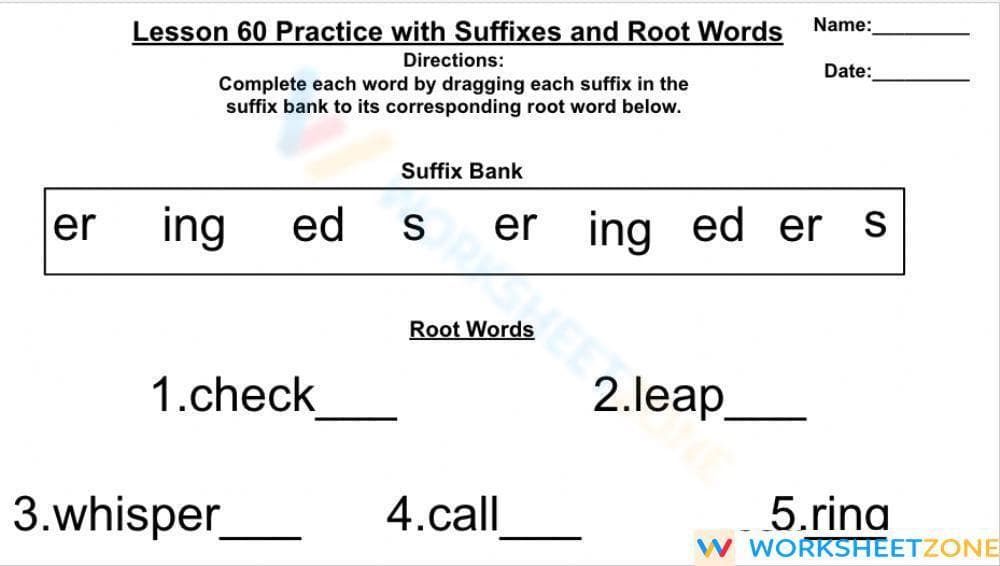

Grade 1 Suffixes — Printable No-Prep Worksheet
Paste this activity's link or code into your existing LMS (Google Classroom, Canvas, Teams, Schoology, Moodle, etc.).
Students can open and work on the activity right away, with no student login required.
You'll still be able to track student progress and results from your teacher account.
This Grade 1 worksheet provides targeted practice in identifying and using common inflectional suffixes. Students will complete five root words by selecting the correct suffix (-ed, -s, -ing, -er) from a word bank, reinforcing their understanding of how suffixes change a word's meaning and tense.
At a Glance
- Grade: 1 · Subject: ELA / Language
- Standard:
CCSS.ELA-LITERACY.L.1.4.C— Identify root words and their inflectional forms.- Skill Focus: Suffixes, Root Words
- Format: 1 page · 5 problems · Answer key included · PDF
- Best For: Independent practice, literacy centers
- Time: 5–10 minutes
What's Inside
This resource is a single-page PDF. It features a "Suffix Bank" with the endings -er, -ing, -ed, and -s, and five root words for students to complete. The clear directions make the task self-explanatory for young learners. An answer key is included for quick checking.
Zero-Prep Workflow
This worksheet is designed for maximum classroom efficiency, requiring virtually no teacher preparation. The workflow is simple and fast:
- Print (1 minute): The entire activity, including directions and the word bank, is contained on a single, easy-to-print page.
- Distribute (1 minute): Hand out the worksheet to students for independent work, in a literacy center, or as a quick warm-up activity. The clear format means no lengthy explanation is needed.
- Review (2 minutes): Use the provided answer key to review the answers with the whole class or to quickly check individual student work.
Total teacher prep time is under two minutes, making this an ideal resource for substitute plans, homework packets, or a last-minute grammar review.
Standards Alignment
This worksheet aligns directly with the Common Core State Standard for first-grade language skills: CCSS.ELA-LITERACY.L.1.4.C, which requires students to "Identify frequently occurring root words (e.g., look) and their inflectional forms (e.g., looks, looked, looking)." The activity provides concrete practice in this foundational skill and also supports Kindergarten standard CCSS.ELA-LITERACY.L.K.4.B. Both standard codes can be copied directly into lesson plans, IEP goals, or district curriculum mapping tools.
How to Use It
Use this worksheet for independent practice after a lesson on suffixes, or place it in a literacy center. As a formative assessment, observe which suffixes students use incorrectly to identify misunderstandings about tense (e.g., confusing -ed and -ing). The 5 problems can be completed in 5-10 minutes.
Who It's For
Designed for first graders, this activity is also suitable for advanced Kindergarteners or as a review for second graders. The simple format with clear visual cues is accessible for diverse learners. Pair this worksheet with an anchor chart of root word families for extra support.
This worksheet offers focused practice aligned with CCSS.ELA-LITERACY.L.1.4.C, a critical early literacy skill. By asking students to identify and apply inflectional forms, the activity builds morphological awareness—the ability to understand how word parts carry meaning. Research consistently shows a strong link between morphological awareness and reading comprehension. The National Assessment of Educational Progress (NAEP) has highlighted the importance of foundational language skills, including the ability to decode words and understand their structure, as a prerequisite for grade-level reading proficiency. This simple, 5-problem exercise provides a practical application of these principles, giving students a hands-on method for manipulating word parts. It serves as a concrete tool for teachers to assess a student's grasp of how root words change with the addition of common suffixes like -ed, -s, and -ing, a key component of early grammar and vocabulary development.


