


























Views
Downloads
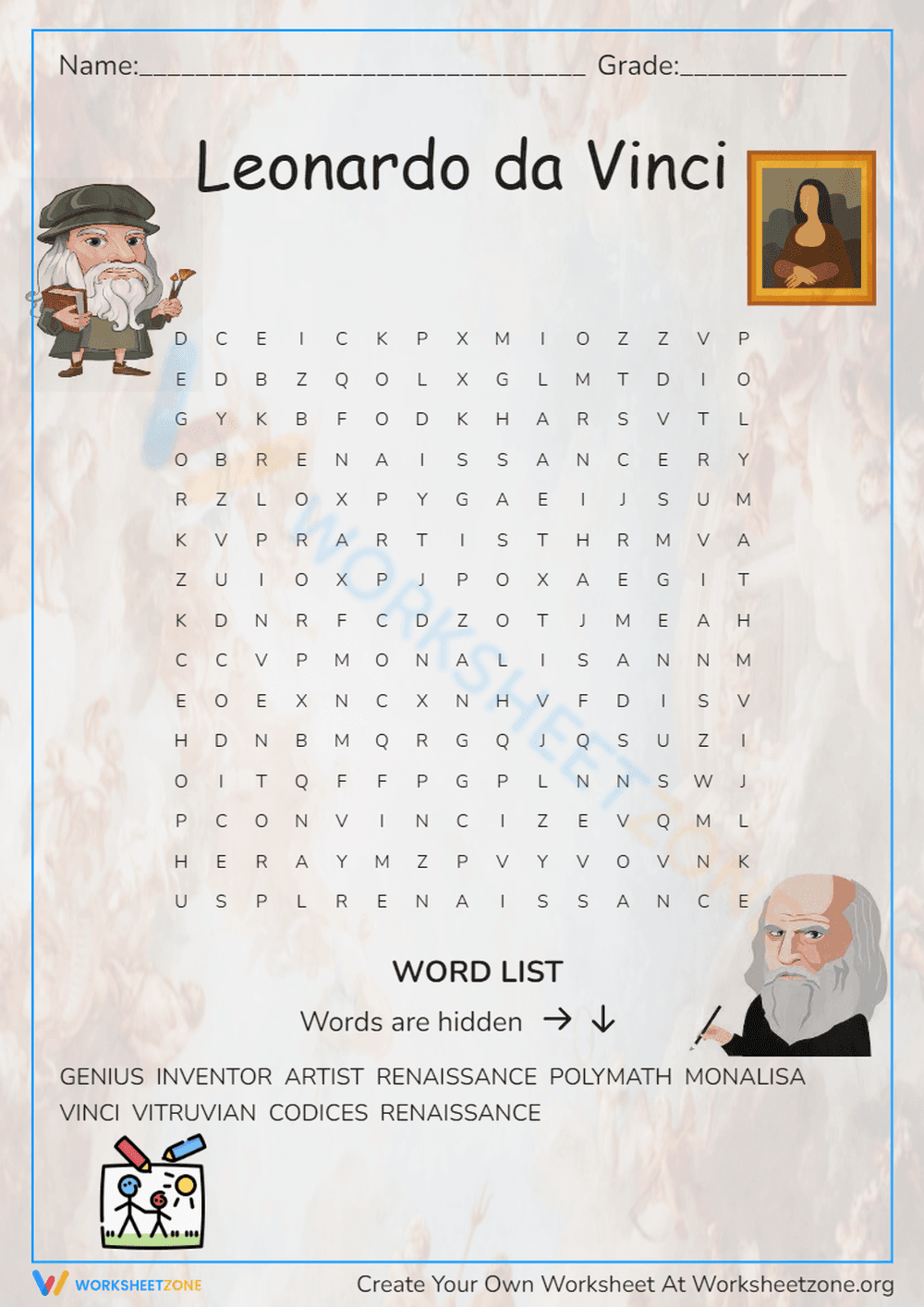

Leonardo da Vinci Word Search | Essential Grade 4 History
Paste this activity's link or code into your existing LMS (Google Classroom, Canvas, Teams, Schoology, Moodle, etc.).
Students can open and work on the activity right away, with no student login required.
You'll still be able to track student progress and results from your teacher account.
This Leonardo da Vinci word search provides a focused vocabulary activity for students to identify key terms associated with the Renaissance polymath. By locating words like Vitruvian and Codices, learners reinforce their recognition of historical concepts and artistic terminology. It serves as an engaging introduction to one of history's most influential figures.
At a Glance
- Grade: 4 · Subject: Social Studies
- Standard:
CCSS.ELA-LITERACY.RI.4.4— Determine the meaning of general academic and domain-specific words or phrases- Skill Focus: Historical Vocabulary
- Format: 1 page · 11 problems · Answer key included · PDF
- Best For: Early finishers and history unit introductions
- Time: 10–15 minutes
This single-page PDF features a word search grid containing 11 specific terms related to Leonardo da Vinci's life and work. The word bank includes academic vocabulary such as Polymath, Renaissance, and Codices, alongside famous works like the Monalisa. The layout is clean and student-friendly, featuring thematic illustrations of the artist and his most famous painting to provide visual context for the lesson.
Zero-Prep Workflow
- Print: Select the single-page PDF and print enough copies for your class in less than 30 seconds.
- Distribute: Hand out the worksheets as students enter the room or transition between subjects; no additional materials are required beyond a pencil.
- Review: Use the included answer key to quickly verify student work or project it on a screen for a 2-minute collective check.
Standards Alignment
The primary standard for this resource is `CCSS.ELA-LITERACY.RI.4.4`, which requires students to determine the meaning of domain-specific words and phrases in a text relevant to a grade 4 topic. By interacting with terms like Vitruvian and Inventor, students build the lexical foundation necessary for reading complex historical biographies. This standard code can be copied directly into lesson plans, IEP goals, or district curriculum mapping tools.
How to Use It
Assign this worksheet as a hook activity at the start of a Renaissance history unit to gauge prior knowledge of Leonardo da Vinci. Alternatively, use it as a formative assessment for early finishers to keep them engaged with academic content while others complete their primary tasks. Completion typically takes 10 to 15 minutes, providing a perfect buffer during classroom transitions.
Who It's For
This resource is designed for elementary students in grades 3 through 5 who are studying world history or art appreciation. It is particularly effective for English Language Learners (ELLs) who benefit from word-to-image associations and repetitive vocabulary exposure. Pair this worksheet with a short biographical passage or an anchor chart about Renaissance inventions for a comprehensive learning experience.
Word searches and similar vocabulary puzzles serve as effective tools for reinforcing orthographic mapping and term recognition within specific domains. According to Fisher & Frey (2014), intentional vocabulary exposure is a critical component of literacy development, especially when students are introduced to complex historical periods like the Renaissance. This worksheet targets CCSS.ELA-LITERACY.RI.4.4 by requiring students to process 11 domain-specific terms, including Polymath and Vitruvian, which are essential for understanding the multi-disciplinary nature of Leonardo da Vinci's contributions. Research indicates that low-stakes vocabulary activities reduce cognitive load while increasing student engagement with new academic language. By integrating these terms into a visual search task, educators provide a scaffolded entry point for deeper historical inquiry. This resource offers a structured way to ensure that key terminology is not just seen, but actively processed by the learner during introductory history lessons.


