


























Views
Downloads
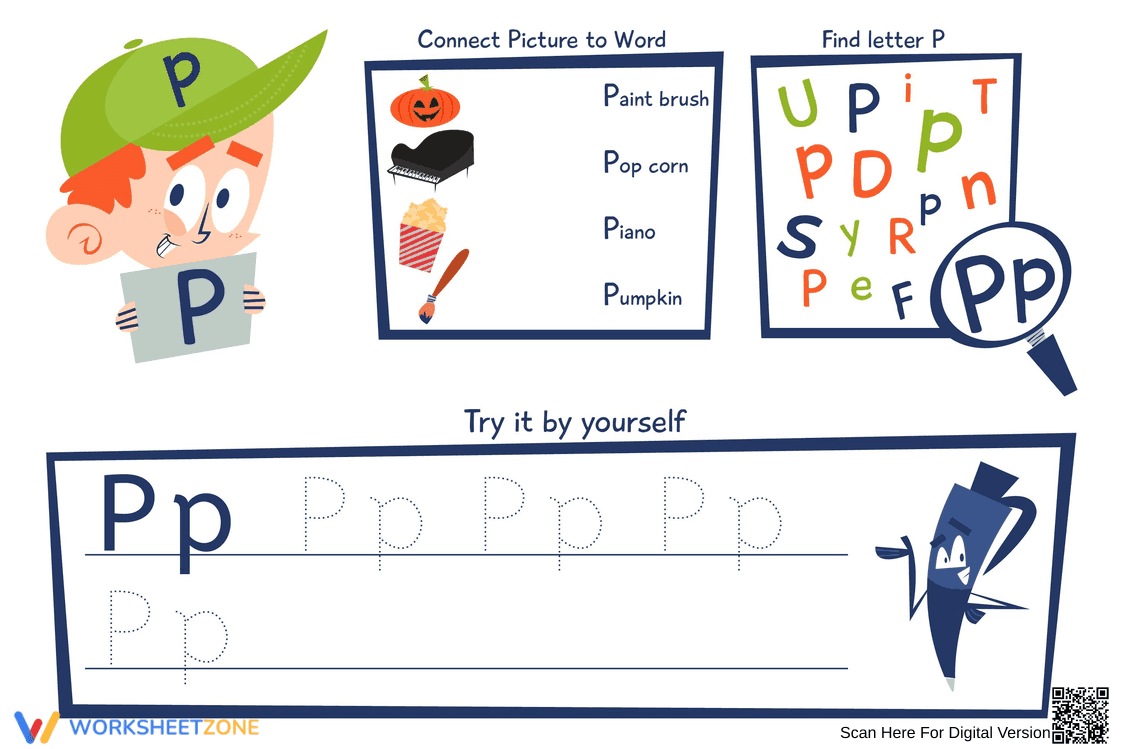

Letter P Tracing Worksheet | Grade 1 Printable
Paste this activity's link or code into your existing LMS (Google Classroom, Canvas, Teams, Schoology, Moodle, etc.).
Students can open and work on the activity right away, with no student login required.
You'll still be able to track student progress and results from your teacher account.
This Grade 1 letter P worksheet provides a comprehensive approach to early literacy by combining visual recognition with fine motor practice. Students engage in three distinct activities to master the uppercase and lowercase forms of the letter P. By connecting words to images and tracing characters, learners build the foundational skills necessary for fluent writing.
At a Glance
At a Glance
- Grade: 1 · Subject: English
- Standard:
CCSS.ELA-LITERACY.L.1.1.A— Print all upper- and lowercase letters correctly and legibly- Skill Focus: Letter P recognition and formation
- Format: 1 page · 3 tasks · Answer key included · PDF
- Best For: Morning work or literacy centers
- Time: 10–15 minutes
What's Inside
This single-page PDF features a 3-in-1 design to keep young learners engaged. It includes a Connect Picture to Word matching section with four vocabulary terms including Paint brush, Pop corn, Piano, and Pumpkin. Additionally, it contains a Find letter P visual discrimination grid and a dedicated Try it by yourself tracing area. The layout uses clear lines and friendly illustrations to support independent student work.
Zero-Prep Workflow
Teachers can integrate this resource into their daily routine in less than 2 minutes. Simply print the required number of copies for your class, distribute them during your phonics block, and review the matching section together as a quick formative check. This worksheet is an ideal grab-and-go option for substitute folders or unexpected schedule changes during the school day.
Standards Alignment
The primary focus is `CCSS.ELA-LITERACY.L.1.1.A`, which requires students to print all upper- and lowercase letters. Additionally, the matching task supports `CCSS.ELA-LITERACY.RF.1.3`, helping students decode regularly spelled one-syllable words by associating sounds with their written forms. Both standard codes can be copied directly into lesson plans, IEP goals, or district curriculum mapping tools.
How to Use It
Use this worksheet during the independent practice phase of a gradual release lesson on the letter P. It works well as a quiet transition activity after a whole-group read-aloud or phonics instruction. Observe students during the tracing portion to ensure they are following the correct top-to-bottom stroke order. Completion typically takes between 10 and 15 minutes for most first-grade learners.
Who It's For
This resource is designed for Grade 1 students who need to solidify their handwriting and letter identification skills. It is also highly effective for English Language Learners who benefit from the visual cues in the matching section. Pair this with a letter P anchor chart or a tactile sand-tracing activity for a multi-sensory experience that reinforces letter formation.
Mastery of letter formation is a critical precursor to writing fluency and overall literacy development. According to research from Fisher & Frey (2014), the gradual release of responsibility moving from guided tracing to independent production is essential for motor memory retention in early childhood education. This worksheet aligns with CCSS.ELA-LITERACY.L.1.1.A by providing structured opportunities for students to practice the specific strokes required for the letter P. By integrating visual discrimination with semantic matching, the resource ensures that students are not just mimicking shapes but are connecting the grapheme to its phonemic and lexical representations. Such multi-modal practice is supported by NAEP findings which suggest that diverse task types improve engagement and skill acquisition in primary grades. This printable PDF serves as a reliable tool for both formative assessment and independent practice in any Grade 1 classroom, ensuring students meet foundational writing benchmarks through consistent and focused repetition.


