


























Views
Downloads

Learn to Write Letter Y: Essential Grade K-1 Handwriting
Paste this activity's link or code into your existing LMS (Google Classroom, Canvas, Teams, Schoology, Moodle, etc.).
Students can open and work on the activity right away, with no student login required.
You'll still be able to track student progress and results from your teacher account.
Mastering the letter Y requires both visual recognition and precise fine motor coordination. This printable handwriting resource provides a structured pathway for early learners to develop letter formation skills through guided tracing and phonetic association. Students focus on stroke order and spatial awareness to ensure consistent uppercase and lowercase production across multiple practice opportunities.
At a Glance
- Grade: K · Subject: ELA
- Standard:
CCSS.ELA-LITERACY.L.K.1.A— Print upper- and lowercase letters accurately using correct stroke order- Skill Focus: Handwriting Letter Y formation
- Format: 3 pages · 45 tracing tasks · Model letters included · PDF
- Best For: Daily morning work or handwriting centers
- Time: 15–20 minutes
What's Inside
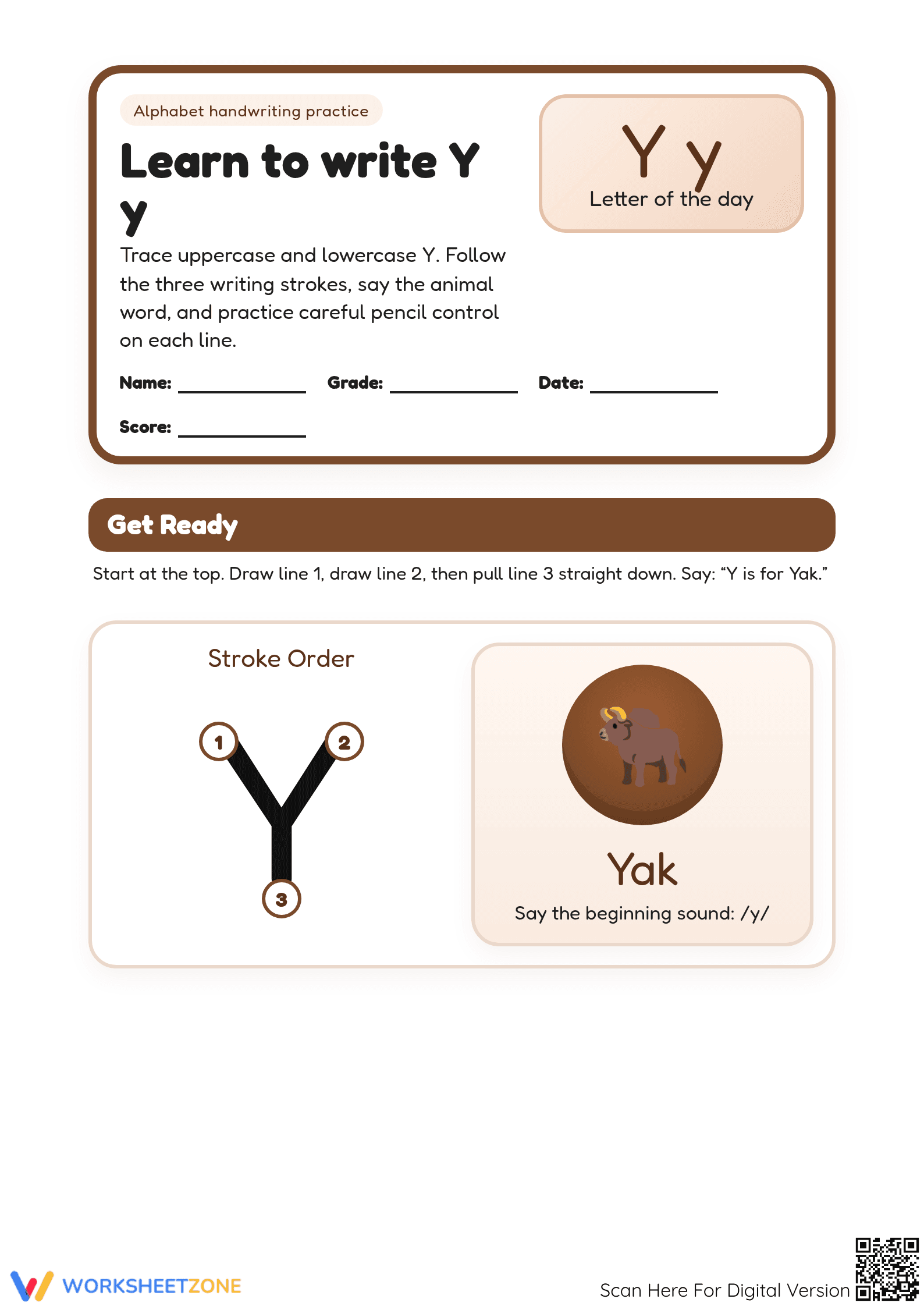
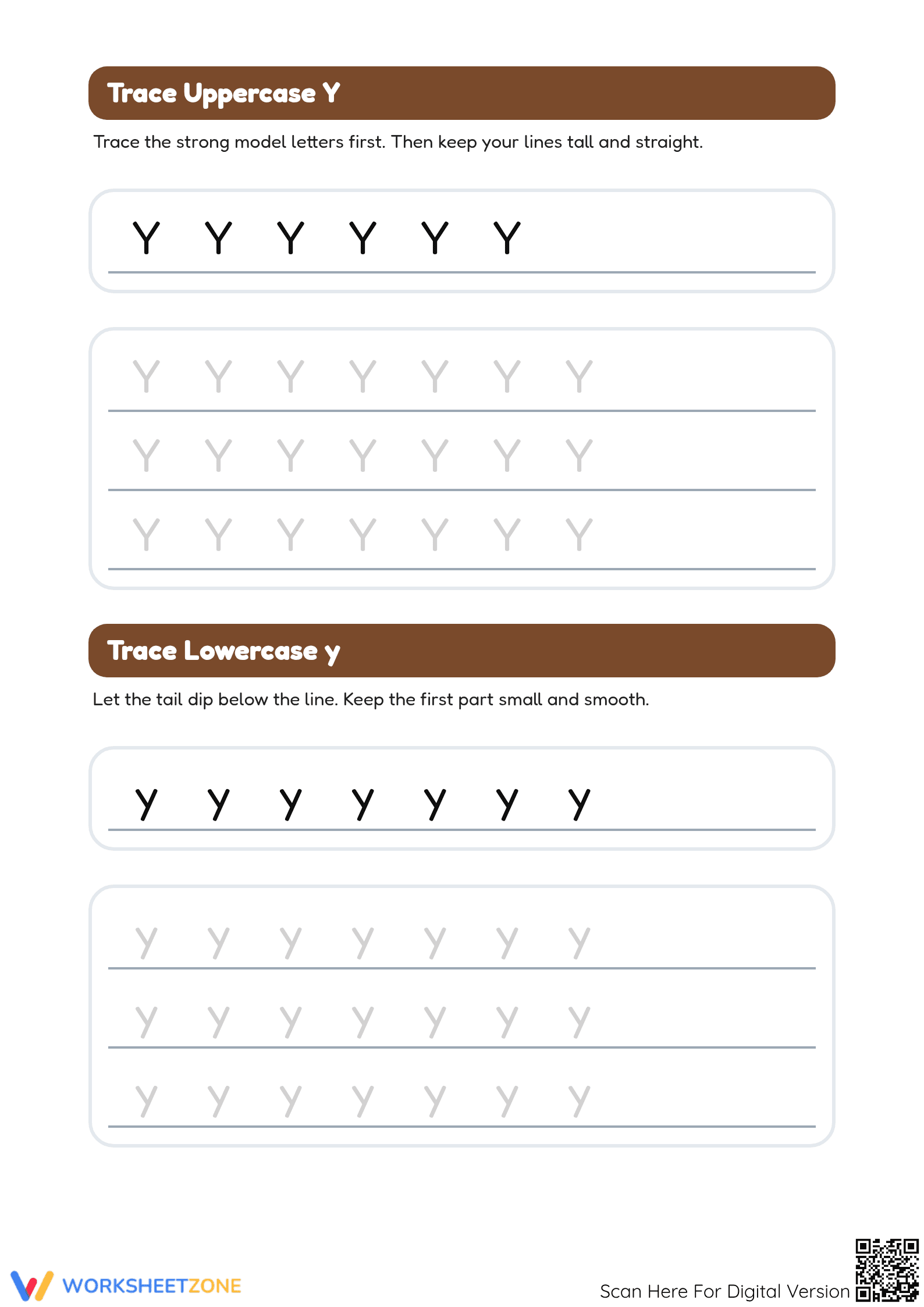
The packet contains three comprehensive pages designed to transition students from guided tracing to independent writing. Page one features a large-scale stroke order diagram with numbered steps (1, 2, 3) to prevent reversals. It includes a "Letter of the Day" visual with a Yak illustration. Subsequent pages provide tracing rows for uppercase and lowercase "Y," followed by an independent writing prompt.
Zero-Prep Workflow
This resource is designed for immediate classroom integration with zero teacher preparation. First, print the three-page PDF set. Second, distribute the worksheets during your literacy block or as a transition activity. Finally, review completed work to identify students needing support with pencil grip or stroke direction. The self-explanatory instructions make it an ideal choice for sub plans or independent learning centers.
Standards Alignment
The primary alignment for this worksheet is CCSS.ELA-LITERACY.L.K.1.A: "Print many upper- and lowercase letters." By focusing on the specific mechanics of the letter Y, the resource also supports foundational reading standards involving letter-sound recognition. This standard code can be copied directly into lesson plans, IEP goals, or district curriculum mapping tools.
How to Use It
Use this worksheet during the "You Do" portion of a gradual release lesson. After modeling stroke order, allow students to work through the tracing pages at their own pace. For a formative assessment tip, observe students at step 3 of the uppercase "Y" to ensure they pull the final line straight down. This helps identify needs for fine motor intervention.
Who It's For
This resource is tailored for Preschool, Kindergarten, and Grade 1 students building foundational literacy skills. It is effective for students requiring extra repetition to master the "tail" placement of lowercase "y." This worksheet pairs naturally with an alphabet song or tactile salt-tray writing lesson for a multi-sensory approach.
Instructional design for early handwriting emphasizes the necessity of explicit stroke order modeling to prevent the fossilization of inefficient writing habits. Research indicates that systematic practice in letter formation, particularly when coupled with phonetic cues like the "Y is for Yak" association, significantly accelerates the transition from letter recognition to fluent writing. According to a NAEP analysis, early mastery of upper- and lowercase letter production is a robust predictor of later writing fluency and overall literacy achievement in the primary grades. This worksheet implements these findings by providing numbered stroke guides and high-frequency tracing opportunities that build muscle memory. By integrating fine motor practice with initial sound identification, the curriculum ensures that students develop the cognitive and physical frameworks required for the CCSS.ELA-LITERACY.L.K.1.A standard. This resource serves as a structured tool for teachers looking to provide evidence-based, printable practice that bridges the gap between identification and application.


