




























Views
Downloads

Letter O Tracing Worksheet | Printable Kindergarten ELA

Paste this activity's link or code into your existing LMS (Google Classroom, Canvas, Teams, Schoology, Moodle, etc.).
Students can open and work on the activity right away, with no student login required.
You'll still be able to track student progress and results from your teacher account.
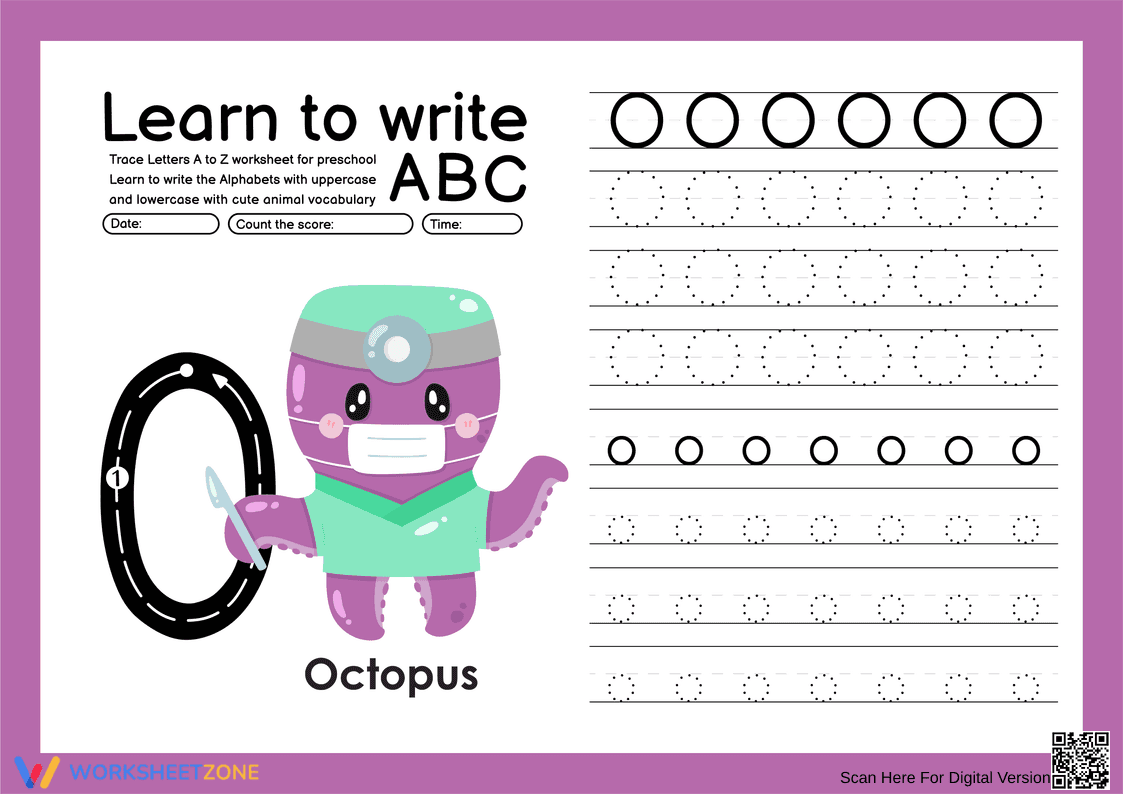
This printable letter O worksheet helps early learners develop essential handwriting skills and letter recognition. By tracing both uppercase and lowercase forms, students build the fine motor control needed for fluent writing. The engaging octopus illustration connects the letter to its beginning sound, reinforcing foundational phonics concepts.
At a Glance
- Grade: Kindergarten · Subject: ELA
- Standard:
CCSS.ELA-LITERACY.L.K.1.A— Print many upper- and lowercase letters- Skill Focus: Letter O Tracing and Recognition
- Format: 1 page · 42 problems · No answer key needed · PDF
- Best For: Independent practice
- Time: 10–15 minutes
This single-page resource features a large, guided letter O with directional arrows to establish proper stroke order. Below the introductory graphic, students will find seven rows of dotted tracing lines. The page includes a mix of uppercase and lowercase practice, alongside a cute octopus character to anchor the letter's phonetic sound. A dedicated space for the date, score, and time helps teachers track student progress.
- Guided practice: Students begin by tracing the large, numbered letter O, following the explicit directional arrows to learn the correct continuous circular stroke.
- Supported practice: The first few rows provide fully dotted letters, allowing children to build muscle memory while staying on the guided lines.
- Independent practice: The final rows offer less scaffolding, encouraging students to form the letter O with increasing independence.
This gradual-release approach ensures students confidently transition from the "I Do" modeling phase to the "You Do" independent writing phase.
This worksheet is aligned to primary standard CCSS.ELA-LITERACY.L.K.1.A: Print many upper- and lowercase letters. It also supports early phonics skills by associating the letter O with the word "octopus." Both standard codes can be copied directly into lesson plans, IEP goals, or district curriculum mapping tools.
Deploy this worksheet during morning work or as a focused literacy center activity after direct instruction on the letter O. Teachers can use it as a formative assessment by observing students' pencil grip and stroke direction as they trace the large initial letter. Expected completion time ranges from 10 to 15 minutes, making it an ideal quick-check activity.
This resource is designed for Preschool, Kindergarten, and Grade 1 students mastering the alphabet. It provides excellent differentiation for occupational therapy students needing targeted fine motor practice. Pair this worksheet with an alphabet anchor chart or a read-aloud focusing on the short "o" sound to maximize engagement.
Mastering letter formation is a critical stepping stone in early literacy development. According to Fisher & Frey (2014), explicit instruction in handwriting and letter recognition significantly impacts a student's future reading and writing fluency. When students practice the specific skill to print many upper- and lowercase letters, as outlined in CCSS.ELA-LITERACY.L.K.1.A, they reduce the cognitive load required for physical writing. This automaticity frees up vital mental resources for more complex composition and reading comprehension tasks later in their academic journey. This targeted letter O tracing worksheet provides the exact repetitive, structured practice necessary to build that essential muscle memory. By combining explicit directional stroke guidance with phonetic visual cues like the octopus, educators can ensure that foundational alphabet skills are firmly established during the critical early childhood learning window, setting students up for long-term literacy success.


