


























Views
Downloads
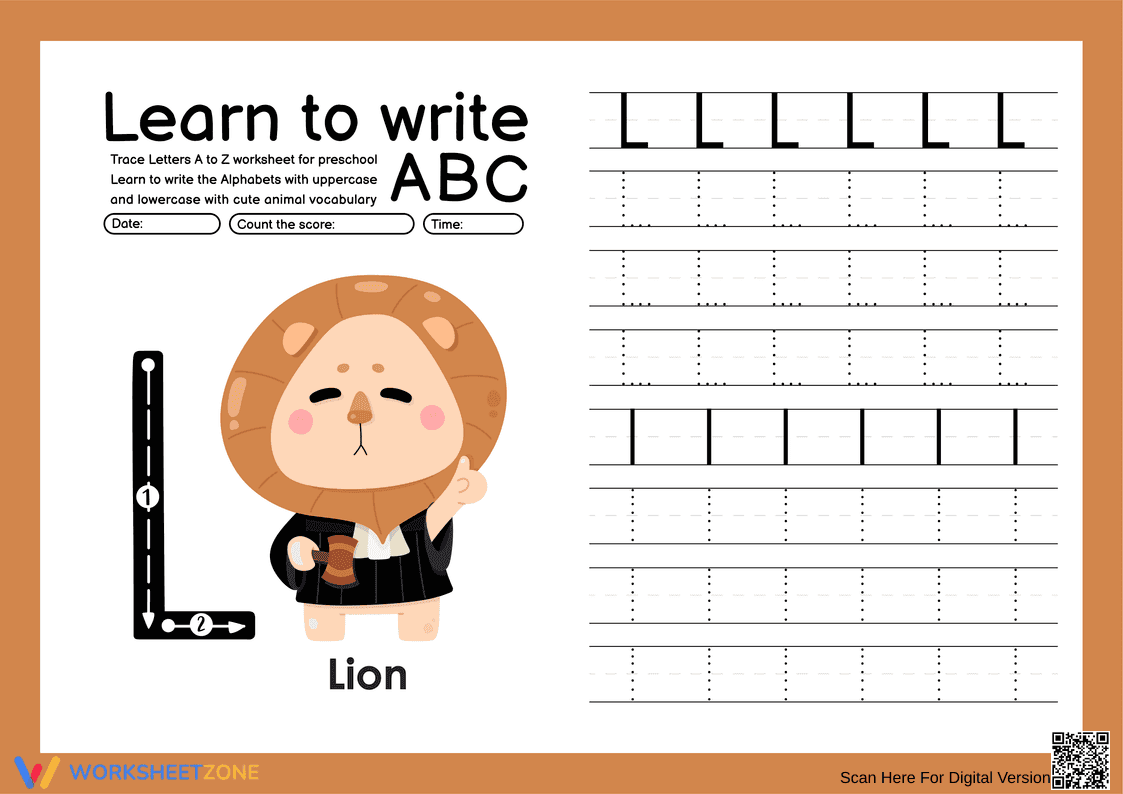

Printable Letter L Tracing Worksheet | Grade K
Paste this activity's link or code into your existing LMS (Google Classroom, Canvas, Teams, Schoology, Moodle, etc.).
Students can open and work on the activity right away, with no student login required.
You'll still be able to track student progress and results from your teacher account.
This printable letter formation worksheet helps early learners master the uppercase letter L through guided tracing practice. Students develop fine motor control and muscle memory as they follow directional arrows and trace the letter repeatedly, ensuring proper stroke order and building foundational handwriting skills for future literacy success.
At a Glance
- Grade: K · Subject: ELA
- Standard:
CCSS.ELA-LITERACY.L.K.1.A— Print many upper- and lowercase letters- Skill Focus: Letter L Formation
- Format: 1 page · 36 problems · No answer key · PDF
- Best For: Independent practice
- Time: 10–15 minutes
This single-page resource features a large, instructional letter L with numbered directional arrows to demonstrate correct top-to-bottom and left-to-right stroke sequence. An engaging lion illustration provides a helpful phonetic anchor. The right side contains six rows of tracing practice, starting with solid models and transitioning to dotted lines, offering 36 total opportunities for students to practice their uppercase L formation.
Zero-Prep Workflow
- Print (1 minute): Simply download the PDF and print the required number of copies. No special materials or cutting required.
- Distribute (1 minute): Hand out the sheets along with pencils or crayons. The visual instructions make the task immediately clear to young learners.
- Review (1 minute): Quickly scan student work to ensure they are starting their strokes at the top line rather than the bottom.
Total teacher prep time is under two minutes, making this an excellent, reliable option for morning work, literacy centers, or emergency substitute plans.
This resource aligns directly with CCSS.ELA-LITERACY.L.K.1.A: Print many upper- and lowercase letters. It specifically targets the uppercase L, providing the repetition necessary for mastery. Both standard codes can be copied directly into lesson plans, IEP goals, or district curriculum mapping tools.
Use this worksheet during morning arrival as a calm, focused activity that reinforces the letter of the week. Alternatively, place it in a literacy center alongside tactile letter-building materials like playdough or sand trays. While students work, observe their pencil grip and stroke direction; intervene gently if a student consistently starts the vertical line of the L from the bottom up. Expected completion time ranges from 10 to 15 minutes depending on the child's fine motor development.
This worksheet is designed for preschool, kindergarten, and first-grade students who are developing basic handwriting skills. It serves as an excellent intervention tool for older students who struggle with letter reversals or stroke sequence. Pair this practice sheet with a read-aloud book featuring a lion or other L-vocabulary words to connect the physical writing task to broader phonetic awareness.
Effective handwriting instruction requires explicit modeling followed by ample opportunities for guided repetition. According to Fisher & Frey (2014), structured practice with immediate feedback is critical for developing automaticity in foundational skills. This worksheet supports that framework by providing clear visual cues for stroke order before asking students to execute the task independently. By aligning with CCSS.ELA-LITERACY.L.K.1.A, which requires students to print many upper- and lowercase letters, this resource ensures that early learners build the necessary muscle memory for fluent writing. The transition from tracing solid lines to dotted lines scaffolds the learning process, reducing cognitive load so students can focus entirely on motor control. Consistent practice with targeted resources like this reduces later struggles with written expression, allowing students to dedicate more working memory to content creation rather than letter formation.


