


























Views
Downloads
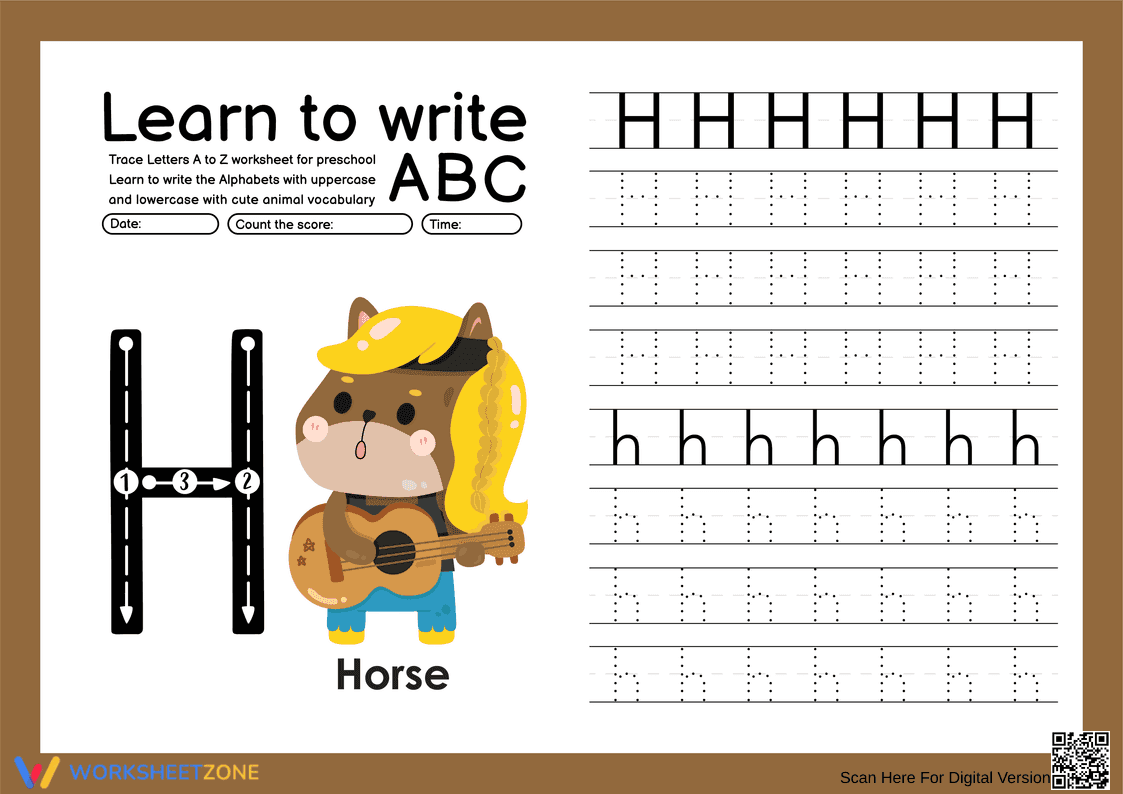

Letter H Writing Practice | Essential Kindergarten Worksheet
Paste this activity's link or code into your existing LMS (Google Classroom, Canvas, Teams, Schoology, Moodle, etc.).
Students can open and work on the activity right away, with no student login required.
You'll still be able to track student progress and results from your teacher account.
This Letter H writing worksheet provides foundational handwriting practice for early learners. Students master the specific stroke sequences required for both uppercase 'H' and lowercase 'h' through repetitive tracing and independent production. By connecting the letter shape to the "Horse" visual, students strengthen phonemic awareness alongside fine motor development.
At a Glance
- Grade: Kindergarten · Subject: ELA Alphabet
- Standard:
CCSS.ELA-LITERACY.RF.K.1.D— Recognize and name all upper- and lowercase letters of the alphabet- Skill Focus: Letter H formation
- Format: 1 page · 48 tasks · Answer key included · PDF
- Best For: Daily morning work or literacy centers
- Time: 10–15 minutes
The worksheet features a large, numbered stroke-order guide for the letter H, accompanied by a friendly horse illustration to anchor the initial sound. It contains 8 dedicated rows for practice: four for uppercase 'H' and four for lowercase 'h'. Each row begins with a solid model followed by dashed tracing guides, transitioning students from supported to independent writing.
Zero-Prep Workflow
This resource is designed for immediate classroom implementation with a total teacher prep time of under 2 minutes. Follow these three steps:
- Print (1 min): Select the single-page PDF and print enough copies for your cohort.
- Distribute (30 sec): Hand out the sheets during your phonics block or as a transition activity.
- Review (30 sec): Quickly scan for proper pencil grip and stroke direction as students work.
The self-explanatory layout makes this an ideal choice for emergency sub plans or independent station work.
Standards Alignment
This worksheet is directly aligned with `CCSS.ELA-LITERACY.RF.K.1.D`, which requires students to "Recognize and name all upper- and lowercase letters of the alphabet." By focusing specifically on the letter H, it provides the targeted repetition necessary for orthographic mapping. This standard code can be copied directly into lesson plans, IEP goals, or district curriculum mapping tools.
How to Use It
Use this worksheet during the "You Do" phase of a gradual release lesson. After modeling the letter formation on a whiteboard, assign this page to verify student understanding. It also serves as an excellent formative assessment; observe if students follow the numbered arrows (1-2-3) or create their own inefficient strokes. Expected completion time is 10 to 15 minutes depending on fine motor proficiency.
Who It's For
This resource is tailored for Preschool, Kindergarten, and Grade 1 students who are developing letter-sound correspondence. It is particularly effective for students requiring extra fine motor support or those in Tier 2 intervention groups. Pair this with a physical alphabet anchor chart or a tactile sand-tracing activity for a multi-sensory learning experience.
The development of letter recognition and formation is a critical precursor to reading fluency, as outlined in the CCSS.ELA-LITERACY.RF.K.1.D standard. Research by Fisher & Frey (2014) emphasizes the importance of guided practice in the "gradual release of responsibility" model, which this worksheet facilitates through its transition from traced to independent lines. By providing 48 distinct opportunities to practice the letter H, this resource ensures that students move beyond simple recognition toward automaticity in handwriting. Such automaticity allows cognitive resources to be redirected from the mechanics of writing to higher-order composition tasks in later grades. This worksheet serves as a reliable tool for educators to document student progress in foundational literacy skills, meeting the rigorous demands of early childhood ELA frameworks and supporting evidence-based instructional strategies in the modern classroom.


