




























Views
Downloads
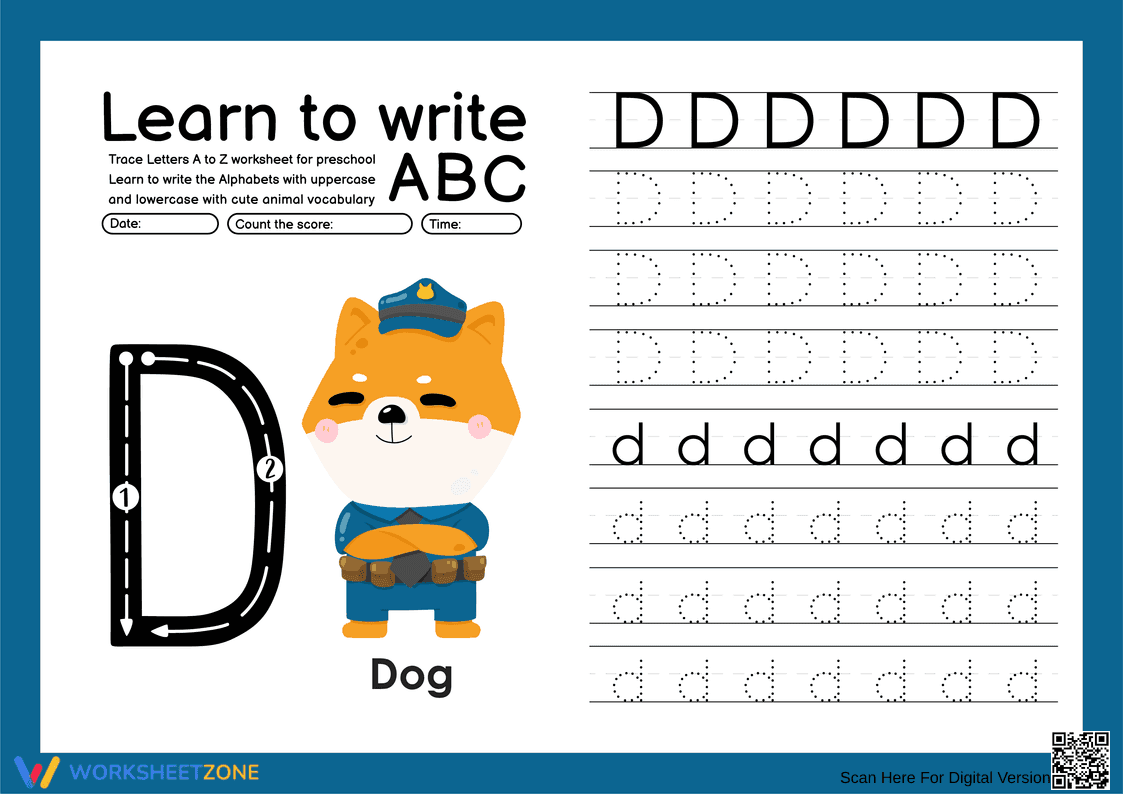

Letter D Writing Practice | Essential Grade K Worksheet

Paste this activity's link or code into your existing LMS (Google Classroom, Canvas, Teams, Schoology, Moodle, etc.).
Students can open and work on the activity right away, with no student login required.
You'll still be able to track student progress and results from your teacher account.
This Grade K letter formation worksheet helps early learners master the specific strokes required to write the letter D. By combining visual cues with repetitive tracing, students develop the fine motor control necessary for legible handwriting. This resource ensures students can confidently distinguish and produce both uppercase and lowercase versions of the letter.
At a Glance
- Grade: Kindergarten · Subject: ELA Alphabet
- Standard:
CCSS.ELA-LITERACY.L.K.1.A— Print many upper- and lowercase letters accurately- Skill Focus: Letter D formation
- Format: 1 page · 56 tracing tasks · Answer key included · PDF
- Best For: Daily morning work or handwriting centers
- Time: 10–15 minutes
Inside this single-page PDF, you will find a large instructional graphic showing the numbered stroke order for the letter D. The worksheet features four rows dedicated to uppercase 'D' and four rows for lowercase 'd', providing ample repetition. A "Dog" keyword illustration reinforces the letter-sound connection, while dedicated fields for date and score help track student progress.
- Guided practice: Students begin by following numbered directional arrows on a large-scale model to understand the vertical and curved strokes.
- Supported practice: Eight rows of dotted-line tracing provide high-frequency repetition to build muscle memory for both cases.
- Independent practice: The final letters in each row transition students toward producing the letter with minimal visual scaffolding.
This sequence follows a gradual-release model, moving from heavy visual support to independent letter production.
This resource is specifically aligned to `CCSS.ELA-LITERACY.L.K.1.A`, which requires students to print many upper- and lowercase letters. It also supports foundational phonics by linking the letter shape to the initial /d/ sound in "Dog." Both standard codes can be copied directly into lesson plans, IEP goals, or district curriculum mapping tools.
Use this worksheet during the "You Do" phase of a handwriting lesson after demonstrating the stroke order on a whiteboard. It is also an excellent formative assessment tool; observe students as they work to identify those struggling with pencil grip or stroke directionality. Expected completion time is 10 to 15 minutes depending on fine motor development.
This worksheet is designed for preschool, kindergarten, and first-grade students who are beginning their literacy journey. It is particularly helpful for students requiring extra fine motor support or English Language Learners (ELLs) building basic vocabulary. Pair this with a letter-sound anchor chart or a tactile sand-tracing activity for a multi-sensory experience.
According to the RAND AIRS 2024 report on early literacy, consistent and repetitive tracing of individual characters is a fundamental precursor to reading fluency and orthographic mapping. This worksheet targets the specific motor pathways required for the letter D, ensuring that students move beyond simple recognition to active production. By isolating the letter D, the resource prevents cognitive overload, allowing young learners to focus entirely on the mechanics of the curve and the vertical line. Research from Fisher & Frey (2014) emphasizes that such focused practice, when integrated into a broader literacy curriculum, significantly improves a child's ability to recall letter shapes during independent writing tasks. This printable provides the structured environment necessary for this development, meeting the rigorous demands of early childhood standards while remaining accessible and engaging for the learner.


