


























Views
Downloads

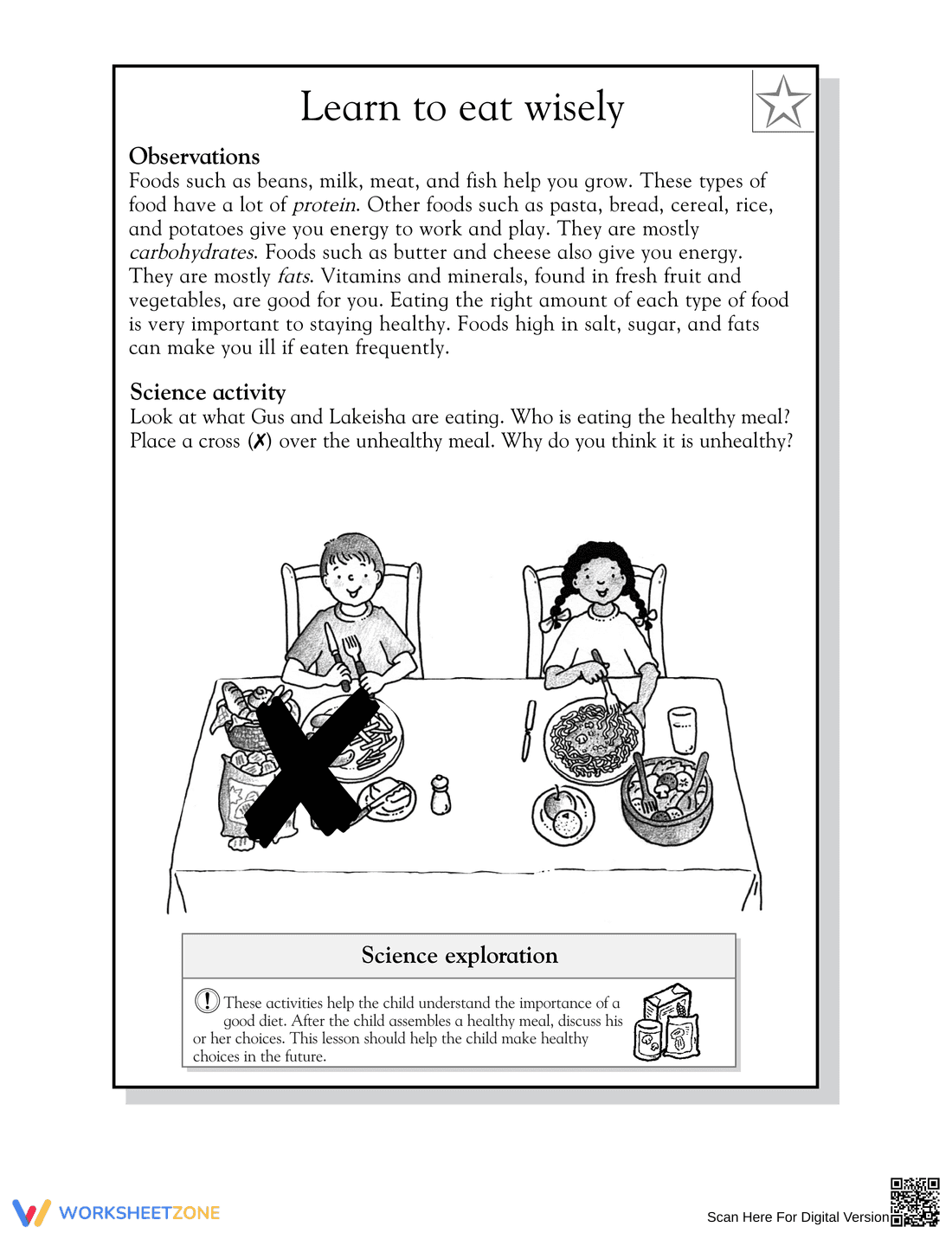

Learn to Eat Wisely: Essential Grade 1-2 Science Worksheet
Paste this activity's link or code into your existing LMS (Google Classroom, Canvas, Teams, Schoology, Moodle, etc.).
Students can open and work on the activity right away, with no student login required.
You'll still be able to track student progress and results from your teacher account.
In this science worksheet, students explore the connection between nutrition and physical growth. By analyzing food groups like proteins and carbohydrates, learners develop skills to distinguish between healthy and unhealthy meal choices. This activity empowers children to make informed decisions about their dietary habits and health.
At a Glance
- Grade: 1-2 · Subject: Science & Health
- Standard:
1-LS1-1— Use observations to describe patterns of what humans need to survive and grow- Skill Focus: Nutritional food groups and healthy meal identification
- Format: 1 page · 3 tasks · Cut-and-paste exploration · PDF
- Best For: Introduction to nutrition and healthy habits
- Time: 20–30 minutes
What's Inside
This single-page worksheet features three sections. It begins with "Observations" text introducing proteins, carbohydrates, fats, and vitamins. The "Science activity" presents a visual comparison task where students analyze Gus and Lakeisha's meals. The sheet concludes with a "Science exploration" where students cut out pictures to construct their own healthy meal.
Skill Progression
- Guided Practice: The "Observations" section provides explicit instruction on 5 key food groups with defined roles for growth and energy.
- Supported Practice: Students apply their knowledge to a 2-person meal comparison task, identifying healthy patterns in a controlled visual context.
- Independent Practice: The final exploration task requires students to select and organize 3 or more food items to build a balanced meal independently.
This sequence follows a gradual-release model, moving from information acquisition to applied critical thinking and creative synthesis.
Standards Alignment
This resource is primarily aligned to 1-LS1-1: "Use materials to design a solution to a human problem by mimicking how plants and/or animals use their external parts to help them survive, grow, and meet their needs." By understanding how nutrients support the body's growth and function, students address the biological requirements for health. Both standard codes can be copied directly into lesson plans, IEP goals, or district curriculum mapping tools.
How to Use It
Use this worksheet during instruction on the human body or food groups. For formative assessment, listen to students explain why they marked a meal as unhealthy; look for mentions of salt or sugar. Expect completion within 25 minutes, depending on whether the cutting activity is done in class.
Who It's For
Designed for first and second graders, this worksheet is ideal for learners who benefit from combining text with visual analysis. It pairs well with a "healthy plate" anchor chart. Teachers can differentiate by providing sentence frames for the written explanation to support English Language Learners.
Health education in early childhood is vital for establishing lifelong habits. According to EdReports 2024, high-quality science materials for primary grades must integrate literacy and visual analysis to build understanding of biological needs. This worksheet addresses standard 1-LS1-1 by asking students to use observations of food groups to identify patterns in healthy living. By categorizing proteins and carbohydrates, students develop the vocabulary necessary to describe how humans grow. Fisher & Frey (2014) emphasize that gradual release—from informative text to applied visual tasks—supports deep cognitive engagement and knowledge retention. Integrating hands-on activities, such as the included cutting exercise, reinforces these concepts for kinesthetic learners while meeting national standards for primary science. This approach ensures that students not only identify healthy foods but also understand the biological "why" behind their choices, facilitating true scientific literacy in early childhood.


