


























Views
Downloads
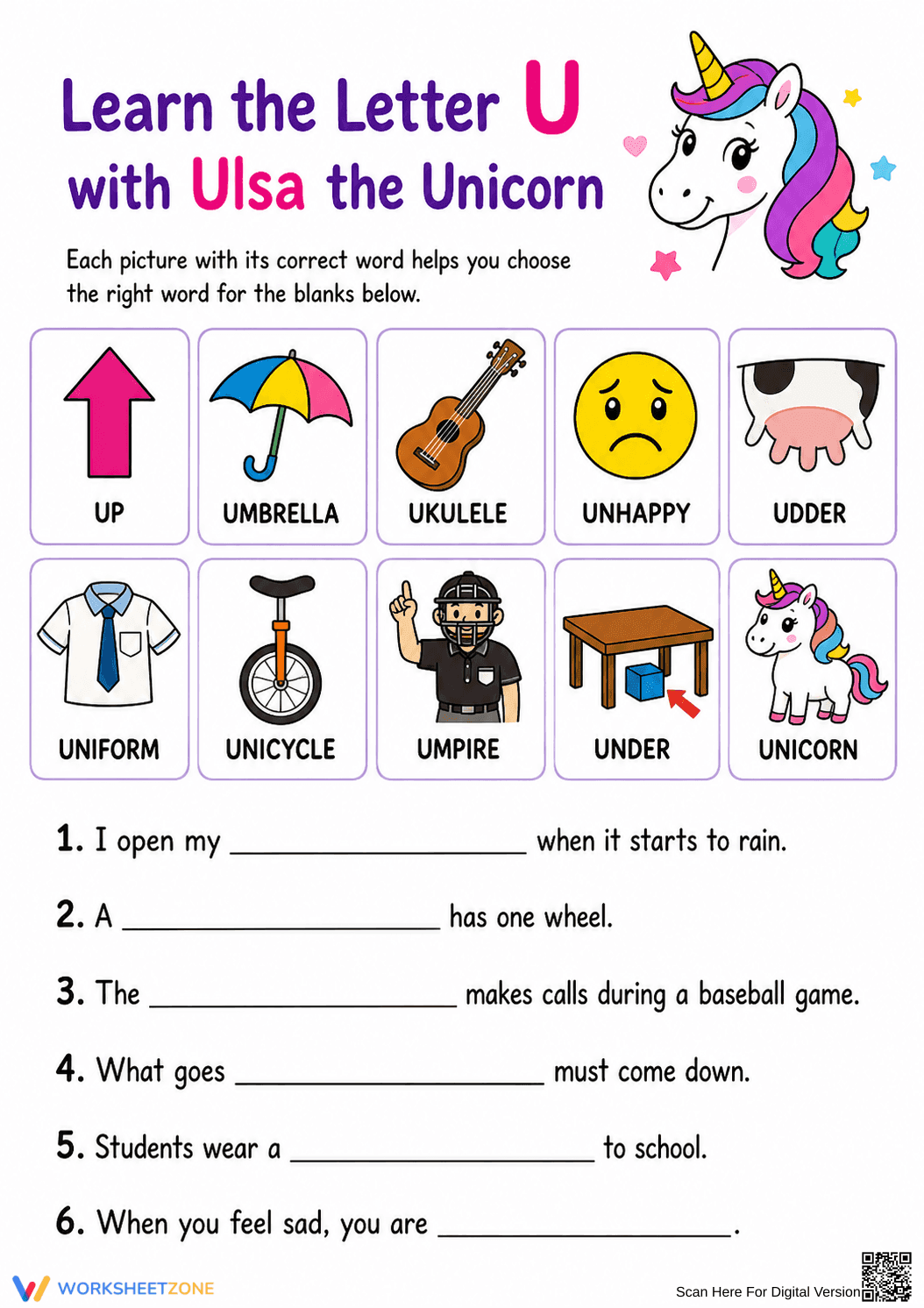

Essential Letter U Vocabulary Worksheet | Grade 3-4
Paste this activity's link or code into your existing LMS (Google Classroom, Canvas, Teams, Schoology, Moodle, etc.).
Students can open and work on the activity right away, with no student login required.
You'll still be able to track student progress and results from your teacher account.
This Grade 3 and 4 ELA worksheet strengthens vocabulary and phonics through context-based sentence completion. Students use visual cues and a word bank to identify words beginning with the letter U, such as unicycle and umpire. By connecting images to written sentences, learners improve their reading comprehension and spelling accuracy in a structured format.
At a Glance
- Grade: 3-4 · Subject: ELA & Grammar
- Standard:
CCSS.ELA-LITERACY.L.3.4— Determine or clarify the meaning of unknown and multiple-meaning words and phrases- Skill Focus: Letter U Vocabulary & Context Clues
- Format: 1 page · 6 problems · Answer key included · PDF
- Best For: Morning work or independent literacy centers
- Time: 10–15 minutes
The worksheet features a vibrant visual word bank containing 10 illustrated terms, including umbrella, ukulele, and uniform. Below the reference section, students encounter 6 fill-in-the-blank sentences designed to test their ability to apply these words in context. The single-page PDF layout ensures all necessary information is visible at once, reducing student frustration and cognitive load during independent work time.
This resource is designed for a zero-prep workflow. First, print the single-page PDF in less than 30 seconds. Second, distribute the sheets to students during a literacy block or as a transition activity. Third, review the answers as a whole group or use the included key for quick grading. Total teacher preparation time is under 2 minutes, making it an ideal sub-plan or emergency filler activity.
This activity aligns with `CCSS.ELA-LITERACY.L.3.4`, focusing on using context as a clue to the meaning of a word or phrase. It also supports foundational phonics by reinforcing word recognition skills. Both standard codes can be copied directly into lesson plans, IEP goals, or district curriculum mapping tools to ensure instructional compliance and tracking.
Use this worksheet as a formative assessment after a lesson on beginning sounds or as a warm-up activity to activate prior knowledge. Teachers should observe if students can match the visual representation of the umpire or unicycle to the specific sentence logic. Completion typically takes 10 to 15 minutes, allowing for easy integration into a busy classroom schedule without disrupting the core curriculum.
This resource is tailored for Grade 3 and 4 students who need targeted practice with vocabulary and spelling. It is particularly effective for English Language Learners (ELL) who benefit from the direct image-to-word association. Pair this worksheet with a reading passage about unicorns or a phonics anchor chart to provide a comprehensive instructional experience for diverse learners.
Research from Fisher & Frey (2014) emphasizes the importance of visual scaffolding in vocabulary acquisition, particularly for students transitioning from primary to intermediate grades. This worksheet utilizes the CCSS.ELA-LITERACY.L.3.4 standard to bridge the gap between phonemic awareness and semantic application. By requiring students to select the correct U word based on sentence logic, the activity promotes higher-order thinking beyond simple rote memorization. According to the NAEP, students who engage in frequent context-clue practice demonstrate significantly higher reading proficiency scores. This printable resource provides 6 specific opportunities for students to practice these essential skills in a low-stakes, high-engagement format. The inclusion of a visual word bank reduces the barrier to entry for struggling readers while maintaining the rigor required for Grade 3 and 4 standards. This evidence-based approach ensures that students develop the linguistic flexibility needed for complex informational texts.


