




























Views
Downloads
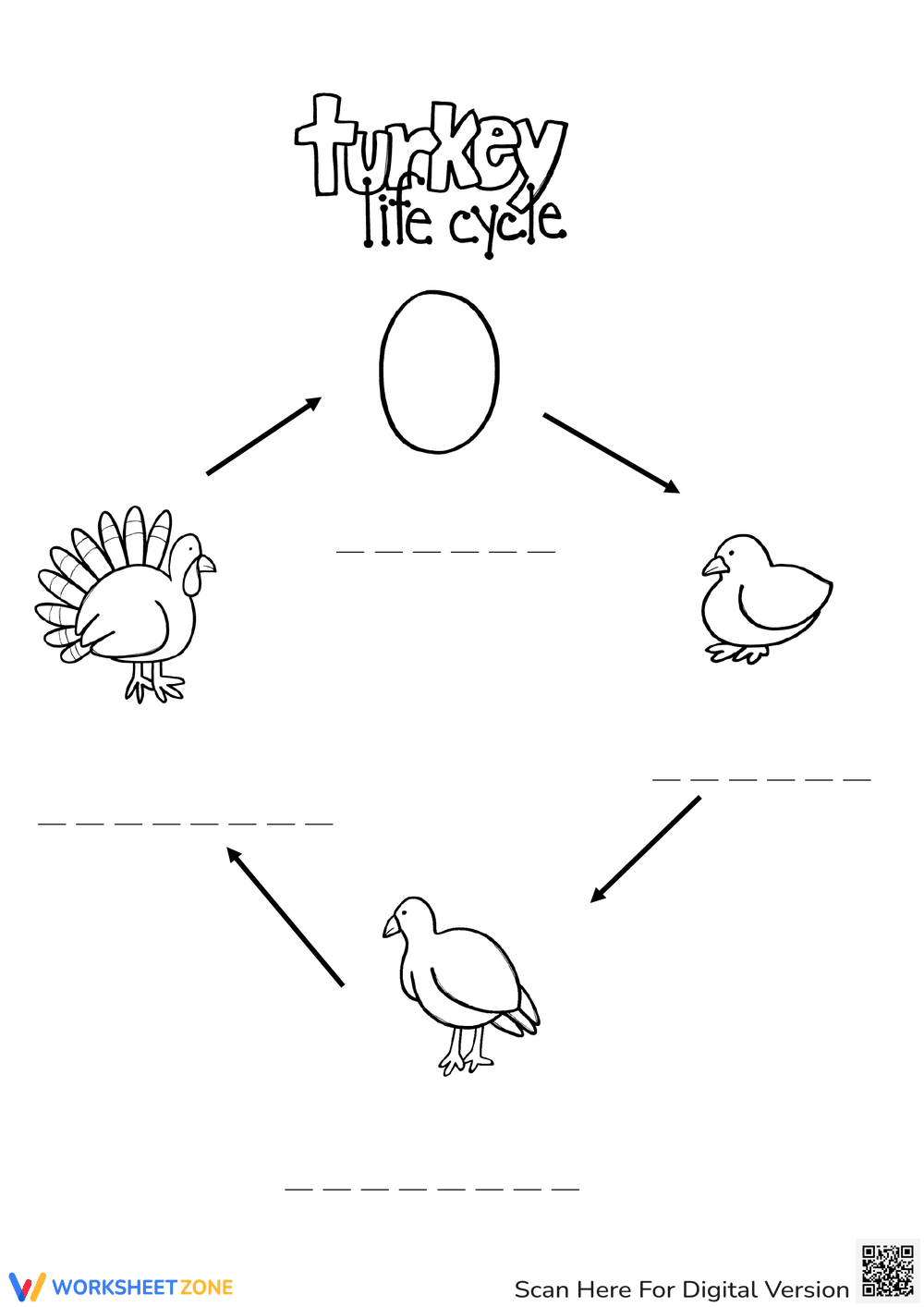

Turkey Life Cycle Worksheet | Essential Grade 3-5 Science

Paste this activity's link or code into your existing LMS (Google Classroom, Canvas, Teams, Schoology, Moodle, etc.).
Students can open and work on the activity right away, with no student login required.
You'll still be able to track student progress and results from your teacher account.
This turkey life cycle worksheet helps students identify and sequence the biological stages of a turkey from egg to adult. By labeling the four distinct phases, learners develop a concrete understanding of growth and development in birds. It is an ideal resource for reinforcing life science concepts during Thanksgiving or autumn-themed science units.
At a Glance
- Grade: 3-5 · Subject: Science
- Standard:
3-LS1-1— Develop models to describe that organisms have unique and diverse life cycles- Skill Focus: Turkey Life Cycle Stages
- Format: 1 page · 4 problems · Answer key included · PDF
- Best For: Quick formative assessment or holiday science
- Time: 10–15 minutes
This single-page PDF features a clear, circular diagram illustrating the four stages of a turkey's development. Students are provided with visual cues for each stage—egg, hatchling, juvenile, and adult—and must fill in the corresponding blanks. The clean layout includes a title and directional arrows to emphasize the cyclical nature of biological growth, accompanied by a comprehensive answer key for teacher use.
Zero-Prep Workflow
- Print: Generate the single-page PDF for your entire class in under 30 seconds.
- Distribute: Hand out the sheets as a quiet warm-up or a focused exit ticket during your science block.
- Review: Use the provided answer key to check for understanding in less than 2 minutes of total teacher time.
This streamlined process makes the worksheet an excellent choice for emergency sub plans or last-minute holiday activities where instructional time is at a premium.
Standards Alignment
This resource aligns with 3-LS1-1: "Develop models to describe that organisms have unique and diverse life cycles but all have in common birth, growth, reproduction, and death." It specifically addresses the "growth" and "birth" components of the standard through visual representation. Both standard codes can be copied directly into lesson plans, IEP goals, or district curriculum mapping tools.
How to Use It
Use this worksheet during the "Explain" phase of a 5E lesson model to solidify vocabulary after observing bird development. It also serves as a perfect formative assessment tool; observe if students can correctly sequence the stages without assistance. Expected completion time is 10 to 15 minutes, depending on whether students color the illustrations after labeling.
Who It's For
This activity is designed for elementary students in grades 3 through 5, though it can be adapted for older students requiring visual supports. It is particularly effective for English Language Learners (ELLs) who benefit from the direct pairing of images with vocabulary terms. Pair this with a non-fiction passage about poultry or a Thanksgiving-themed anchor chart.
According to the RAND AIRS 2024 report, high-quality visual aids in science education significantly improve the retention of complex biological sequences among elementary learners. This worksheet utilizes a circular model to represent the 3-LS1-1 standard, focusing on the turkey life cycle. By requiring students to actively label stages like the egg and adult phases, the resource moves beyond passive observation toward active cognitive engagement. Research from Fisher & Frey (2014) suggests that such scaffolded labeling tasks are essential for building domain-specific vocabulary in the life sciences. This printable provides a structured environment for students to demonstrate mastery of life cycle concepts while reducing the cognitive load through clear, representational imagery. Educators can rely on this tool to provide evidence of student understanding regarding how organisms grow and change over time, ensuring that foundational NGSS requirements are met through a simple, classroom-ready format.


