




























Views
Downloads

Grade K-1 Kinds of Birds — Printable No-Prep Worksheet

Paste this activity's link or code into your existing LMS (Google Classroom, Canvas, Teams, Schoology, Moodle, etc.).
Students can open and work on the activity right away, with no student login required.
You'll still be able to track student progress and results from your teacher account.
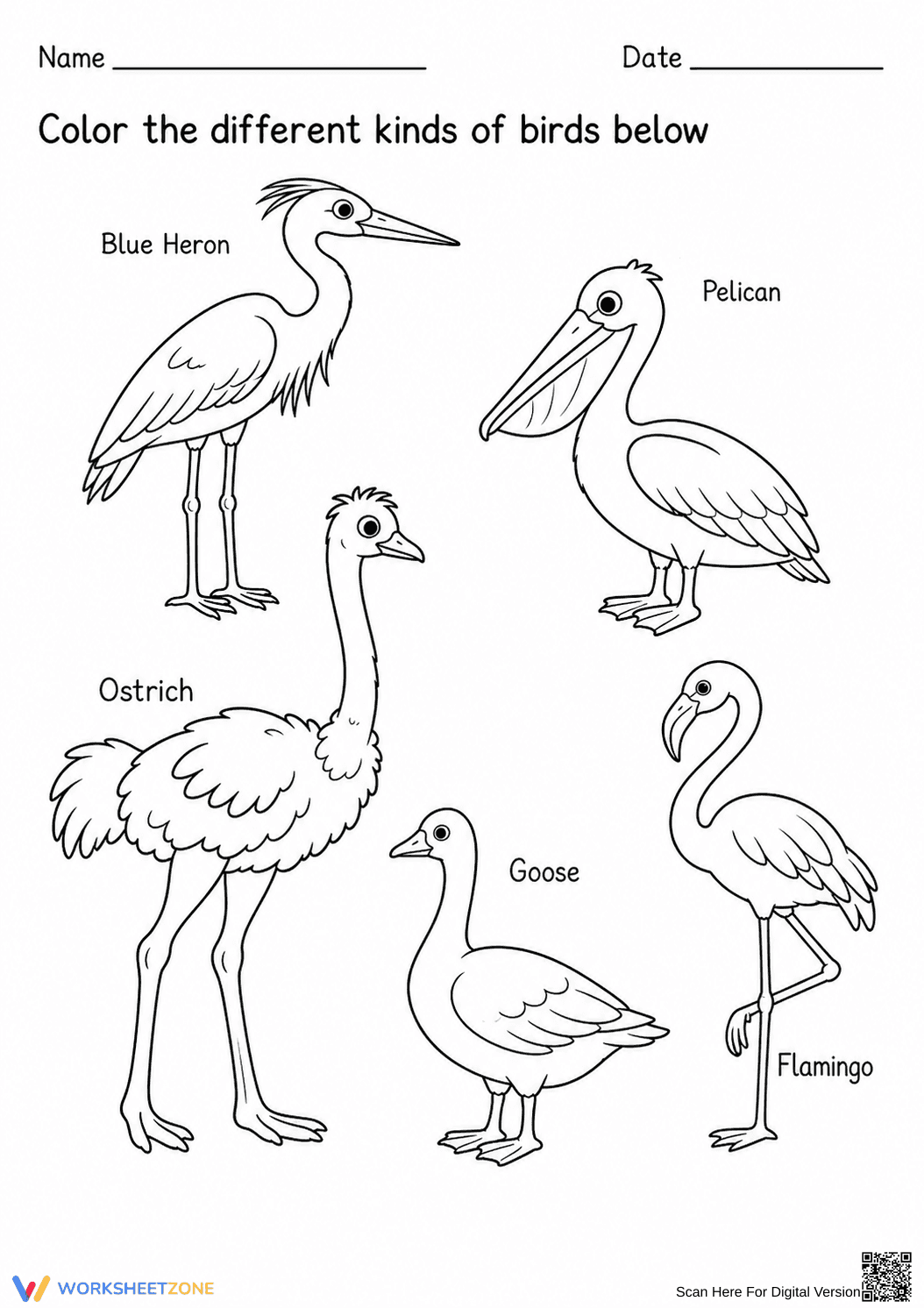
This Grade K-1 science worksheet helps students identify unique bird species while practicing essential fine motor skills. By observing distinct shapes of species like the flamingo and ostrich, young learners build a strong mental framework for animal classification and biological diversity.
At a Glance
- Grade: K-1 · Subject: Science
- Standard:
K-LS1-1— Use observations to describe patterns in animals- Skill Focus: Bird Species Identification
- Format: 1 page · 5 tasks · No answer key required · PDF
- Best For: Science centers or early finishers
- Time: 15–20 minutes
What's Inside
This single-page PDF features clear line art of five diverse birds: the Blue Heron, Pelican, Ostrich, Goose, and Flamingo. Each bird is labeled to support early literacy and vocabulary acquisition. The illustrations are designed for easy coloring, making it an ideal resource for engaging young students in a low-stakes science activity.
Zero-Prep Workflow
The zero-prep workflow for this resource is designed for maximum efficiency. First, print the single-page document in seconds. Second, distribute the sheets to your students during your science block or as a calm transition activity. Finally, review the different bird names as a class. Total teacher preparation time is under two minutes, making it perfect for emergency sub plans.
Standards Alignment
Aligned with K-LS1-1, this activity encourages students to use observations to describe patterns of what animals need to survive. Specifically, it allows them to visualize variation in bird anatomy, from the long legs of the flamingo to the unique beak of the pelican. Both standard codes can be copied directly into lesson plans, IEP goals, or district curriculum mapping tools.
How to Use It
Use this worksheet during a unit on living things to introduce animal habitats and physical adaptations before direct instruction. As a formative assessment, observe students as they color to see if they can distinguish which birds might live near water based on physical traits. This worksheet takes 15 to 20 minutes to complete, providing a perfect window for focused individual work.
Who It's For
This resource is designed for Preschool, Kindergarten, and First Grade students exploring biological sciences. It provides excellent differentiation for English Language Learners by pairing visual representations with direct vocabulary labels. Pair this activity with a picture book about birds or an anchor chart showing animal coverings to deepen student understanding.
The K-LS1-1 standard emphasizes the importance of observation in early childhood science education, encouraging students to use observations to describe patterns in animals. This kinds of birds worksheet provides a focused platform for students to engage in primary observation, distinguishing between the Blue Heron, Pelican, Ostrich, Goose, and Flamingo based on their unique silhouettes and physical features. Research by Fisher & Frey (2014) highlights that visual aids and coloring activities serve as essential scaffolds for vocabulary acquisition and conceptual understanding in primary grades. By interacting with these illustrations, learners build a mental schema for avian diversity, which is a foundational component of biological sciences. The integration of fine motor practice through coloring further supports cognitive development and memory retention of bird types. This resource acts as a high-quality bridge between abstract biological concepts and concrete visual recognition, ensuring students achieve mastery of observable natural patterns.


