




























Views
Downloads

Kindergarten Color Quest — Printable No-Prep Worksheet

Paste this activity's link or code into your existing LMS (Google Classroom, Canvas, Teams, Schoology, Moodle, etc.).
Students can open and work on the activity right away, with no student login required.
You'll still be able to track student progress and results from your teacher account.
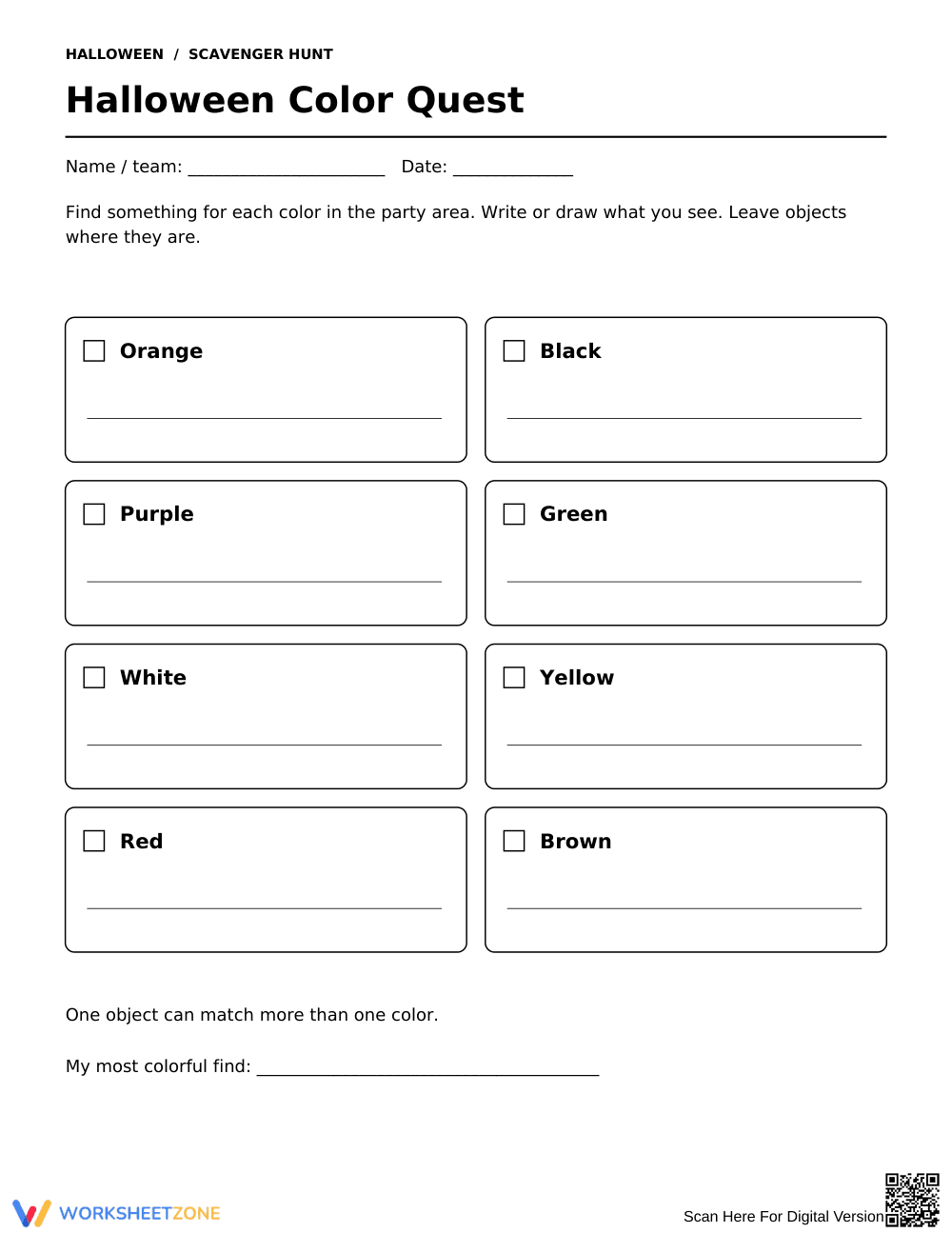
This printable Halloween color quest worksheet reinforces attribute classification through an active classroom scavenger hunt. Students identify, sort, and record objects across 8 color categories to build foundational observation skills. Designed for quick engagement, it combines visual discrimination with hands-on sorting to support early mathematical reasoning.
At a Glance
- Grade: Kindergarten · Subject: Math
- Standard:
CCSS.MATH.CONTENT.K.MD.B.3— Classify objects into given categories such as color and sort the items- Skill Focus: Color identification, sorting attributes, and visual recording
- Format: 1 student page · 8 tasks · Facilitator guide included · PDF
- Best For: Classroom learning station or party activity
- Time: 10–15 minutes
What's Inside
This resource includes a 1-page student hunt sheet and a 1-page facilitator guide. The student sheet features 8 color-coded prompt boxes with checkboxes, color names, and primary lines for writing or drawing. A concluding prompt highlights each child's favorite colorful find.
Zero-Prep Workflow
Educators can implement this activity with under 2 minutes of prep:
- Step 1: Print (1 minute): Copy the single student sheet and review the host guide.
- Step 2: Distribute (30 seconds): Provide pencils or crayons and set boundary rules.
- Step 3: Review (30 seconds): Check boxes as children share findings.
The clear directions make this an effective emergency sub plan or holiday center.
Standards Alignment
The primary focus aligns with CCSS.MATH.CONTENT.K.MD.B.3: classify objects into given categories, count items in categories, and sort categories. Supporting standard CCSS.ELA-LITERACY.L.K.5.A reinforces sorting objects to comprehend conceptual categories. Both standard codes can be copied directly into lesson plans, IEP goals, or district curriculum mapping tools.
How to Use It
Use this hunt during independent practice after a sorting lesson. For formative assessment, observe whether students match objects by true color rather than naming items arbitrarily. It also functions after direct instruction as a 10-minute partner game. Completion takes 10 to 15 minutes.
Who It's For
This sheet targets kindergarten and early primary learners building visual discrimination. Emergent writers can sketch instead of writing. Pair this activity with an autumn read-aloud or a classroom color anchor chart.
Structured attribute categorization provides the necessary cognitive bridge between perceptual recognition and mathematical classification in early childhood education. Aligned with CCSS.MATH.CONTENT.K.MD.B.3, this 8-task scavenger hunt requires young learners to classify objects into given categories by isolating color attributes across varied learning environments. According to Fisher & Frey (2014), purposeful sorting tasks that prompt students to observe, classify, and orally verify physical properties establish strong conceptual foundations before abstract computation begins. By integrating visual checkboxes with dual write-or-draw response lines, this 1-page printable enables early elementary children to demonstrate attribute identification across multiple modalities. Teachers utilize this resource to conduct swift formative checks, verifying that students distinguish between overlapping color characteristics while recording physical evidence. Consequently, this targeted classification activity equips educators with a reliable, research-supported tool that strengthens both descriptive language acquisition and early analytical classification in primary classrooms.


