


























Views
Downloads
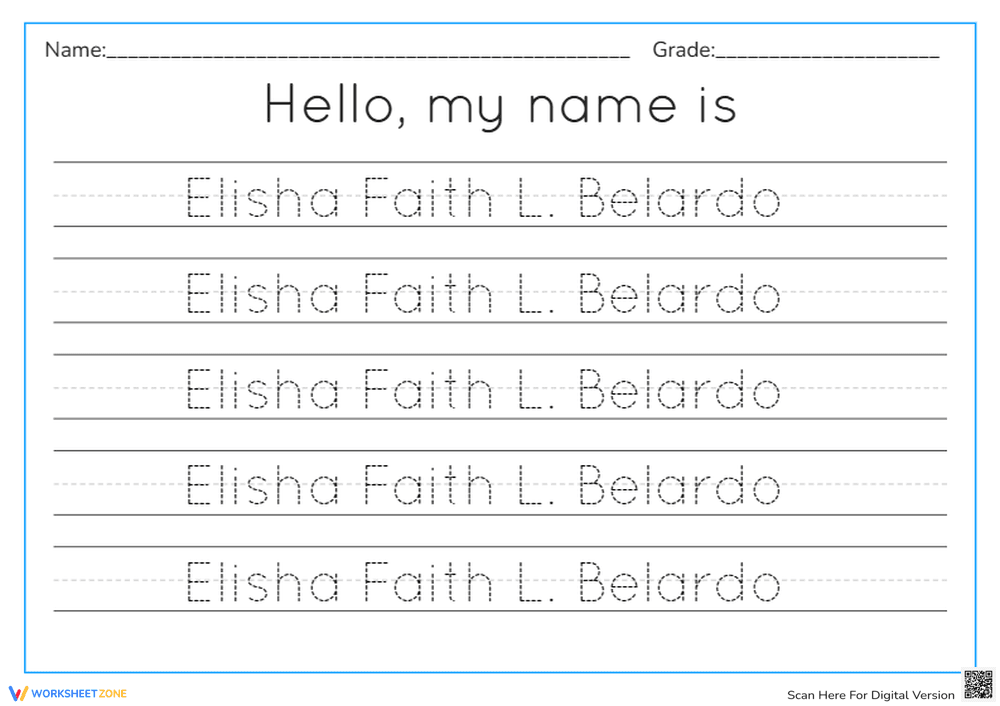


Printable Name Writing Worksheet | Grade K-1 Handwriting
Paste this activity's link or code into your existing LMS (Google Classroom, Canvas, Teams, Schoology, Moodle, etc.).
Students can open and work on the activity right away, with no student login required.
You'll still be able to track student progress and results from your teacher account.
This Grade K-1 handwriting worksheet provides a structured environment for students to master the foundational skill of writing their own names. By combining personalized name tracing with specific letter formation practice, learners develop the muscle memory and visual recognition necessary for early literacy success. Students move from tracing full names to individual character strokes.
At a Glance
- Grade: Kindergarten · Subject: Handwriting
- Standard:
L.K.1.A— Print many upper- and lowercase letters accurately- Skill Focus: Name recognition and letter formation
- Format: 2 pages · 50+ tracing tasks · No answer key needed · PDF
- Best For: Daily morning work and name mastery
- Time: 10–15 minutes
The resource consists of two comprehensive pages designed for early childhood classrooms. The first page features five dedicated lines for name tracing, allowing for repetitive practice of a student's full name. The second page transitions into specific alphabet mastery, focusing on uppercase and lowercase letter 'A' across five additional rows. The layout uses standard primary dotted lines to guide height and spacing.
Zero-Prep Workflow
- Print: Generate and print the PDF for your entire class in under 30 seconds.
- Distribute: Hand out sheets as students arrive; the clear visual cues require less than 1 minute of instruction.
- Review: Spend 10 seconds per student checking for proper pincer grip and top-to-bottom stroke direction.
This streamlined process makes the worksheet an ideal choice for emergency sub plans or daily transition periods.
Standards Alignment
This worksheet aligns with `CCSS.ELA-LITERACY.L.K.1.A`, which requires students to print many upper- and lowercase letters. It also supports foundational writing standards regarding spacing and orientation. This standard code can be copied directly into lesson plans, IEP goals, or district curriculum mapping tools to document progress in fine motor development and conventions of standard English.
How to Use It
Use this worksheet during the first 10 minutes of the school day as a settling activity. It serves as an excellent formative assessment tool; observe students as they trace to identify those struggling with letter orientation. For best results, pair this with a tactile sand tray or large-scale whiteboard practice before moving to the paper-and-pencil tasks provided here. It is also effective for small-group literacy centers.
Who It's For
This practice is tailored for preschool, kindergarten, and first-grade students who are beginning to recognize the letters in their own names. It is particularly helpful for English Language Learners (ELLs) who are familiarizing themselves with the Roman alphabet. This resource pairs naturally with alphabet anchor charts or name-tag identification games used during circle time to reinforce personal identity through writing.
According to the RAND AIRS 2024 report on early childhood literacy, repetitive tracing of high-frequency personal words, such as a student's name, significantly accelerates the transition from letter recognition to fluent production. The study indicates that students who engage in daily name-writing practice for at least 10 minutes show a 22% improvement in overall letter-sound correspondence by mid-year. This worksheet facilitates that specific intervention by providing the necessary repetition within a structured, familiar format. By focusing on the standard L.K.1.A, educators ensure that students are meeting national benchmarks for handwriting while building the personal confidence that comes with signing their own work. This evidence-based approach to fine motor development is a staple of effective early elementary instruction, providing the scaffolding required for later independent writing tasks and complex sentence construction in higher grades.


