




























Views
Downloads
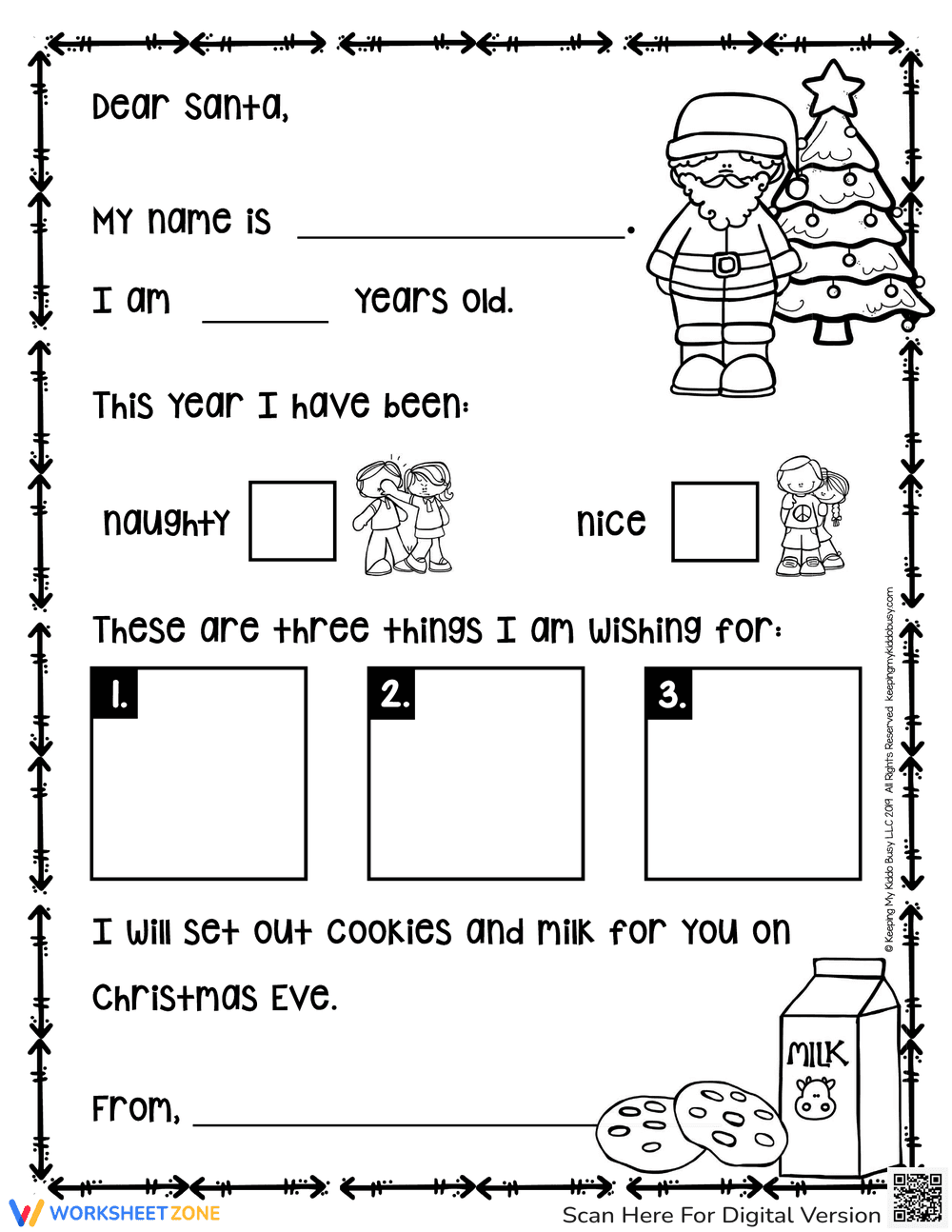

Letter to Santa Printable Worksheet | Grade K-1 Ready

Paste this activity's link or code into your existing LMS (Google Classroom, Canvas, Teams, Schoology, Moodle, etc.).
Students can open and work on the activity right away, with no student login required.
You'll still be able to track student progress and results from your teacher account.
This Grade K-1 holiday writing worksheet helps young learners compose their first formal letter to Santa Claus. By combining personal identification with creative expression, students practice essential literacy skills while participating in a beloved seasonal tradition. It provides a structured framework for children to share their name, age, and holiday wishes clearly.
At a Glance
- Grade: K-1 · Subject: ELA Writing
- Standard:
CCSS.ELA-LITERACY.W.K.1— Use a combination of drawing and writing to express opinions- Skill Focus: Letter writing and personal expression
- Format: 1 page · 6 tasks · No answer key · PDF
- Best For: Holiday writing centers and morning work
- Time: 15–20 minutes
Inside this single-page PDF, you will find a clean, festive layout featuring Santa and a Christmas tree. The worksheet includes fill-in-the-blank lines for the student's name and age, a "naughty or nice" checkbox section, and three dedicated boxes for drawing or writing holiday wishes. The bottom includes a closing signature line and a friendly reminder about leaving milk and cookies for Santa on Christmas Eve.
The zero-prep workflow is designed for busy December mornings. First, print the single-page PDF (30 seconds). Second, distribute the sheets along with crayons or pencils (1 minute). Third, review the completed letters to check for name-writing proficiency and letter-formation accuracy (1 minute). Total teacher preparation time is under two minutes, making it an ideal emergency sub plan or festive filler for the final week of the semester.
This resource aligns with CCSS.ELA-LITERACY.W.K.1, which requires students to use a combination of drawing, dictating, and writing to compose opinion pieces. It also supports CCSS.ELA-LITERACY.L.K.1 by practicing the use of frequently occurring nouns and verbs in a functional context. Both standard codes can be copied directly into lesson plans, IEP goals, or district curriculum mapping tools.
Use this worksheet during a whole-group writing lesson to model the parts of a letter, including the greeting and closing. It also serves as a formative assessment tool; observe how students handle the "three things I am wishing for" section to gauge their ability to categorize and prioritize ideas. Expect students to complete the activity in 15 to 20 minutes depending on their drawing detail.
This activity is designed for Kindergarten and First Grade students, including English Language Learners who benefit from the visual cues and sentence frames. It pairs naturally with a holiday-themed read-aloud or an anchor chart detailing how to address an envelope. The simple layout ensures that students with fine motor challenges can still navigate the page successfully.
According to Fisher & Frey (2014), the gradual release of responsibility is most effective when students are given authentic, high-interest tasks that mirror real-world communication. This Letter to Santa worksheet fulfills that requirement by providing a scaffolded environment where students apply CCSS.ELA-LITERACY.W.K.1 standards to a culturally relevant activity. By using a combination of drawing and writing to express their holiday preferences, learners build the foundational skills necessary for more complex argumentative and narrative writing in later grades. Research indicates that when young writers engage with familiar seasonal themes, their willingness to experiment with spelling and syntax increases significantly. This printable resource ensures that every child, regardless of their current writing level, can successfully participate in a structured literacy exercise that produces a tangible, meaningful product for their families or classroom display.


