


























Views
Downloads


Essential 2.MD.C.7 Worksheet | Grade 2 Time to 5 Minutes
Paste this activity's link or code into your existing LMS (Google Classroom, Canvas, Teams, Schoology, Moodle, etc.).
Students can open and work on the activity right away, with no student login required.
You'll still be able to track student progress and results from your teacher account.
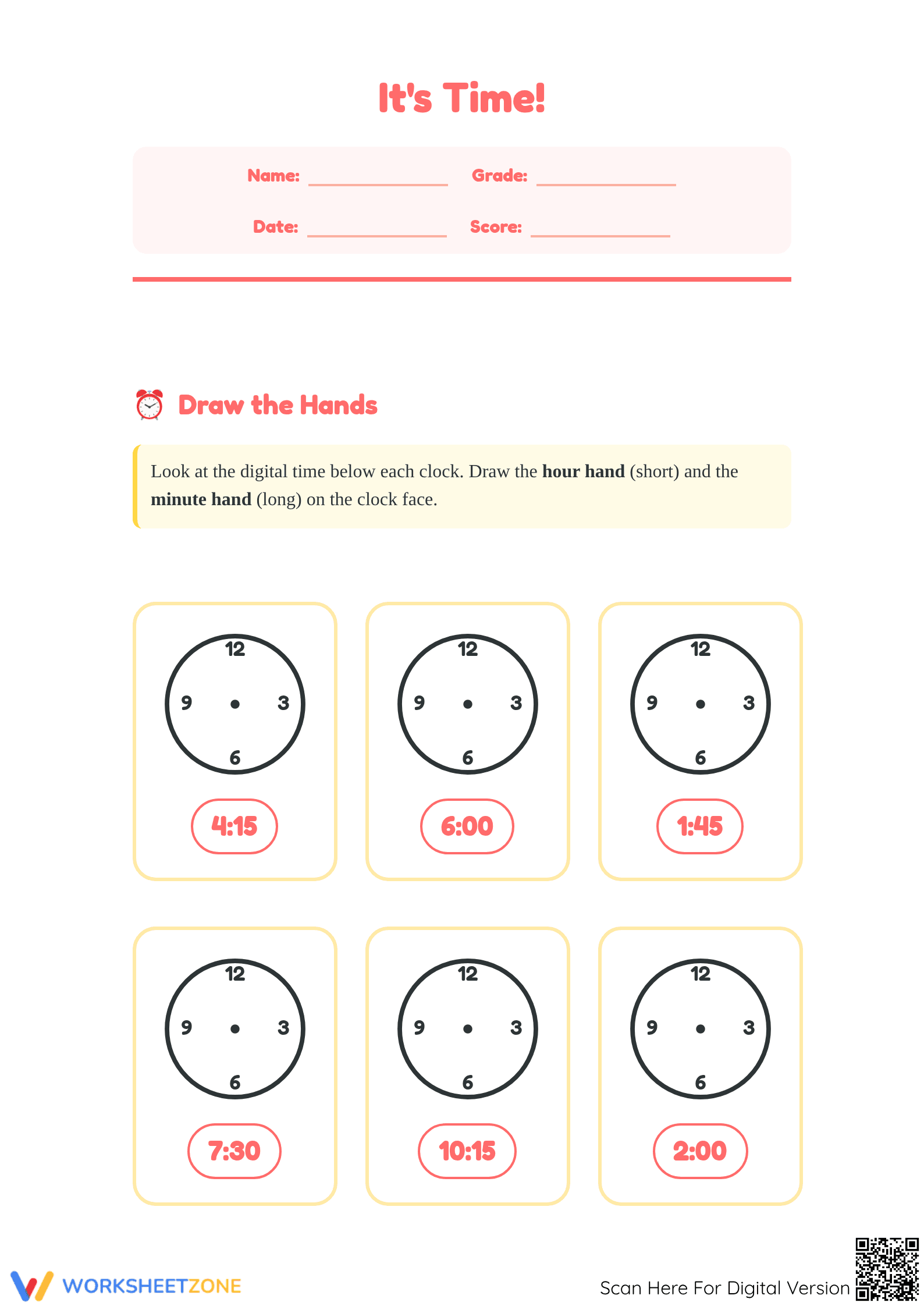
This Grade 2 Math worksheet focuses on translating digital time into analog hand positions. By targeting five-minute increments, the resource ensures students achieve fluency with the 2.MD.C.7 standard. The uncluttered layout allows for immediate engagement and measurable assessment of time-telling proficiency.
At a Glance
- Grade: 2 · Subject: Math
- Standard:
2.MD.C.7— Tell and write time to the nearest five minutes using clocks- Skill Focus: Analog Clock Construction & Time Drawing
- Format: 2 pages · 15 problems · Answer key included · PDF
- Best For: Daily morning work or quick formative assessment
- Time: 15–20 minutes
This two-page PDF includes fifteen unique clock faces paired with digital displays. The resource features a primary 'Draw the Hands' section and a focused 'Extra Practice' block. Clocks feature orientation numbers at the 12, 3, 6, and 9 positions to assist student hand placement. A complete answer key is included.
Implementing this resource requires zero preparation. First, print the two-page document (30 seconds). Second, distribute the worksheets during your math block (30 seconds); the clear instructions allow students to begin immediately without verbal explanation. Finally, review the tasks using the answer key (60 seconds), allowing for instant feedback. Total teacher effort is under two minutes.
Aligned with Common Core standard `2.MD.C.7`, this worksheet requires students to tell time to the nearest five minutes. It specifically addresses analog literacy and hand placement, a prerequisite for advanced time reading. This standard code can be copied directly into lesson plans or district curriculum mapping tools.
Use this worksheet as a morning work activity or exit ticket. Teachers should observe whether students correctly differentiate between the short hour hand and the long minute hand. Expected completion time ranges from 15 to 20 minutes. It provides a consistent review of critical math intervals.
This printable is designed for Grade 2 students, though it is effective for Grade 3 RTI groups. The 'Extra Practice' section provides a challenge for advancing learners. Pair this resource with a physical classroom clock to provide a multi-modal learning experience for visual and tactile students.
The mastery of measurement and data standards, specifically CCSS.MATH.CONTENT.2.MD.C.7, serves as a critical developmental bridge for second-grade students as they transition from basic counting to complex interval reasoning. This worksheet focuses on the cognitive translation of digital numerals into analog spatial representations, a skill that requires simultaneous processing of hour and minute hands. According to Fisher & Frey (2014), instructional materials that utilize gradual release—moving from familiar time blocks to the five-minute increments—effectively scaffold the abstract concept of time. This printable resource provides fifteen structured opportunities for students to practice drawing hands, reinforcing the 5-minute counting patterns essential for later math proficiency. By isolating the 'Draw the Hands' task, the worksheet eliminates the cognitive load of handwriting digital numbers, allowing students to focus purely on the geometric relationships within the clock face. This alignment ensures that every student develops a robust mental model for timekeeping that supports both academic standards and real-world functional literacy.


