




























Views
Downloads

Essential Noun or Verb? Worksheet | Grades 1-3 ELA

Paste this activity's link or code into your existing LMS (Google Classroom, Canvas, Teams, Schoology, Moodle, etc.).
Students can open and work on the activity right away, with no student login required.
You'll still be able to track student progress and results from your teacher account.
This Grade 1-3 English Language Arts worksheet helps students master the fundamental distinction between nouns and verbs through engaging visual associations. By identifying whether a word represents a naming object or a doing action, learners build the linguistic awareness necessary for early sentence construction and reading fluency. This resource provides immediate clarity for young writers developing their grammar skills.
At a Glance
- Grade: 1-3 · Subject: ELA
- Standard:
CCSS.ELA-LITERACY.L.1.1— Use frequently occurring nouns and verbs to demonstrate command of standard English grammar.- Skill Focus: Noun and Verb Categorization
- Format: 1 page · 9 problems · Answer key included · PDF
- Best For: Independent practice or quick morning work
- Time: 10–15 minutes
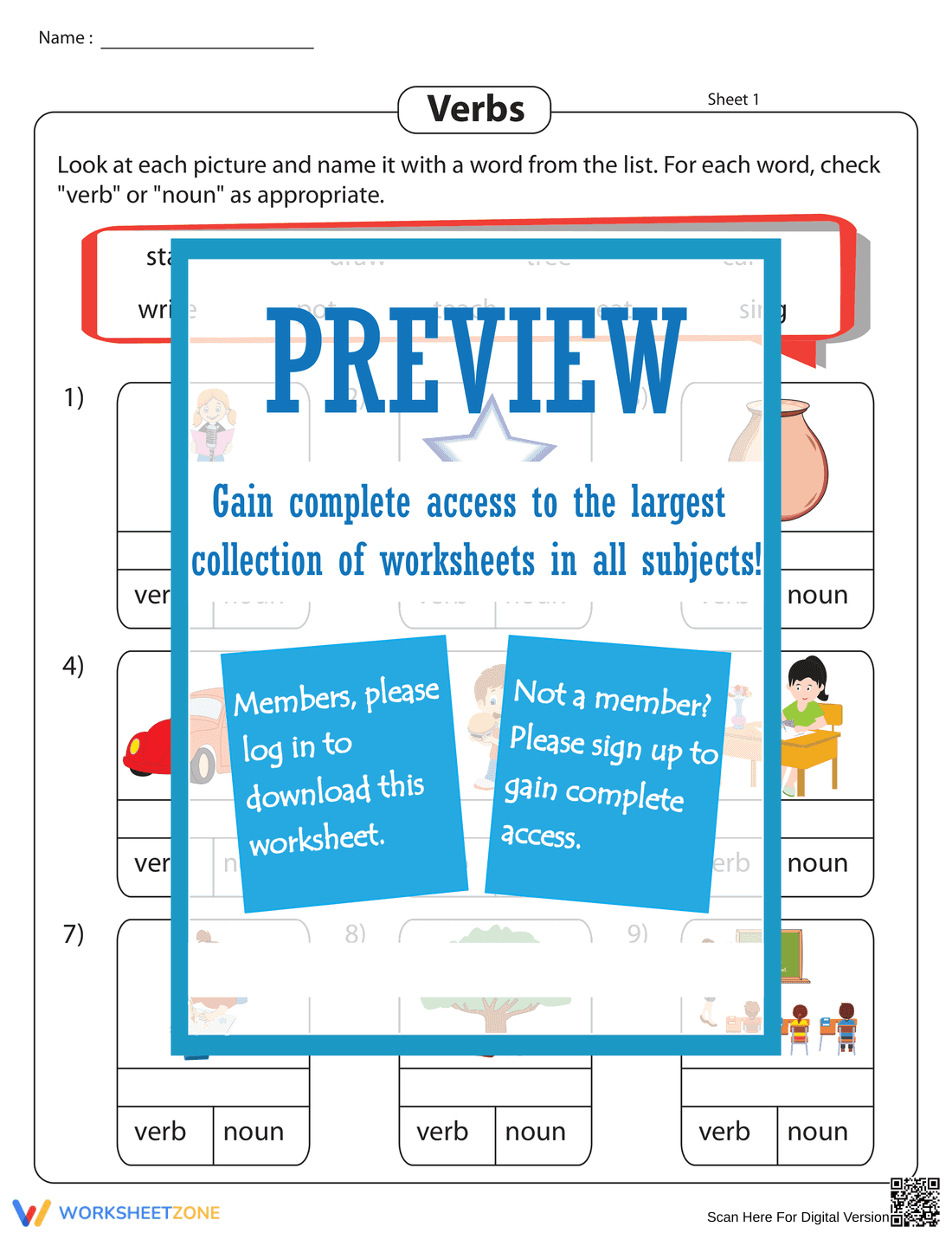
What's Inside: The PDF includes one high-density page featuring nine distinct illustrations representing common objects and actions. Students select the correct term from a word bank containing essential vocabulary like "sing," "car," and "draw." They label each corresponding image and then classify the word as either a verb or a noun using provided checkboxes, reinforcing the link between text, image, and category.
Zero-Prep Workflow: This resource is designed for immediate classroom integration. Simply print the single-page PDF in less than a minute, distribute it to students as a bell-ringer or exit ticket, and review the answers using the included key. The total teacher preparation time is under two minutes, making it an ideal choice for substitute plans or busy instructional blocks where efficiency is paramount.
Standards Alignment: Aligned to CCSS.ELA-LITERACY.L.1.1, which requires students to demonstrate command of the conventions of standard English grammar and usage. This task specifically addresses the identification of frequently occurring nouns and verbs in a concrete, visual context. The standard code can be copied directly into lesson plans, IEP goals, or district curriculum mapping tools for easy tracking.
How to Use It: Assign this worksheet during the guided practice phase of a grammar lesson to verify students can apply definitions of parts of speech. Alternatively, use it as a formative assessment after direct instruction on verbs; observe if students struggle with abstract actions like "teach" versus concrete nouns like "pot" to identify which learners may need targeted intervention or additional sentence framing support.
Who It's For: This activity is perfect for first through third-grade students, English Language Learners (ELL) who benefit from visual scaffolding, and students with IEPs requiring simplified categorization tasks. It pairs naturally with a parts-of-speech anchor chart or a short reading passage focusing on action words to extend the learning into broader writing contexts.
Research by Fisher & Frey (2014) emphasizes the importance of visual scaffolding and word categorization in early literacy development to bridge the gap between vocabulary acquisition and structural grammar. This worksheet focuses on `CCSS.ELA-LITERACY.L.1.1`, helping Grade 1-3 students categorize nine common nouns and verbs through image-to-text association. By requiring students to simultaneously label and classify, the resource strengthens semantic mapping and morphological awareness. This approach aligns with NAEP recommendations for increasing the frequency of short, focused grammar applications within the elementary ELA block. Teachers can use these targeted tasks to monitor progress toward foundational writing standards without the overhead of longer assessments. The self-contained format ensures that the standard code and the specific student action of distinguishing "naming words" from "doing words" are clearly documented for instructional planning and data-driven reviews.


