


























1 / 2
0
Views
0
Downloads

Save
0 Likes
Share
Introduction to Thermodynamics: Science Worksheet
0 Views
0 Downloads
Paste this activity's link or code into your existing LMS (Google Classroom, Canvas, Teams, Schoology, Moodle, etc.).
Students can open and work on the activity right away, with no student login required.
You'll still be able to track student progress and results from your teacher account.
Information
Description
What It Is:
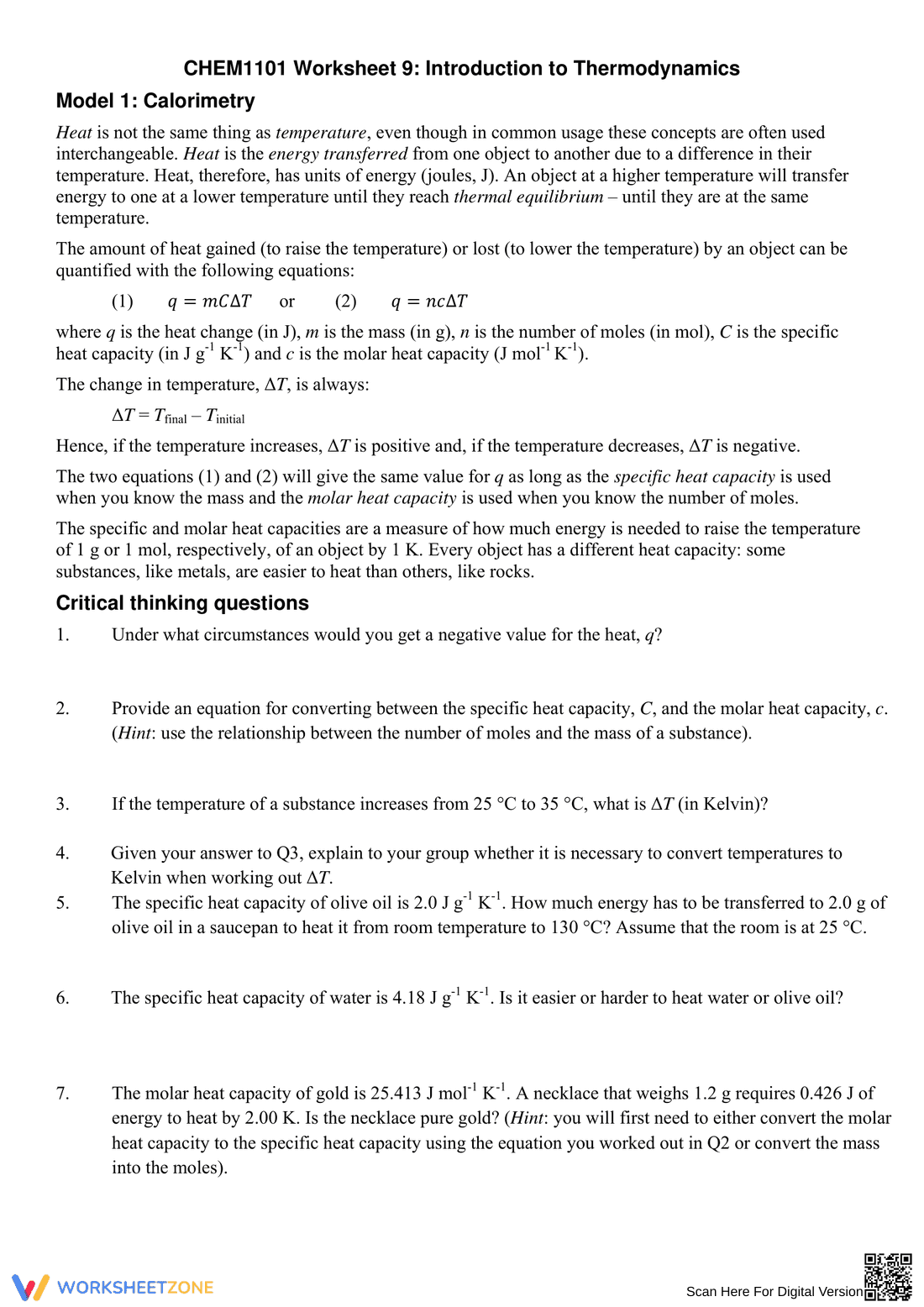
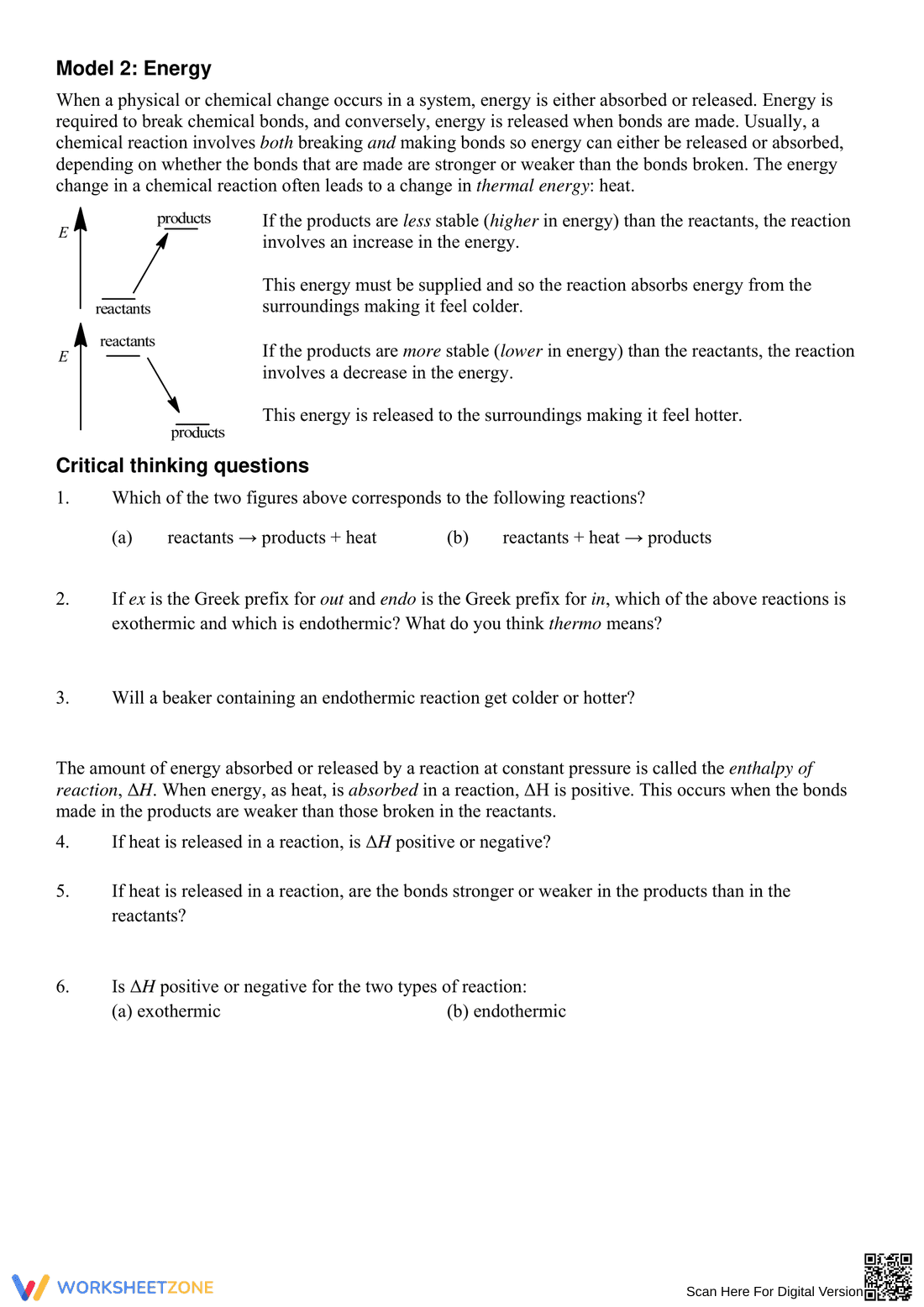
This is a chemistry worksheet titled 'CHEM1101 Worksheet 9: Introduction to Thermodynamics' focusing on calorimetry. It presents information about heat, temperature, specific heat capacity, and molar heat capacity, including the formulas q=mCΔT and q=ncΔT. The worksheet includes critical thinking questions requiring students to apply these concepts, perform calculations involving heat transfer, and compare the heat capacities of different substances like olive oil, water, and gold.
Grade Level Suitability:
This worksheet is suitable for high school (Grades 11-12) and introductory college-level chemistry courses. The content requires an understanding of basic chemistry principles, algebraic manipulation, and problem-solving skills related to thermodynamics.
Why Use It:
This worksheet helps students understand the difference between heat and temperature, apply the concepts of specific and molar heat capacity, and practice calculations related to heat transfer. It promotes critical thinking by asking students to analyze scenarios and make comparisons between different substances. It reinforces the application of thermodynamic principles to real-world examples.
How to Use It:
Students should first read the introductory text explaining the concepts of heat, temperature, and heat capacity. Then, they should use the provided formulas to solve the calculation problems. The critical thinking questions should be answered using the information provided and their understanding of the concepts. The worksheet could be used for in-class practice, homework, or as a review activity.
Target Users:
The target users are high school chemistry students, introductory college chemistry students, and teachers who need practice materials or assessments related to calorimetry and thermodynamics.
This is a chemistry worksheet titled 'CHEM1101 Worksheet 9: Introduction to Thermodynamics' focusing on calorimetry. It presents information about heat, temperature, specific heat capacity, and molar heat capacity, including the formulas q=mCΔT and q=ncΔT. The worksheet includes critical thinking questions requiring students to apply these concepts, perform calculations involving heat transfer, and compare the heat capacities of different substances like olive oil, water, and gold.
Grade Level Suitability:
This worksheet is suitable for high school (Grades 11-12) and introductory college-level chemistry courses. The content requires an understanding of basic chemistry principles, algebraic manipulation, and problem-solving skills related to thermodynamics.
Why Use It:
This worksheet helps students understand the difference between heat and temperature, apply the concepts of specific and molar heat capacity, and practice calculations related to heat transfer. It promotes critical thinking by asking students to analyze scenarios and make comparisons between different substances. It reinforces the application of thermodynamic principles to real-world examples.
How to Use It:
Students should first read the introductory text explaining the concepts of heat, temperature, and heat capacity. Then, they should use the provided formulas to solve the calculation problems. The critical thinking questions should be answered using the information provided and their understanding of the concepts. The worksheet could be used for in-class practice, homework, or as a review activity.
Target Users:
The target users are high school chemistry students, introductory college chemistry students, and teachers who need practice materials or assessments related to calorimetry and thermodynamics.


