


























Views
Downloads

Frog or Toad? Essential Compare and Contrast Worksheet
Paste this activity's link or code into your existing LMS (Google Classroom, Canvas, Teams, Schoology, Moodle, etc.).
Students can open and work on the activity right away, with no student login required.
You'll still be able to track student progress and results from your teacher account.
This Grade 5-8 informational text worksheet helps students distinguish between frogs and toads through active reading and evidence-based analysis. Students will identify key characteristics of amphibians and organize data to understand biological differences. By the end of the activity, learners will demonstrate mastery in comparing and contrasting complex ideas within a non-fiction passage.
At a Glance
- Grade: 5-8 · Subject: ELA Reading
- Standard:
CCSS.ELA-LITERACY.RI.5.3— Explain the relationships or interactions between two or more individuals or ideas- Skill Focus: Compare and contrast informational text
- Format: 3 pages · 8 problems · Answer key included · PDF
- Best For: Middle school science-integrated ELA lessons
- Time: 25–35 minutes
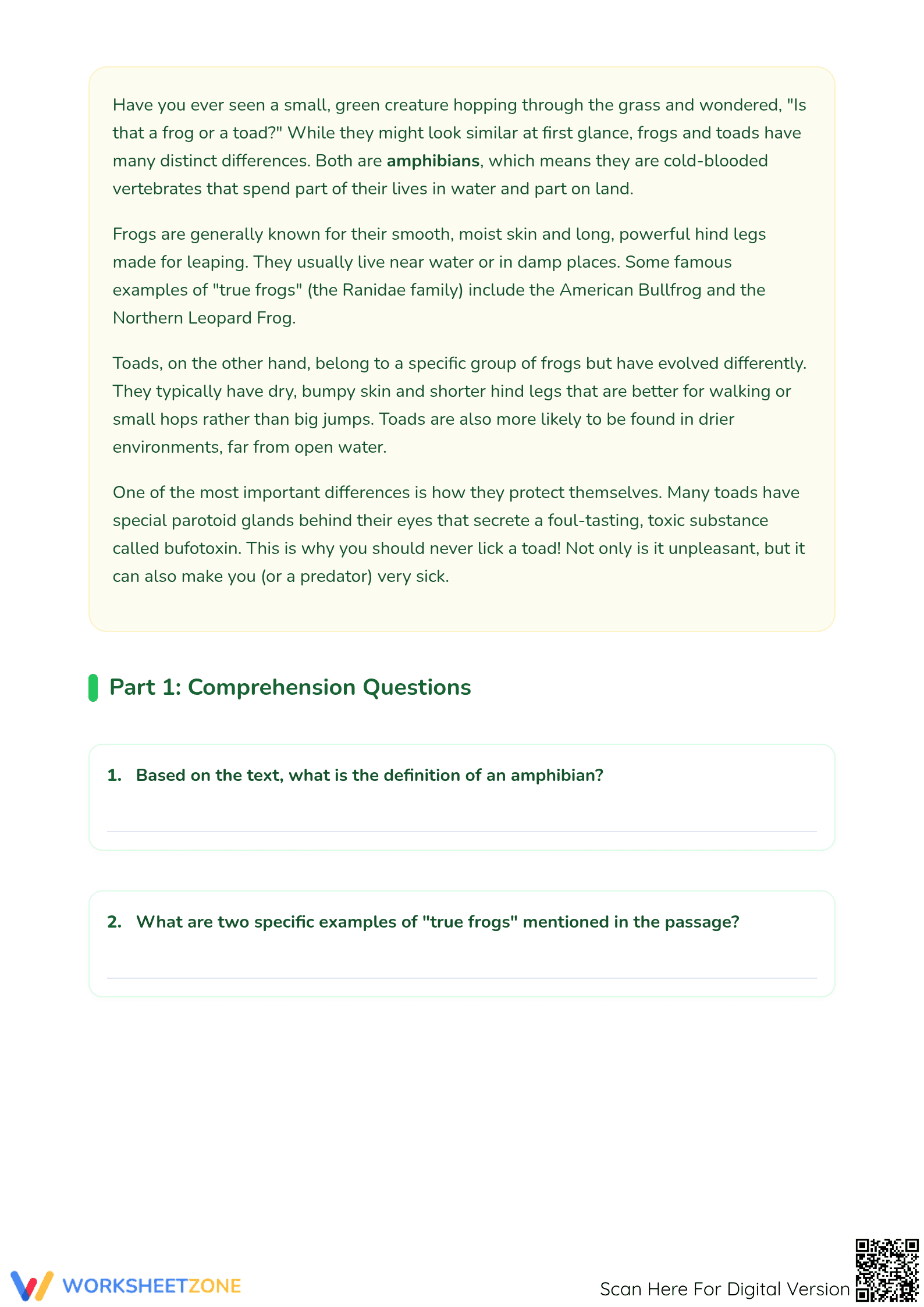
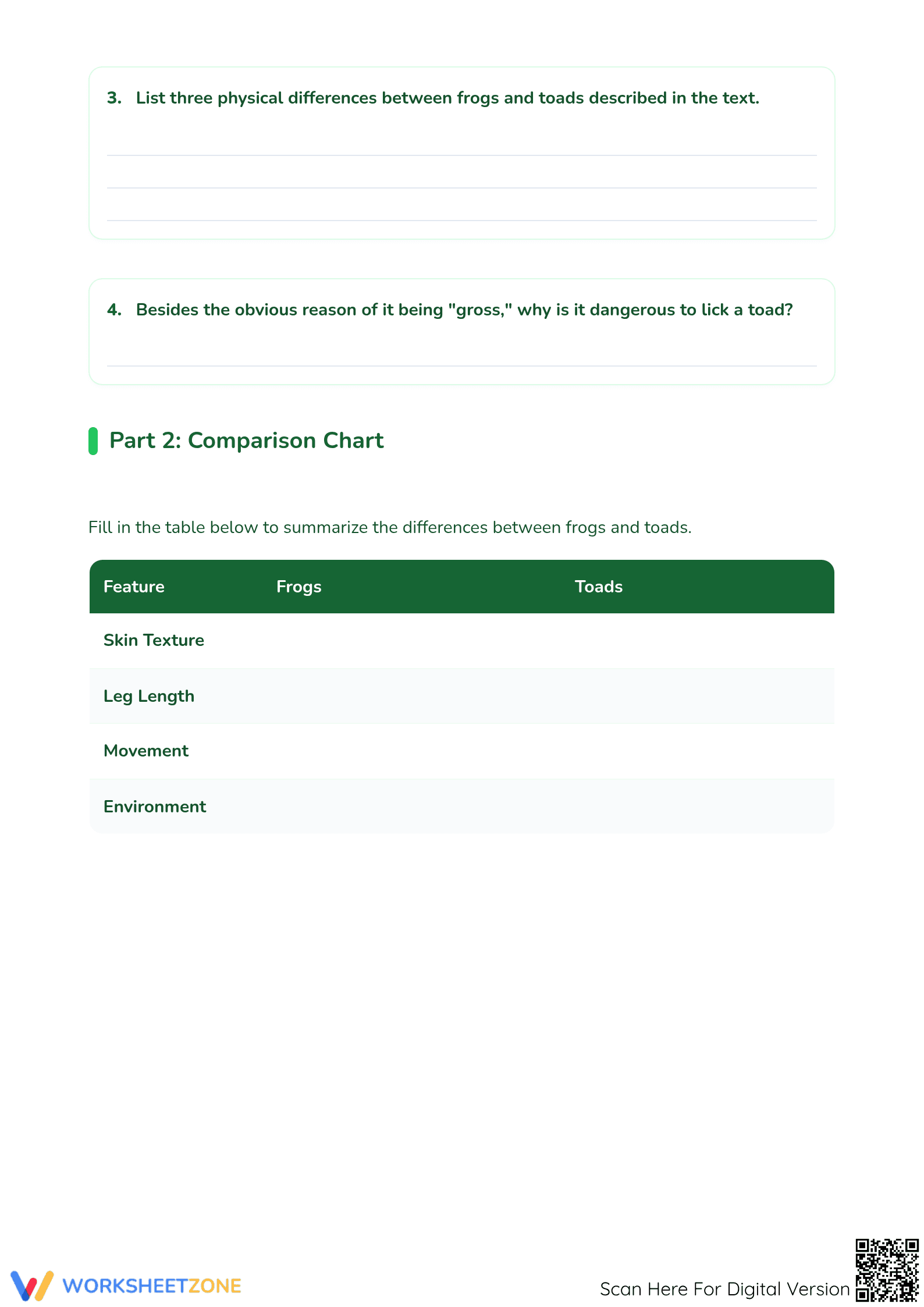
The resource contains a three-page structured layout. Page one features a dedicated note-taking area to support active reading strategies. Page two provides a high-interest informational passage titled "To Leap or Not to Leap," followed by text-dependent comprehension questions. Page three concludes with a detailed comparison chart and a full answer key for immediate feedback.
Skill Progression
- Guided practice: Students begin by defining key terms like "amphibian" directly from the text to establish a foundational understanding.
- Supported practice: Four open-ended comprehension questions require students to locate specific evidence regarding physical traits and defense mechanisms.
- Independent practice: The final comparison chart tasks students with synthesizing information into four distinct categories: skin, legs, movement, and habitat.
This gradual-release model ensures students move from basic recall to higher-order organizational thinking.
Standards Alignment
This worksheet is primarily aligned with CCSS.ELA-LITERACY.RI.5.3, which requires students to explain the relationships or interactions between two or more individuals, events, ideas, or concepts in a scientific or technical text based on specific information. It also supports RI.6.1 by demanding textual evidence for all claims. Both standard codes can be copied directly into lesson plans, IEP goals, or district curriculum mapping tools.
How to Use It
Use this as a mid-unit formative assessment during a non-fiction reading block. Before independent work, model how to use the "Notes" section on page one to highlight contrasting adjectives. Expect students to complete the reading and tasks in 25 to 35 minutes. Observe if students are pulling specific vocabulary like "parotoid glands" into their comparison charts to gauge depth of reading.
Who It's For
This resource is designed for middle-grade students in general education or ICT settings. It is particularly effective for learners who benefit from graphic organizers to process informational content. Pair this worksheet with a short video clip of amphibian movement or an anchor chart on "Signal Words for Contrast" to provide a multi-modal learning experience.
According to the RAND AIRS 2024 report, the use of structured comparison matrices in informational text instruction significantly improves long-term retention of scientific concepts among middle school learners. This worksheet leverages that research by requiring students to map the specific traits of frogs and toads against a standardized set of criteria. By engaging with CCSS.ELA-LITERACY.RI.5.3, students practice the essential skill of explaining interactions between biological categories. The inclusion of text-dependent questions ensures that students remain grounded in the evidence provided rather than relying on prior misconceptions. This evidence-based approach aligns with Fisher & Frey’s (2014) emphasis on the gradual release of responsibility, moving from guided reading to independent synthesis. Educators can confidently integrate this tool into ELA or cross-curricular science units to meet rigorous state standards for informational literacy.


