


























Views
Downloads

Independence Day Scavenger Hunt | Printable Grade 3
Paste this activity's link or code into your existing LMS (Google Classroom, Canvas, Teams, Schoology, Moodle, etc.).
Students can open and work on the activity right away, with no student login required.
You'll still be able to track student progress and results from your teacher account.
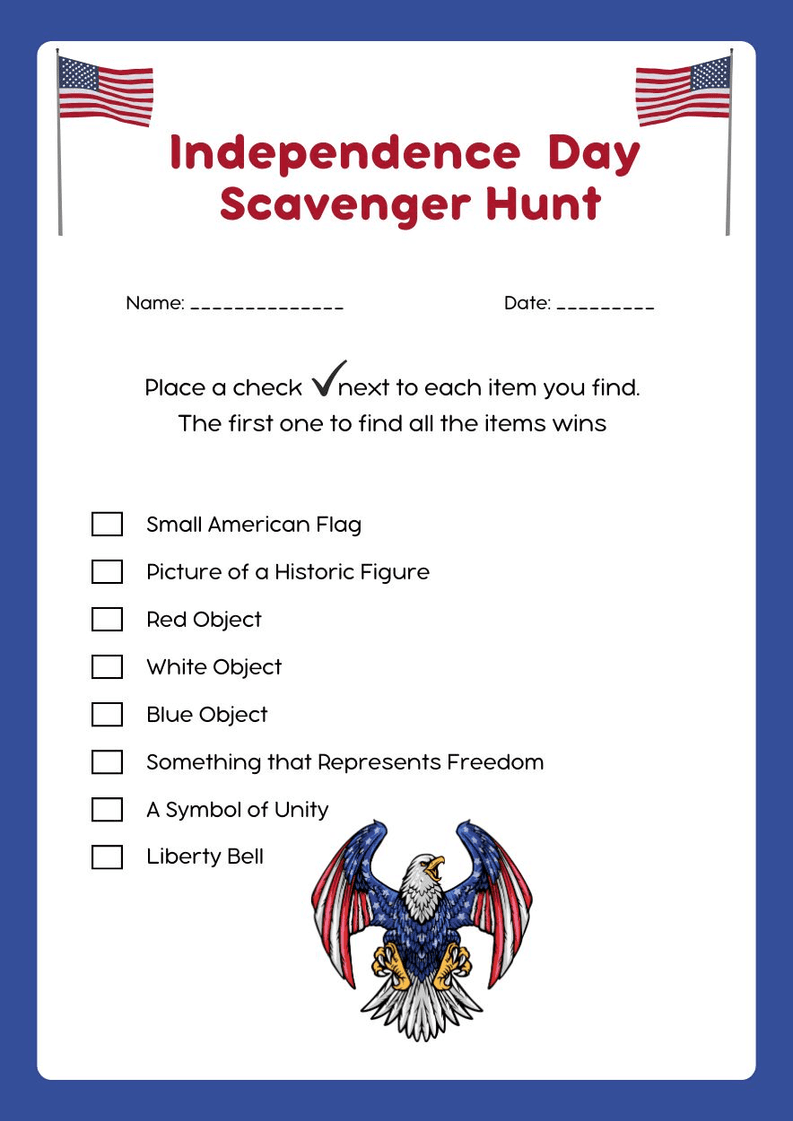
This printable Independence Day scavenger hunt gets students out of their seats to identify key American symbols and colors. By searching for items that represent abstract concepts like freedom and unity, learners actively connect civic vocabulary to their immediate environment in a highly engaging, interactive format.
At a Glance
- Grade: 3 · Subject: Social Studies
- Standard:
CCSS.ELA-LITERACY.L.3.5.B— Identify real-life connections between words and their use.- Skill Focus: Civic Symbols & Vocabulary
- Format: 1 page · 8 problems · No answer key needed · PDF
- Best For: Holiday activities and brain breaks
- Time: 15–20 minutes
This single-page resource features a straightforward checklist of eight thematic items. The list includes concrete objects like a small American flag, alongside abstract challenges such as finding a symbol of unity. A patriotic eagle illustration keeps the design festive. Because answers depend entirely on the student's environment, no answer key is required.
This activity is designed for immediate implementation with zero teacher preparation.
- Print (1 minute): Generate the PDF and print copies for your class.
- Distribute (1 minute): Hand out the worksheets and clipboards.
- Review (2 minutes): Read through the eight items together to clarify abstract terms.
Total prep time is under two minutes, making this an excellent emergency sub plan or spontaneous holiday activity.
This worksheet aligns with CCSS.ELA-LITERACY.L.3.5.B, requiring students to identify real-life connections between words and their use. By asking students to find physical objects representing "freedom," the activity bridges abstract civic vocabulary and tangible reality. Both standard codes can be copied directly into lesson plans, IEP goals, or district curriculum mapping tools.
Use this scavenger hunt as an active brain break during a social studies block about American history. Alternatively, assign it as a collaborative partner race within the classroom. As a formative assessment tip, observe which students struggle to identify objects representing "unity" to guide immediate discussion on civic concepts. Expect completion in 15 to 20 minutes.
Ideal for second through fifth-grade students who benefit from kinesthetic learning. The mix of literal items (colors) and conceptual items provides natural differentiation, allowing concrete thinkers to succeed while challenging advanced learners. It pairs perfectly with a read-aloud book about the Fourth of July.
Integrating movement into vocabulary and civic instruction significantly enhances student retention and engagement in the elementary classroom. This worksheet directly targets CCSS.ELA-LITERACY.L.3.5.B by asking students to identify real-life connections between words and their use. According to Fisher & Frey (2014), providing students with structured opportunities to interact with academic vocabulary in varied, physical contexts deepens their conceptual understanding and promotes long-term memory transfer. By transforming a traditional vocabulary matching exercise into an active, kinesthetic scavenger hunt, educators can lower affective filters and increase participation across diverse learner profiles. Finding tangible, real-world representations of abstract ideas like unity and freedom ensures that foundational civic concepts resonate personally with younger students, rather than remaining isolated terms in a textbook. This approach bridges the gap between language acquisition and active citizenship.


